Portuguese
  Spanish


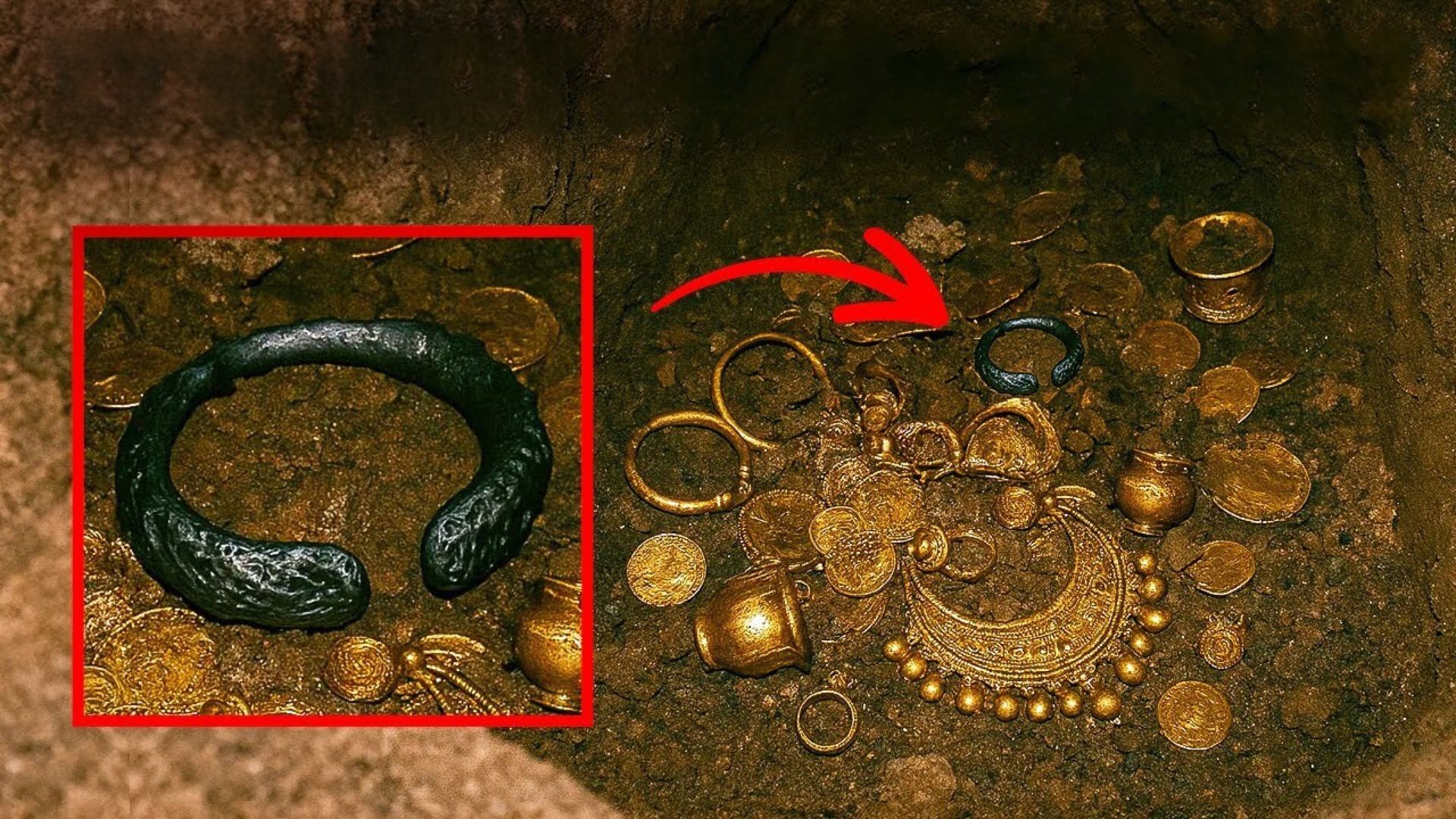

Study reveals that two objects from the Villena Treasure in Spain were made with meteoritic iron, centuries before iron metallurgy reached the Iberian Peninsula.
According to ScienceAlert, the Villena Treasure was discovered in 1963 near the city of Villena, in the province of Alicante, Spain, during a foundation work. The collection had 66 objects buried in a ceramic container, including 27 bracelets, 11 bowls, and dozens of pieces of jewelry and ornamentation, almost all in gold. With about 9.7 kilograms of pure gold, it is considered the second largest prehistoric gold treasure in Western Europe.
But among the golden pieces, there were two objects that did not fit with the rest of the collection: a C-shaped bracelet and a hollow hemisphere covered by a gold sheet. Both were made of iron. The problem is that iron metallurgy did not yet exist in the Iberian Peninsula when the treasure was buried, between 1400 and 1200 B.C.. The answer found now is what archaeologists have pursued for decades: the two objects were made of meteoritic iron, that is, metal coming from space.
Meteoritic iron from the Villena Treasure solves 60-year archaeological mystery
According to ScienceAlert, the two objects spent about 60 years on display at the Villena Municipal Archaeological Museum as anomalies without a definitive explanation. The solution came with the work of Salvador Rovira-Llorens, former head of conservation at the National Archaeological Museum of Spain, alongside Martina Renzi and Ignacio Montero-Ruiz, from the CSIC Institute of History, in Madrid.
-
Stingless Bee Honey from Brazil Can Cost Up to $120 a Liter, Surprises with Flavors of Wood, Citrus, and Even Cheese

-
Woman Claims to Have Spotted a Technical Pattern in Recent FIFA Tournaments, Predicts Possible World Cup Winner
-
Chevrolet Offers Chance to Win a 2026 Sonic RS for Free via WhatsApp
-
Earthquake vs. Tsunami: Which Causes More Destruction and Why One Can Be Even More Dangerous


The team analyzed microscopic samples of the two objects using mass spectrometry. The decisive point was measuring the nickel content, an element that appears in high concentrations in meteoritic iron, but not in common terrestrial iron used in later metallurgy. The result showed nickel levels incompatible with any known terrestrial iron for that archaeological context.
According to the researchers, the bracelet and the hemisphere are today the first two objects attributable to meteoritic iron in the Iberian Peninsula. This changes the interpretation of the treasure and increases the symbolic weight of the two pieces within a set already considered exceptional by European archaeology.
Nickel was the key to proving that the metal came from space
According to ScienceAlert, the difference between terrestrial iron and meteoritic iron cannot be perceived with the naked eye. Both have a similar appearance in color, shine, and texture when polished. What changes everything is the chemical composition.
Terrestrial iron, obtained from ores, usually has a very low or practically nonexistent nickel content. On the other hand, meteoritic iron comes from the cores of planetesimals, small celestial bodies formed at the beginning of the Solar System, and preserves a natural alloy of iron and nickel in much higher concentrations, generally above 5% by weight. Cobalt can also appear as a secondary marker.
The technique used by the researchers was decisive because the two objects are very corroded. More conventional methods, such as portable X-ray fluorescence, could not offer a reliable result. Only mass spectrometry analysis on minimal samples was able to reveal the chemical signature preserved within the metal.
Bracelet and hemisphere show that celestial metal had elite value in the Bronze Age
According to ScienceAlert, the two meteoritic iron objects from the Villena Treasure are very different physically and probably had distinct functions. The bracelet has a maximum diameter of 8.5 centimeters, is open, C-shaped, and still bears marks of hammering and manual shaping. It was an object for direct use on the body.
The hollow hemisphere, on the other hand, has a maximum diameter of 4.5 centimeters, a smooth and almost mirror-like internal surface, and an external gold-plated decorated cover.

Archaeologists propose that it may have been a pommel, a piece placed on top of a sword hilt or at the end of a scepter of authority. If this interpretation is correct, someone of very high status held a power object made from material fallen from the sky.
This helps explain why these two pieces may have had an even greater symbolic value than the gold of the treasure itself. In the Bronze Age, iron was not a common metal. When it came from meteorites, it was a very rare, mysterious material associated with extreme prestige.
In the Iberian Peninsula, iron did not yet exist as metallurgy when the treasure was buried
According to ScienceAlert, between 1400 and 1200 B.C., iron was not part of the everyday metallurgical practice in the Iberian Peninsula. Artisans mainly worked with bronze, an alloy of copper and tin that could be melted at much lower temperatures than those required to extract iron from ore.
Terrestrial iron would only arrive in the region around 850 B.C., more than three centuries later. This means that at the time the Villena Treasure was buried, the only available form of iron was precisely meteoritic iron, which already arrived in a metallic state and could be worked by hammering by experienced artisans.

This fact reinforces the exceptional nature of the pieces. It was not just a rare metal, but a material that completely escaped the local productive logic of the time. It was something that could not be manufactured, only found.
Villena Treasure joins Tutankhamun and other objects made with iron from the sky
According to ScienceAlert, the case of Villena is not isolated. The use of meteoritic iron appears in other high-prestige contexts in antiquity. The most famous example is the dagger of Tutankhamun, confirmed in 2016 to be made of iron from a meteorite.

The publication also cites Hittite texts that describe the material as iron from the sky, as well as a Bronze Age arrowhead found in Switzerland and an iron bead from a 5,000-year-old necklace in Gerzeh, Egypt, also recognized as meteoritic. The pattern that unites these findings is clear: different cultures identified that this metal was distinct and reserved it for objects linked to power, prestige, and authority.
With this, the Treasure of Villena becomes part of a much broader tradition of objects produced with celestial material. The discovery not only solves a Spanish mystery but also inserts the Iberian Peninsula into a global symbolic network of the Bronze Age.
Research still tries to discover from which meteorite the two objects came
According to ScienceAlert, the study resolved the main question about the nature of the metal but opened new questions. The most important is the exact origin of the meteorite that provided the material used in the bracelet and the hemisphere.
Researchers argue that the chemical composition of the objects needs to be compared to catalogs of meteorites found in the Iberian Peninsula and nearby regions. This could show whether the meteorite fell near Villena and was used locally or if the metal arrived through broader trade routes.
Another issue is the advanced corrosion of the pieces. Although the results strongly point to a meteoritic origin, more advanced non-invasive techniques, such as neutron computed tomography, may still offer more complete data without damaging objects that have survived for more than three thousand years.
The most enigmatic objects of the Treasure of Villena may also be the most important
According to ScienceAlert, the bracelet and the hemisphere remain on display at the Villena Municipal Archaeological Museum, but now they are no longer just inexplicable curiosities. They have come to be recognized as the first two meteoritic iron objects identified in the Iberian Peninsula.
This changes the place of these pieces within the treasure itself. Surrounded by almost 10 kilograms of gold, the two iron objects may seem secondary at first glance, but they were probably the most symbolically significant.
They were artifacts made with material that came from a celestial body fragmented even before the Earth existed in its current form.
In the end, what the Treasure of Villena reveals is not just wealth. It shows how societies of the Bronze Age recognized value in something far beyond the shine of gold: the possession of a rare, inexplicable metal literally fallen from the sky.