Portuguese
  Spanish


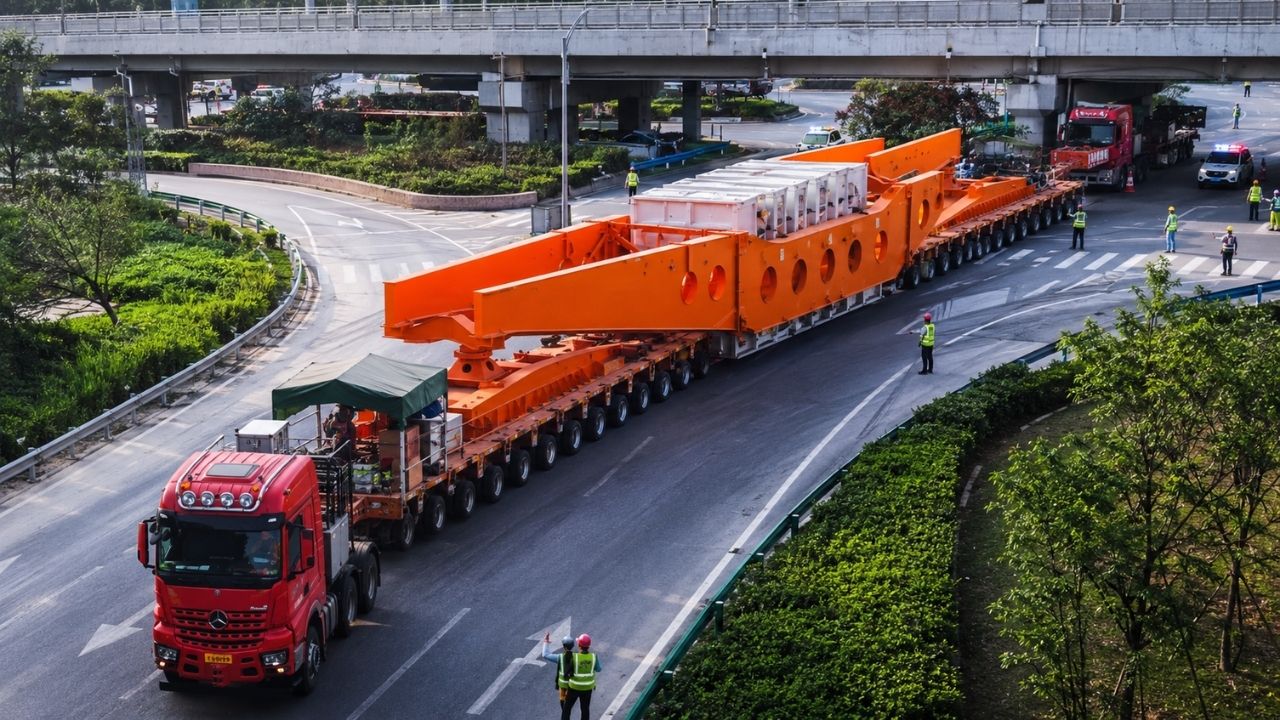

Published by the channel Process Addicted on May 27, 2026, the video shows a giant convoy linked to Dongfang Electric crossing Chinese villages. The original record on Douyin appears associated with the company and marked as content from about five years ago, placing the recorded operation around 2020/2021.
A giant convoy nearly 100 meters long, 600 tons, and about 300 tires crossed narrow roads in China to deliver a heavy generator part to its final destination. The operation was shown by the channel Process Addicted in a video published on May 27, 2026, and drew attention for its slow pace, technical control, and manual interventions along the way.
The Chinese record “东方电气物流(运输600吨定子实记)”, associated with Dongfang Electric on Douyin, appears marked as content from about five years ago. With this temporal reference, the safest editorial form is to place the operation recorded on video around 2020/2021, without pinpointing the exact day or month of the transport.
Operation appears linked to Dongfang Electric and Chinese heavy logistics
The operation appears associated with Dongfang Electric in the Chinese record shown on Douyin. The institutional source of the Sichuan Modern Logistics Association identifies the company as Dongfang Electric Group Heavy Logistics Co., Ltd., founded on May 25, 2007, with a focus on large cargo logistics.
-
Collector adapts forklift electric motor in a Kombi Corujinha pickup, hides 16 batteries under the bed, and makes the Brazilian classic run silently with up to 90 km of range.

-
Goodbye traditional vacuum: Samsung surprises and launches 2-in-1 robot with steam, AI that recognizes floors and stains, self-cleaning station, hot air drying, automatic emptying, water refill, and app control.
-
Brazil is transforming acerola waste discarded by the pulp industry into an ambitious and surprising project that could forever change the way the country utilizes one of the most invisible by-products of the fruit sector.
-
Scientists have created a colossal digital twin to predict tsunamis in real time, a simulation of 55.5 trillion unknowns run on 43,520 GPUs that reduced 50 years of calculation to 0.2 seconds and could change the defense of coastal cities.


The company is presented as headquartered in Chengdu, in Sichuan province, with a logistics base in Deyang. These details help contextualize the business structure linked to heavy transport and the operation shown in the video, without turning the administrative headquarters into the exact route of the giant convoy.
The piece left the port, but the biggest challenge began before the road
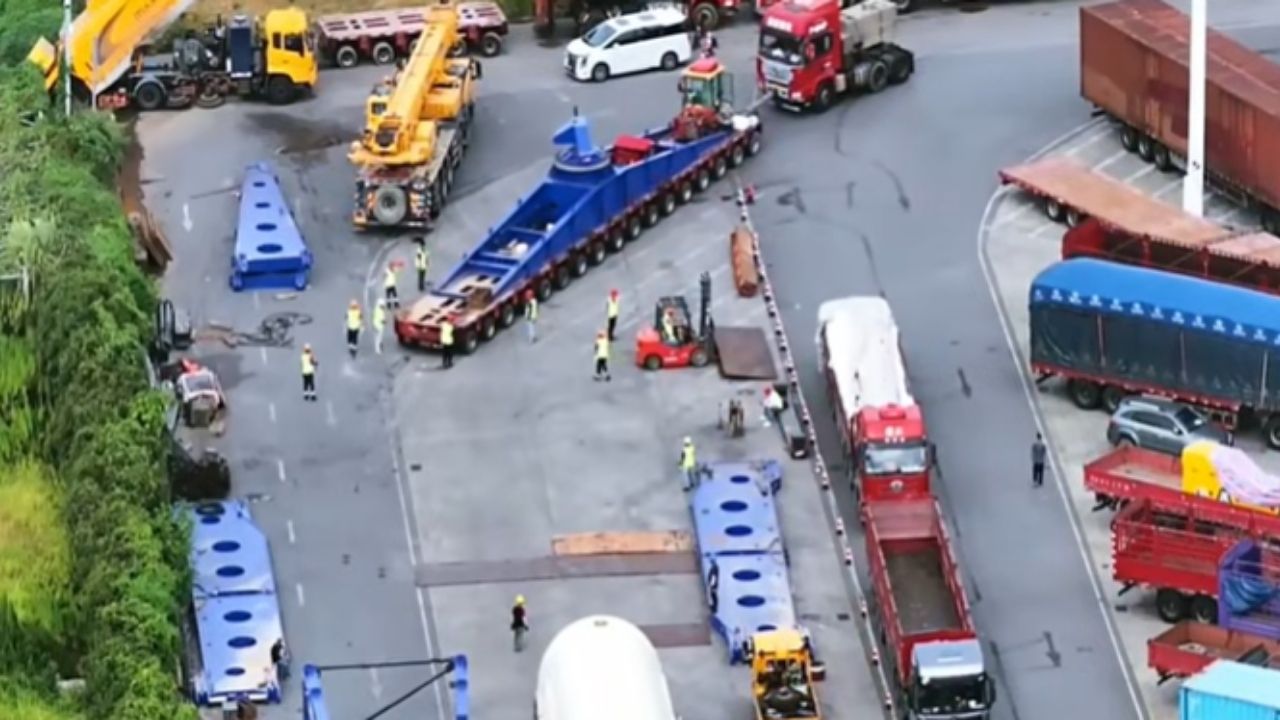
The operation began in a port area, where a piece of approximately 400 tons, described as the stator of a power generator, arrived by ship. The problem was that the port did not offer enough space to assemble the complete transport structure. Therefore, the load had to be placed first on a smaller vehicle and taken to a support area near the highway.
It was there that the giant convoy began to be assembled. Before advancing any meter, workers positioned steel plates on the ground, adjusted the piece, and began connecting the metal sections of the structure. The operation was not just about driving a heavy vehicle, but building, on-site, the very machine that would carry out the transport.
Structure was assembled piece by piece with crane and hydraulic jacks
The video describes the use of a 130-ton crane to lift sections of the structure, as well as electric hydraulic jacks to raise and lower the stator in small movements. With a load of this size, any misalignment could compromise the fitting of the beams, connection pins, and support points.
The assembly progressed in stages. The lower beams were positioned, connections were adjusted, and the load had to be slowly raised and lowered to allow the removal of shims and height adjustment. The first day ended without the convoy even starting to move, showing that preparation was as critical as the movement.
Two 630 hp mechanical horses commanded the movement
On the second day, the team returned to the site to complete the connection between the piece and the transport structure. The final assembly was about 90 meters long and weighed approximately 600 tons. The operation used two mechanical horses, one at the front and one at the rear, each with 630 horsepower.
The role of the two vehicles was not just to pull. On ascents, the front horse took on the main force. On descents, the rear vehicle helped with containment. In the most difficult maneuvers, the two could work in opposite directions to rotate the assembly. A giant convoy of this size does not turn like a regular truck; it needs to be maneuvered like an articulated and calculated structure.
Highway was closed and bridge had to be reinforced to support the load
To enter the main highway, traffic authorities temporarily blocked intersections in both directions. The front cabin had to move into the opposite lane to gain turning space, while operators coordinated the movement via radio. The most striking image is of a slow, deliberate advance that is difficult to interrupt.
A critical point of the route was a bridge that could not support the weight of the transport. The structure had to be specifically reinforced for the passage of the 600 tons and for future heavy transports on the same road. A single generator part ended up necessitating a permanent improvement in public infrastructure.
Villages turned the operation into a centimeter-by-centimeter test
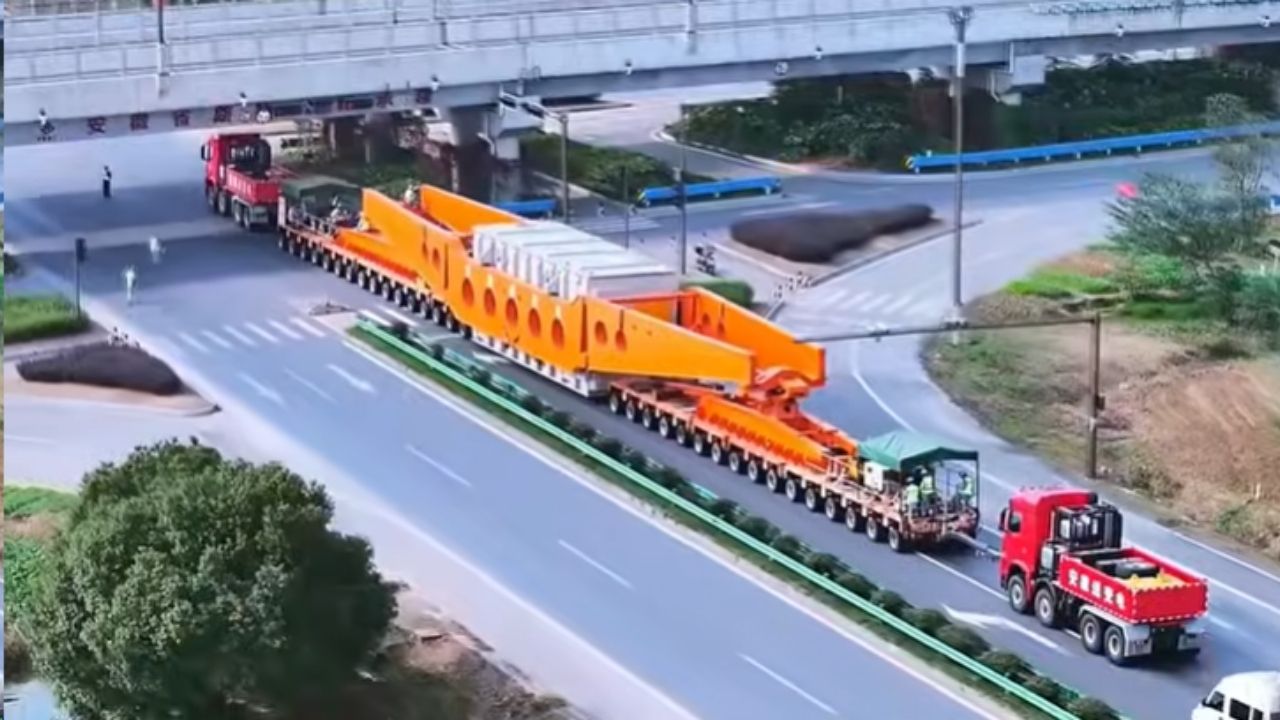
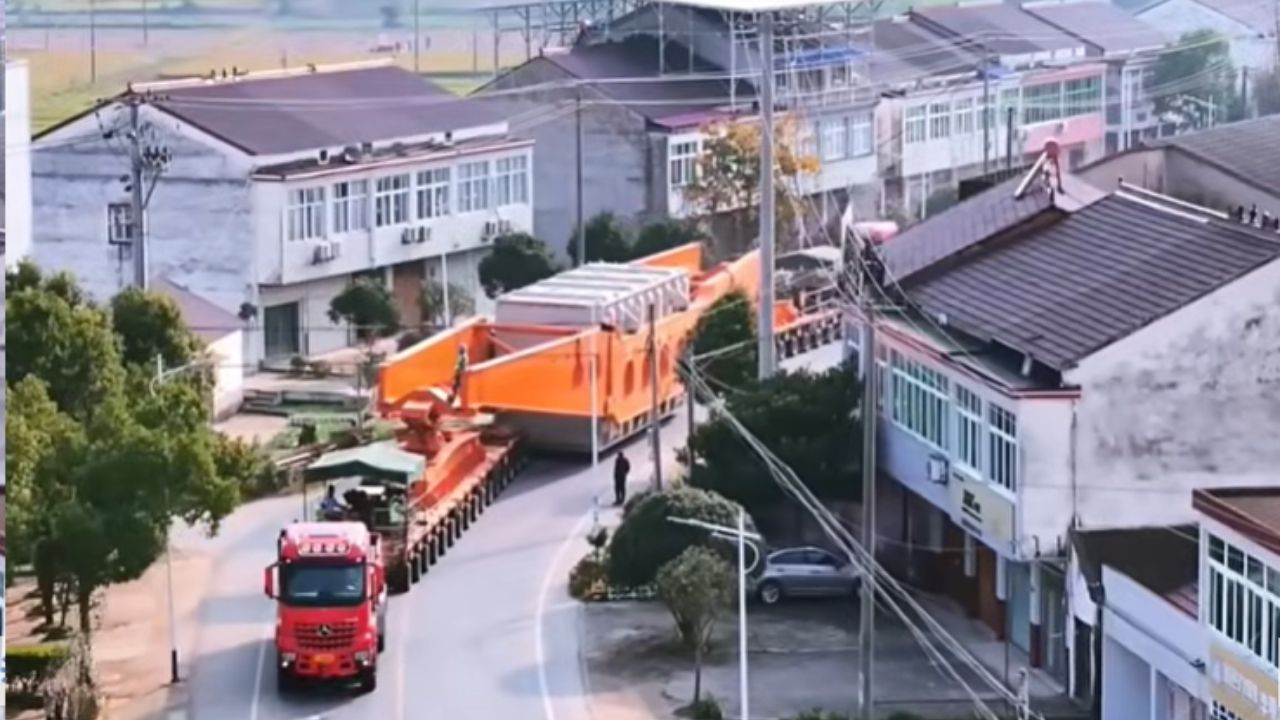
After the highway, the challenge became even greater. The final stretch passed through villages, narrow streets, houses close to the pavement edge, and low power and telephone cables. The width of the convoy was almost the same as the road, forcing the team to monitor each side of the vehicle in real time.
The giant convoy advanced at only 5 km/h. Workers walked ahead, manually lifting cables so the structure could pass underneath. Others followed the sides, checking minimal clearances and alerting operators to any risks. Every meter traveled depended on collective attention, quick communication, and patience.
The most difficult turn seemed impossible for a vehicle nearly 100 meters long
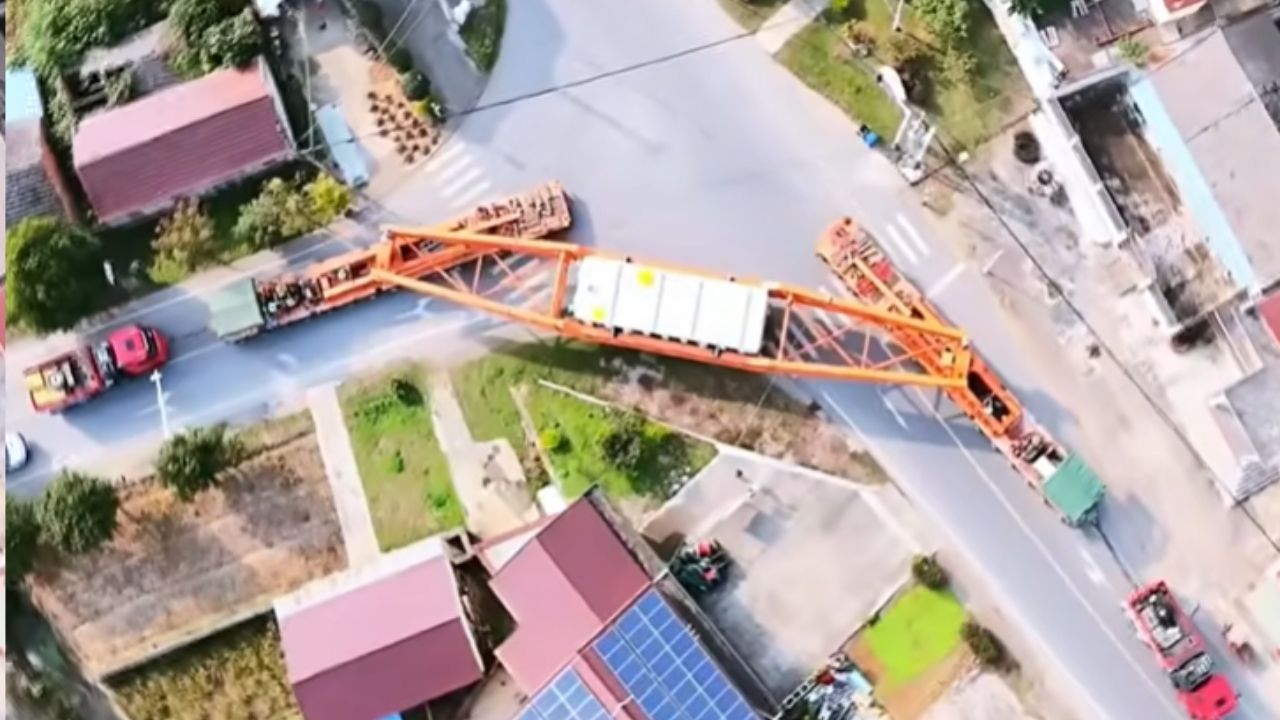
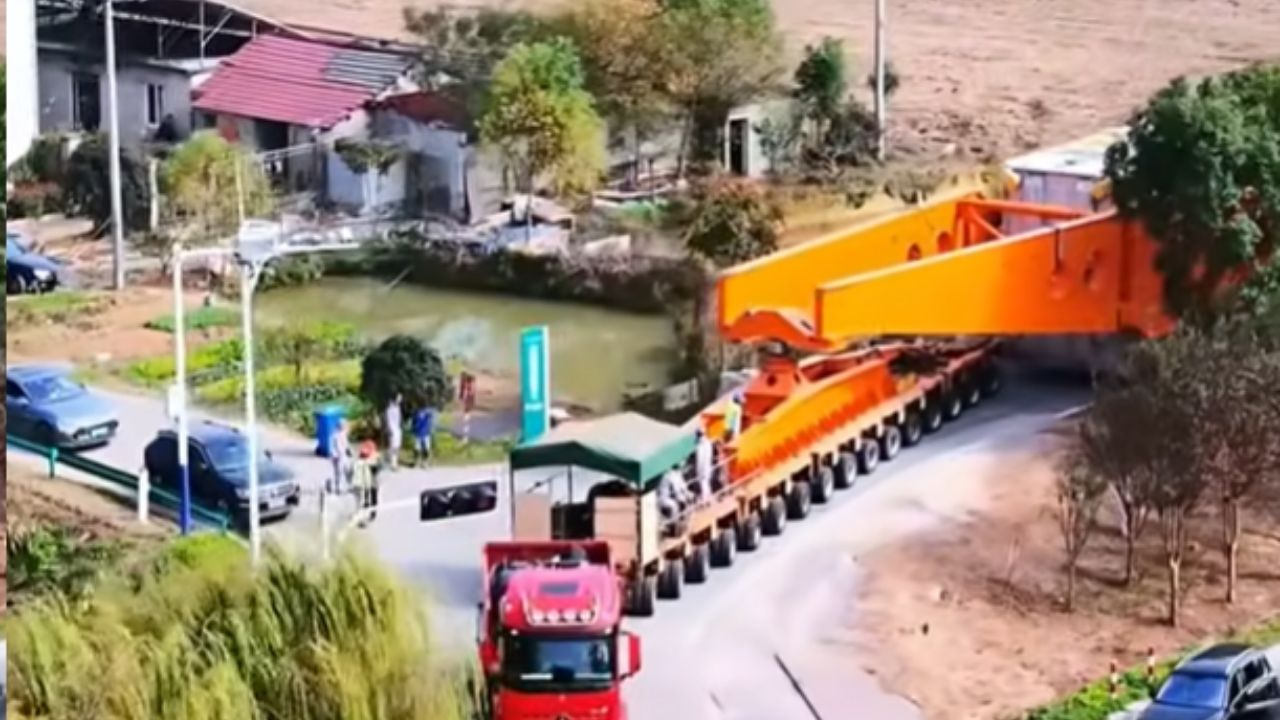
In one of the most impressive segments, the set had to perform a maneuver similar to a spin on its own axis. For this, the front and rear cabins worked in opposite directions: one advanced while the other retreated. The result was a controlled rotation of the equipment, without relying on a conventional turning radius.
This type of maneuver is only possible because the hydraulic axles of the set can be steered independently. The video mentions 17 axles on the hydraulic flatbed, controlled by an operator with a wireless control. Without this system, a vehicle of this length would not be able to handle tight turns in villages and would simply continue in a straight line.
Residents watched the passage of a machine that few will see up close
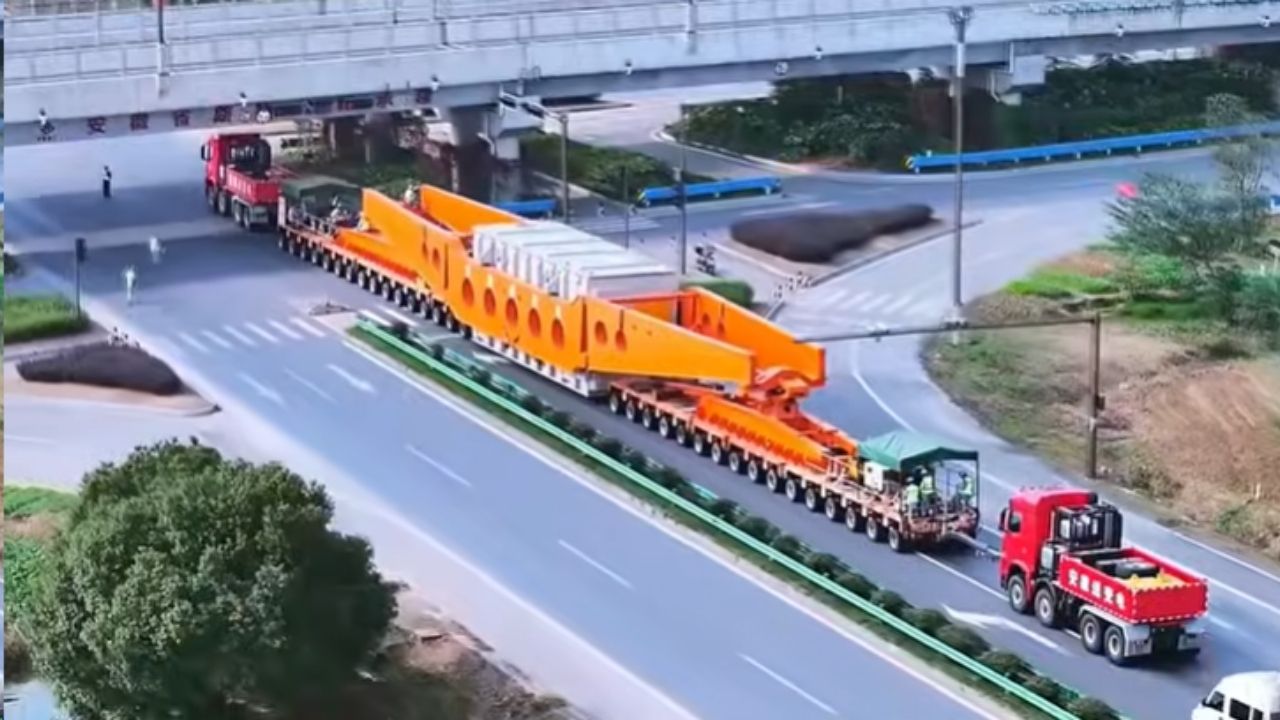
During the crossing, residents watched the transport’s progress from their doorsteps. At a certain point, a tricycle got in the way, and the convoy stopped. The described scene had no horns or rush: the team waited for the road to clear and resumed the movement at a controlled pace.
The presence of the giant convoy temporarily transformed local streets into an industrial transport corridor. For those living nearby, the passage was a rare event. For China’s energy infrastructure, it was just another step in a logistics chain that usually remains invisible to most people.
The cargo is part of an ultra-high voltage power grid
The video published by Process Addicted states that the transported piece would be part of an 800-kilovolt ultra-high voltage system. This type of grid is used to transport electricity over long distances, connecting energy-producing and consuming regions.
This context helps explain the size of the operation. Power generation and transmission equipment may require special transport because they do not fit on conventional trailers and cannot be divided into smaller parts without compromising their technical function. Heavy logistics exist precisely to move what modern infrastructure needs but almost never appears to the end consumer.
What this crossing reveals about giant works that go unnoticed
The case shows how large energy projects depend on silent, long, and extremely precise steps. Before an electrical grid operates, there are ships, cranes, closed roads, reinforced bridges, operators, local workers, and dozens of people monitoring movements that seem too slow for outsiders but too fast to allow for error.
It also highlights the contrast between industrial scale and village routine. On one side, a piece weighing hundreds of tons connected to an ultra-high voltage network. On the other, narrow streets, cables lifted by hand, and residents watching from their doorsteps. It is in this meeting between heavy technology and everyday life that the operation gains visual and journalistic strength.
The road became the stage for an engineering feat that almost no one follows
The crossing of the giant convoy in China was not just the transport of a heavy piece. It was an engineering operation in motion, carried out with cranes, hydraulic axles, two mechanical horses, traffic blocks, bridge reinforcement, and maneuvers calculated centimeter by centimeter.
The episode, recorded on video around 2020/2021 and republished by the channel Process Addicted on May 27, 2026, raises an interesting question: do you find the 600-ton piece more impressive, the maneuvering in narrow curves, or the fact that a bridge needed to be reinforced just to allow the convoy’s passage? Leave your opinion in the comments.