






 Portuguese
  Spanish
  4 min of reading
  0 comments


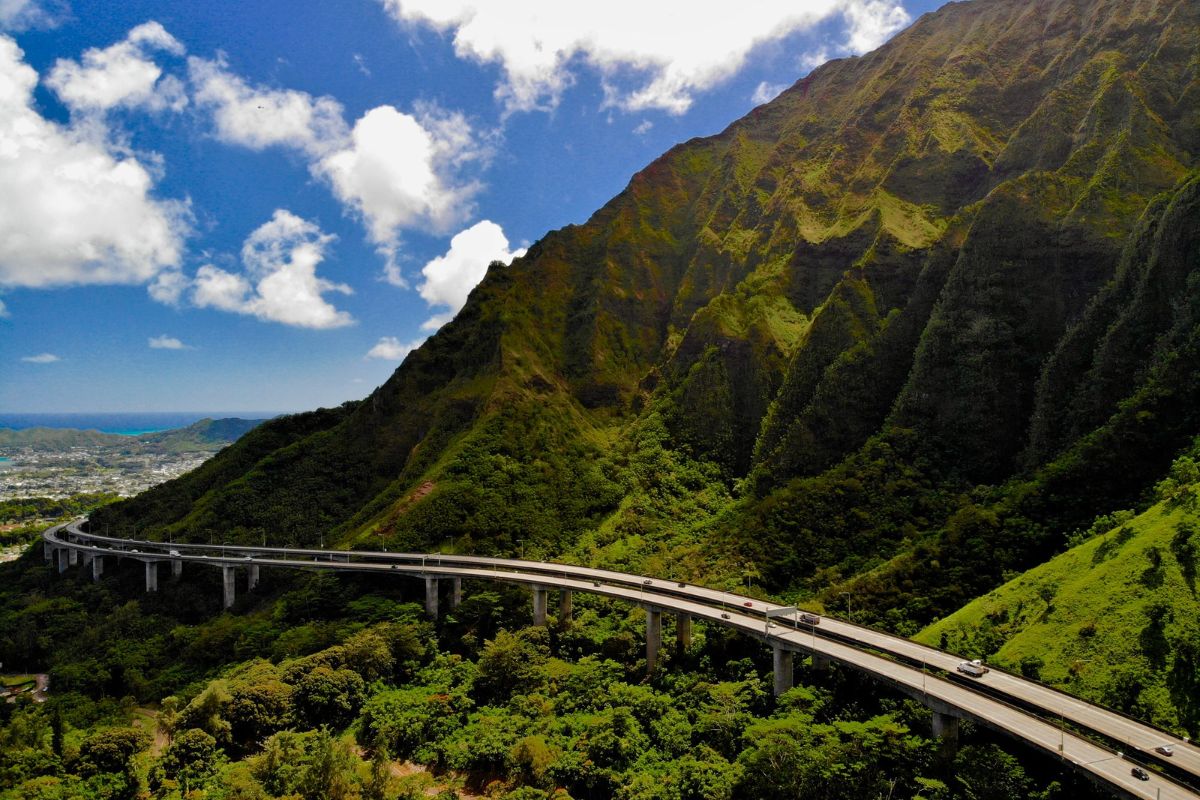
Built for US$ 1.3 Billion Over 37 Years, the Road Cut Through Sacred Lands and Became a Symbol of Conflict in Paradise, Celebrated as an Engineering Wonder and Condemned as a “Scar” on the Island of Oʻahu.
On the Island of Oʻahu, in Hawaii, there is a road that is a paradox. The Interstate H-3 in Hawaii, officially known as John A. Burns Freeway, is both one of the most beautiful and one of the most controversial in the world. It cuts through tunnels in mountains and rises over lush valleys, but its history is paved with protests, legal battles, and a deep disrespect for sacred lands.
Conceived for military purposes during the Cold War, its construction took 37 years and cost the impressive sum of US$ 1.3 billion. In 2025, it remains a point of contention: an engineering marvel for some, and a “cursed road” for others.
The Origin of the Highway in 1960
The story of the Interstate H-3 in Hawaii began shortly after the territory became the 50th U.S. state in 1959. The following year, in 1960, the U.S. Congress authorized its construction as part of the National Defense Highway System. The aim was purely military: to create a high-speed route to connect the naval base at Pearl Harbor in the south of the island to the Marine Corps Base in Kaneohe Bay.
-
Brazil’s Rio State Deploys 480 Hidden Cameras in Reserves to Track Jaguars, Tayras, and Peccaries After 27 Years Without Updating Threatened Species List

-
Brazilian City Revitalizes Nearly Extinct Ecosystem by Planting 11 Million Native Trees and Paying Residents to Restore Forests Over 40 Years

-
Victorian-era Glass Dumped into the North Sea Returns as Rare Multicolored Gems on Seaham Beach, Attracting Global Collectors.

-
Brazilian Researchers Develop Technology to Extract Drinking Water from Air Humidity Using Recycled Synthetic Fiber


As it was deemed vital to national security, the project received 90% of its funding from the federal government. This justification of “defense” would be used for decades to overcome all opposition that would come.
How Popular Opposition Saved the Sacred Valley of Moanalua in the 70s

The original H-3 route passed through the Valley of Moanalua, an area of profound spiritual and historical significance for Native Hawaiians. The threat of destruction mobilized a strong coalition of environmentalists, residents, and activists, who formed the “Stop H-3 Association” in 1971.
After years of legal battles, the opposition achieved a decisive victory. In 1976, a federal court protected the valley, considering its cultural importance. The decision forced the state to abandon the original route, but this victory had a tragic consequence: the project was diverted to the neighboring valley, the Valley of Hālawa, a site that would prove to be even more sacred.
The Profanation and Protests in the Valley of Hālawa
With the route change, the conflict intensified. In the new alignment, archaeologists discovered a complex of temples (heiau) of immense religious importance. Controversy erupted in 1992, when an archaeologist from the Bishop Museum, Barry Nakamura, reported that the institution was downplaying the findings to avoid delaying construction, and he was subsequently dismissed.
The dismissal was the spark for protests. Native activists occupied the sacred sites to physically protect them. The confrontation peaked in August 1992, when protesters blocking construction trucks were arrested. The event was a painful milestone, solidifying the image of the H-3 as a project imposed against the local community.
Engineering of US$ 1.3 Billion: The Project That Took 37 Years to Complete

The saga of the construction of the H-3 is as dramatic as its social history. The original budget of US$ 250 million ballooned, reaching a final cost of US$ 1.3 billion, making it one of the most expensive highways in the world per kilometer.
The project was only completed thanks to a powerful political intervention. In 1986, with the project stalled by court decisions, U.S. Senator Daniel K. Inouye used his influence to pass a law exempting the H-3 from the environmental laws that were blocking it. This maneuver nullified the opposition’s victories in court and allowed large-scale construction to resume, which would only finish on December 12, 1997.
Cursed or Engineering Wonder? The Legacy of the Highway in 2025
Today, the Interstate H-3 in Hawaii is a place of contradictions. On one hand, it is celebrated as an engineering wonder. Its views from the overpasses over the valleys and the tunnel exits to Kaneohe Bay are spectacular, attracting tourists and photographers.
On the other hand, it bears the nickname “Road to Nowhere” and “cursed road”. For many, its military purpose from the Cold War is obsolete, and its layout does not serve local residents well in their daily lives. For the native community, it remains a scar on the landscape and the soul of the island, a permanent reminder of a lost battle and sacred lands that were profaned in the name of progress.


-

-

-

-

-

-

30 people reacted to this.