






 Portuguese
  Spanish


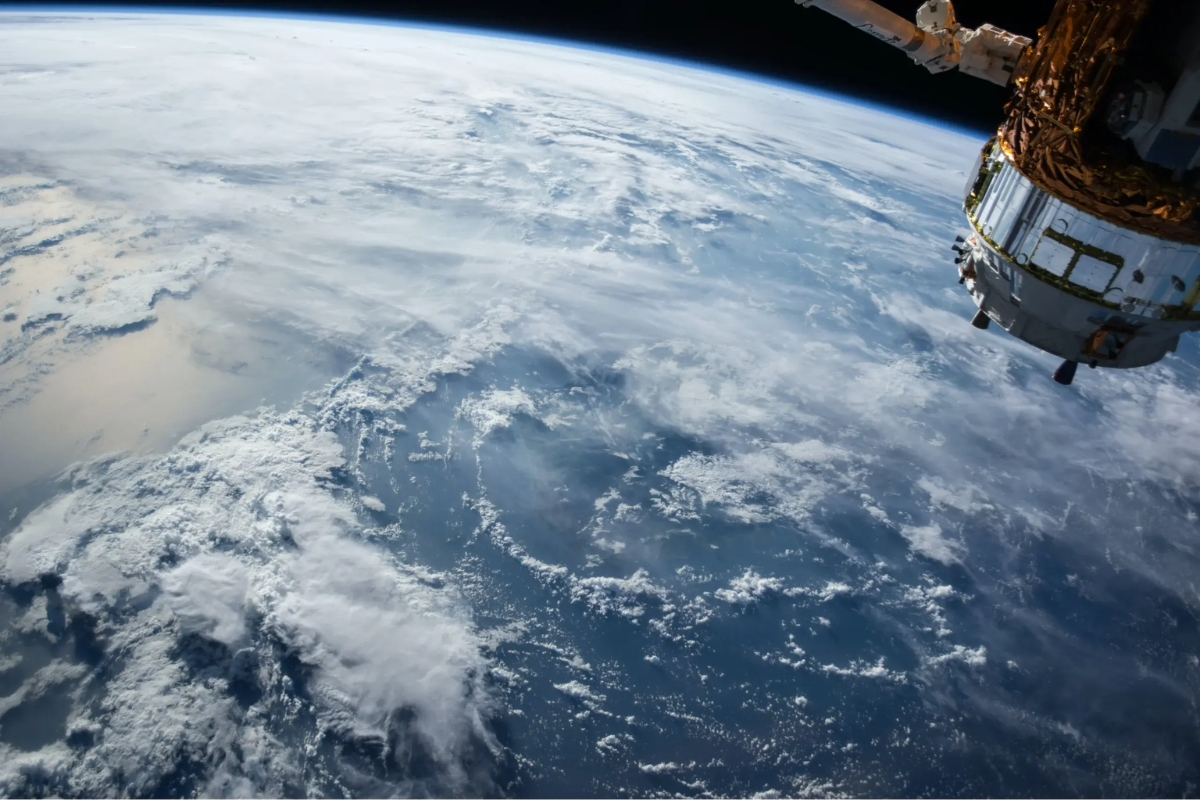

NASA and Infleqtion Aim to Launch an Autonomous Quantum Gravity Sensor into Orbit by 2030 That “Sees” Mass Variations Beneath the Earth, Promises Unprecedented Maps of Water and Ice, and Could Change Environmental Monitoring Forever
Imagine if you could “see” what happens beneath the ground or at the bottom of the oceans without needing to dig or dive. It sounds like science fiction, but this is exactly what NASA and the company Infleqtion intend to do. They announced a historic partnership to launch, around 2030, the first autonomous quantum gravity sensor into orbit.
But what does this mean in practice? To understand this mission, called the Quantum Gravity Gradiometer Pathfinder (QGGPf), we first need to understand what this technology is and why it is so revolutionary for our planet.
What Is a NASA Quantum Gravity Sensor?
To explain simply, think of gravity not as an invisible force that merely “pulls” us to the ground, but as a map. Everything that has mass, mountains, underground water reservoirs, ice layers, and even minerals exerts a gravitational force.
-
China Develops Custom 140-Ton Electric Mining Truck with 770 kWh Swappable Battery, Deploys 290 Units in Xinjiang’s Largest Zinc Mine

-
Meta to Launch Arena, a New Prediction App Targeting 3.56 Billion Users, Competing with Polymarket and Kalshi

-
Scientist Challenges Famous Human Evolution Theory, Argues Homo Sapiens Evolved Gradually Over Thousands of Years
-
15-Year-Old American Builds Ocean Generator with PVC Pipe and 3D-Printed Propeller for $12, Wins National Prize, Presents at White House, and Makes Forbes 30 Under 30 List




A common sensor can measure this force, but it has limitations. The quantum gravity sensor, on the other hand, uses the strange and fascinating rules of the subatomic world to achieve incredible precision. It utilizes “neutral atoms” (in this case, rubidium atoms) that are cooled to temperatures close to absolute zero, the coldest place that the universe allows.
In this extreme freezing state, the atoms stop behaving like “balls” and start acting like waves. When these atomic waves encounter variations in the Earth’s gravity, they undergo small changes. The sensor reads these changes and creates a detailed map of what is happening below.

Why Measure Space Gravity?
You may wonder: “Why go so far to measure gravity?” The answer lies in the microgravity of space. On Earth, ambient noise and the planet’s own force make ultra-sensitive measurements difficult. In space, scientists can keep the atoms in “interaction” for longer, making the sensor much more sensitive.
With this technology, NASA will be able to monitor:
- Invisible Water: Track underground rivers and reservoirs that are drying up.
- Polar Melting: Accurately measure how many grams of ice Greenland or Antarctica are losing.
- Disaster Prevention: Identify changes in land mass that may indicate impending earthquakes or volcanic eruptions.
A Technological Leap for Humanity
The mission involves an investment of over 20 million dollars and combines the knowledge of NASA’s Jet Propulsion Laboratory (JPL) with cutting-edge engineering from Infleqtion. This project is not just about pure science; it has direct applications for our safety.
By mastering the measurement of quantum gravity, we can create navigation systems that do not rely on GPS (useful for submarines or areas where the signal is blocked) and better understand the health of our planet in times of climate change.
The Future Is Quantum
We are living at the beginning of a new era. Just as the telescope changed our view of the stars, the quantum gravity sensor will change our view of the Earth itself. It will give us “quantum eyes” to monitor natural resources and protect the future of the coming generations.
The planned launch in 2030 will mark the moment when the universe’s most complex physics will begin to work, practically and quietly, to save our blue planet.






