






 Portuguese
  Spanish


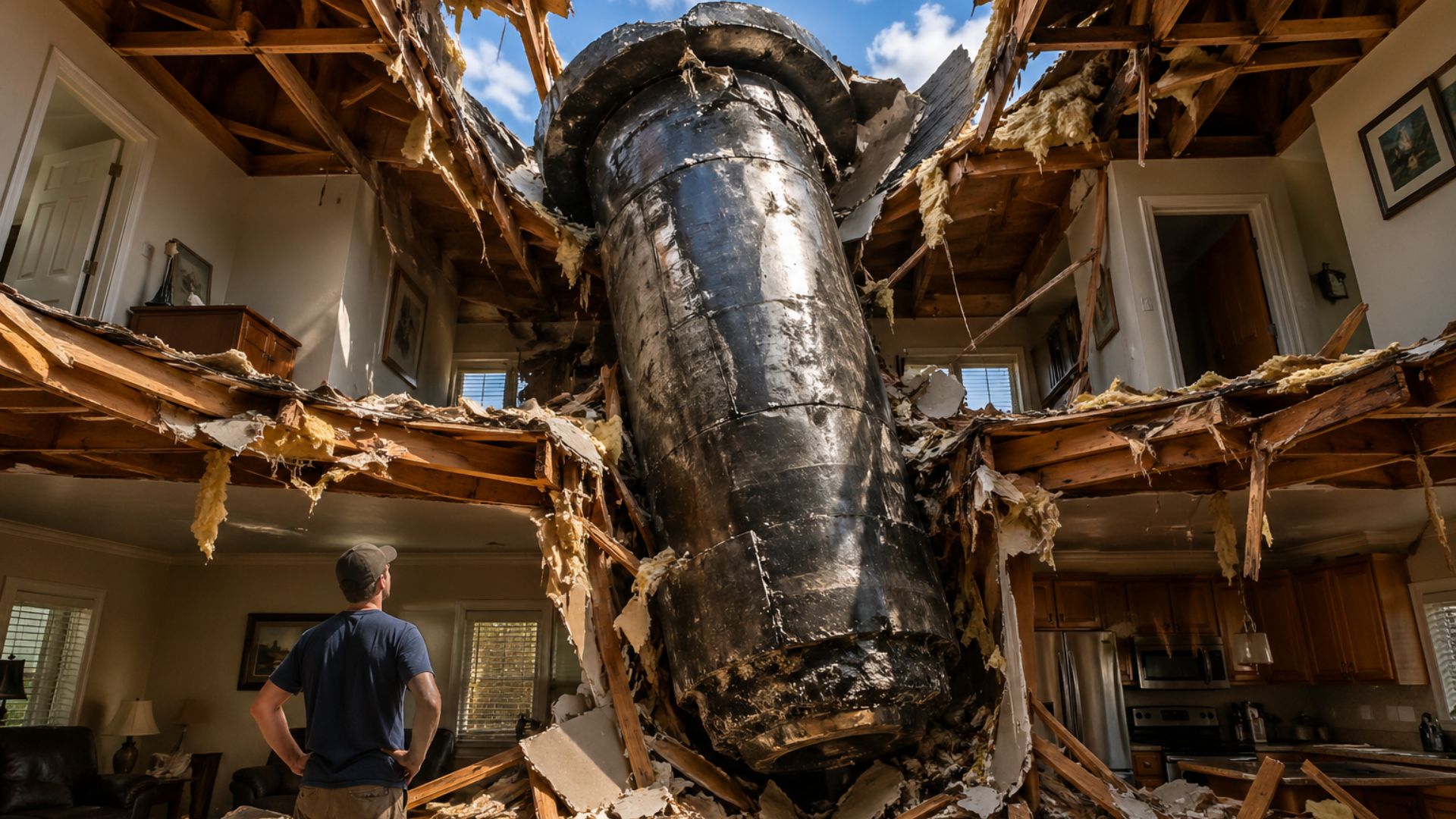

Space fragment pierces US home, prompts NASA to revise re-entry calculations after confirmation of origin from International Space Station equipment.
A metallic fragment that pierced the roof and two floors of a house in Naples, Florida, has been confirmed by NASA as part of discarded equipment from the International Space Station.
After surviving re-entry into the atmosphere on March 8, 2024, the piece hit the residence after failing to completely disintegrate, contrary to technical expectations normally applied to this type of material released in orbit.
Object’s origin and NASA’s confirmation
According to the American agency, the identified object corresponds to a stanchion, a structural component used to secure old batteries on a cargo pallet connected to the space station during previous logistical operations.
-
Rescue Teams Use Flashlights to Find 47 Dogs in Abandoned, Powerless U.S. Home, Offering Them a Fresh Start Through Responsible Adoption

-
Siblings Discover 1939 Superman Comic in Late Mother’s Attic, Sets Record at $9.12 Million Auction

-
12-Year-Old Discovers 80-Million-Year-Old Marine Tylosaurus Fossil During Kansas Field Trip
-
At 24, Beatriz Becomes First Woman from Mato Grosso to Work on Live Power Lines with Energisa, Starting as a Meter Reader in 2022



Confirmation occurred after analyses conducted at the Kennedy Space Center in Florida, where technicians evaluated the dimensions, shape, and composition of the recovered fragment, cross-referencing this information with records of equipment previously released into orbit.
As detailed by NASA, the item was made of Inconel metal alloy, weighed approximately 730 grams, was approximately 10 centimeters tall, and had a 4-centimeter diameter, characteristics compatible with the analyzed hardware.

Discarded ISS equipment and re-entry
As part of a larger assembly, the object was among equipment discarded from the station in March 2021, when nickel-hydrogen batteries were replaced with more modern lithium-ion models during orbital upgrade operations.
In this context, the released pallet had an approximate total mass of 2,630 kilograms, and was designed to disintegrate during atmospheric re-entry, a standard procedure for disposing of end-of-life space materials.
Even so, part of the structure withstood extreme heating during its passage through the atmosphere, allowing a fragment to reach the ground and transform an initially uncertain episode into a case with officially proven origin.
Impact in residential area draws attention
Unlike occurrences recorded in remote regions or oceans, the episode gained prominence for having occurred in an inhabited area, altering the perception of risk associated with falling space debris.
Consequently, the impact on an occupied residence brought a topic normally restricted to technical studies into everyday life, causing material damage and highlighting the concrete possibility of direct effects in urban environments.
Revision of calculations and risks of space debris

According to NASA, engineering models are used to estimate how objects heat up, fragment, and lose mass during re-entry, considering variables such as composition, shape, and displacement speed.
Given the incident, the agency stated that it intends to deepen the investigation into the disposal carried out and revise the parameters adopted in calculations that project the complete destruction of materials upon re-entry into the Earth’s atmosphere.
Furthermore, the case’s repercussions helped to dismiss interpretations without technical backing, as the object’s origin was confirmed through detailed physical analysis and comparison with official records.
It was not, therefore, a meteor, an unknown artifact, or an unidentified fragment, but a component with a documented trajectory and a direct link to operations carried out on the space station.
Space activity and consequences on Earth
The identification of the fragment also reinforces a relevant aspect of contemporary space activity, marked by constant cycles of launching, operation, replacement, and disposal of equipment in low Earth orbit.
In this scenario, satellites, cargo spacecraft, and auxiliary structures continue to perform essential functions, while remaining subject to re-entry processes that depend on technical predictions that are not always entirely accurate.
Although events like this are considered rare, the episode in Florida demonstrates that isolated failures can occur, requiring continuous revisions to reduce risks associated with falling space debris.
For this reason, each fragment recovered on the ground contributes to the improvement of models and the reduction of uncertainties in future operations, expanding the ability to predict behaviors during re-entry.
NASA affirmed its commitment to responsible practices in low Earth orbit and to measures aimed at mitigating risks to people on Earth whenever equipment disposal becomes necessary.
In the case of Naples, the analyzed object became a concrete example of how operational decisions in space can produce direct and unexpected consequences on the Earth’s surface.


