






 Portuguese
  Spanish


While Foreign Drones Seed The Skies Of The Country, A 100% National Innovation Bets On A Ground Robot To Restore Ecosystems In Record Time, Transforming The Scenario Of Environmental Recovery.
Brazil faces the immense challenge of restoring 12 million hectares of land by 2030. Given the slowness of manual planting, technology emerges as a protagonist. In this scenario, two approaches stand out: seed dispersal by drones, led by the French company Morfo, and a terrestrial revolution driven by a Brazilian startup, AutoAgroMachines, with its robot capable of planting seedlings with unprecedented efficiency.
The Technology Race Of The Brazilian Startup To Restore The Forests Of Brazil
The traditional reforestation is a slow, expensive process and often impractical in rugged terrains. The need to accelerate the recovery of degraded areas in Brazil has opened a new market for technological solutions. The image of drones planting 10,000 trees a day captures attention, but the reality reveals a competition between two distinct philosophies: aerial seeding and automated ground planting.
The Aerial Seed Strategy

The forefront of aerial reforestation in Brazil is represented by the French company Morfo. The company uses drones to execute an integrated method in four steps: area diagnosis with high-resolution images, selection of native seeds, aerial dispersal, and continuous monitoring with artificial intelligence.
-
India excavates a 28 km artificial lake in the Thar Desert, lines the bottom with a giant plastic sheet to prevent 1.41 million tons of water from disappearing into the sand, and attempts to supply 5 million people throughout the year.

-
12-year-old girl develops a virtual receptionist with artificial intelligence for small businesses and demonstrates how the combination of creativity, programming, and automation can boost productivity, reduce repetitive tasks, and expand access to digital transformation.

-
A rock weighing almost 500 tons seems to defy gravity for over 11,000 years in Finland and remains balanced on a tiny base without collapsing or moving.
-
At 76 years old, a retired man reveals a subterranean labyrinth he dug by hand for 30 years under his own garden, descending 6 meters into sand dunes, erecting 1.5-meter concrete walls with calculations from his mathematician wife, and transforming a “crazy” idea into a hidden cave with a bridge and waterfall.


The difference is not just the drone, but the technology it carries. The seeds are wrapped in biodegradable capsules that protect and nourish them, eliminating the need for nurseries. A single drone can disperse 180 capsules per minute, covering up to 50 hectares per day, a speed 50 to 100 times faster than the manual method.
The Robot From The Brazilian Startup AutoAgroMachines
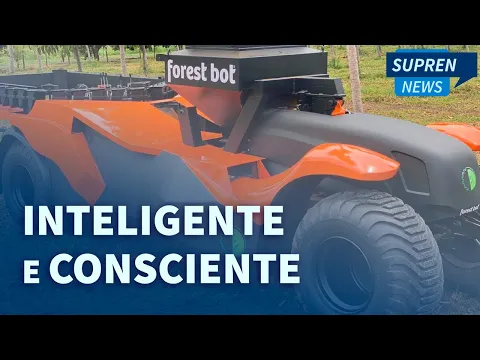
In contrast to the aerial solution, a Brazilian startup has developed a 100% national response. AutoAgroMachines, founded by Marcello Guimarães, created the Forest.bot, an electric ground robot designed to plant seedlings, not seeds.
This nine-ton machine represents a leap in engineering. Its patented planting system inserts seedlings into the soil perfectly, without damage from dragging. Using artificial intelligence, the robot checks the quality of each planting in real-time. Its capacity is impressive: it can plant up to 1,800 seedlings per hour, with the potential to reach 86,000 trees in 24 hours of continuous operation. Each planted seedling has its species and GPS position recorded, creating a detailed map for future automated actions.
Comparing Reforestation Technologies
The choice between the two technologies depends on the goal and conditions of the location.
- Drones (Aerial): Have unmatched speed and access. They are ideal for covering large areas that are difficult to access, such as steep slopes. The cost can be up to five times lower than traditional planting. The challenge is to ensure the survival rate of the seeds in the field.
- Robot (Ground): Offers high precision and quality control, planting already established seedlings, which generally results in higher survival rates. It is perfect for commercial forestry and restoration areas on traversable terrain.
The Future Of Reforestation: Challenges And Opportunities
The speed of planting with these new technologies exposes a new bottleneck: the supply chain of high-quality native seeds and seedlings. The ability to plant millions of trees per day depends on the availability of diverse, genetically suitable biological material.
The future of reforestation in Brazil will not be a one-winner competition but rather an intelligent integration of solutions. Drones may be used to quickly cover vast areas with pioneer species, while robots like those from the Brazilian startup AutoAgroMachines will be able to perform enrichment planting with surgical precision. Together, these technologies form the most powerful alliance for Brazil to meet its environmental goals and rebuild its ecosystems.



Sensacional magnífico é Divino.