Portuguese
  Spanish


In Ainsdale, near Liverpool, a common garden hides hand-dug caves by Francis Proctor, with concrete walls calculated by his wife to support tunnels in sandy terrain.
In the backyard of an apparently ordinary house in Ainsdale, near Liverpool, UK, retiree Francis Proctor built over three decades an underground network of caves, tunnels, and passages hand-dug in sandy terrain.
The project is about 6 meters below the garden and was only possible, according to him, thanks to the calculations made by his wife, Barbara, who was a mathematician.
Proctor, 76 years old, is a retired photographer and has lived for more than 50 years on the property in Southport, in the Merseyside region.
-
Seen from space, an astronaut captures in Canada a geometric carpet of crops drawn over the backdrop of a ghost lake that disappeared 12,000 years ago, was once larger than all the Great Lakes combined, and left a scar of fertile mud that still sustains agriculture.

-
Billionaire says the most valuable skill will help overcome job elimination caused by AI, following Bill Gates’ fears

-
A Dutchman created a ‘box’ that makes trees grow in the desert almost without water and without irrigation: the invention has already brought seedlings to dozens of countries and achieves up to 90% survival where common planting did not exceed 10%.

-
Abandoned warehouse hid a giant collection of rare computers, with over 2,000 artifacts from the 1930s to the 1980s.




The idea came after a visit to Blue John Cavern, a tourist cave in Derbyshire, and started as the intention to create an underground room accessed from the garden.
The terrain, however, did not favor the work.
The house is situated on sand dunes near Ainsdale beach, a condition that made excavation more difficult and increased the risk of collapse.
In an interview reproduced by British media, Proctor explained that digging in sand required a structural solution before any depth advancement.
“If you dig in the sand, you can imagine what would happen: it would simply collapse on itself, so you would think it would be almost impossible to build caves here,” he said.
The solution came during a house extension project.
According to Proctor, Barbara analyzed the plans, did the calculations, and indicated that it would be necessary to brace the walls from top to bottom, with thick concrete structures to support the excavation.
“Barbara looked at the plans and said it was quite simple. Under her guidance, she explained what we needed to do,” Proctor told The Sun.
The result was an underground construction supported by concrete walls about 1.5 meters thick, equivalent to five feet.
With shovels and hoes, Proctor slowly advanced underground and transformed the initial idea into a labyrinth with chambers, stairs, a bridge, a waterfall, and decorative objects gathered over the years.
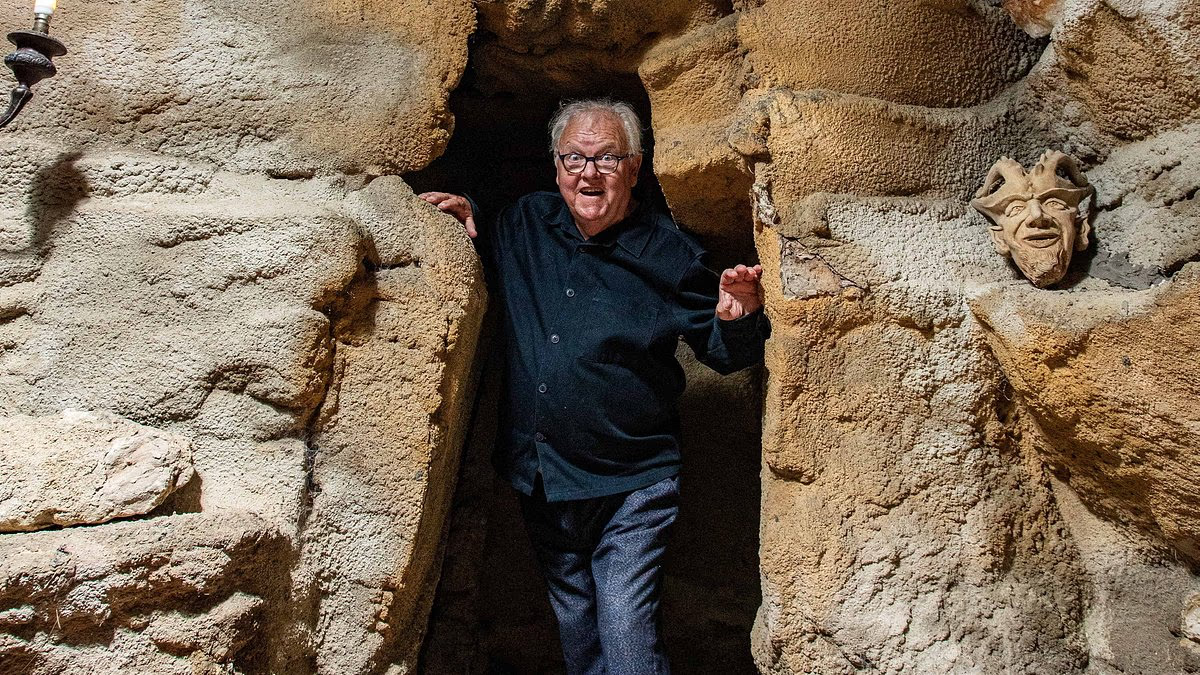
Underground garden in Ainsdale
The space is located at the back of the house, at 33 Pershore Grove, an address now listed in the National Garden Scheme, a British program that opens private gardens to the public on scheduled dates or visits for charity fundraising.
The garden’s official page describes the location as a small garden with a bridge, romantic ruin, and artificial caves with entertainment features, built over 30 years.
The profile also mentions the use of recycled materials and warns that the cave entrance may not be suitable for people with mobility difficulties.
The visit does not occur like a tourist spot open every day.
According to the National Garden Scheme, the garden receives groups by appointment between May 19 and October 18, with groups of 10 to 20 people.
This detail helps gauge the type of attraction.
The labyrinth is not a natural cave nor a conventional public structure, but a private creation that started receiving visitors through an open gardens program.
From the outside, the house does not indicate what exists in the back.
Images published by British media show a common residence seen from the street, while the garden behind the property features stairs, stones, underground passages, and scenic elements.
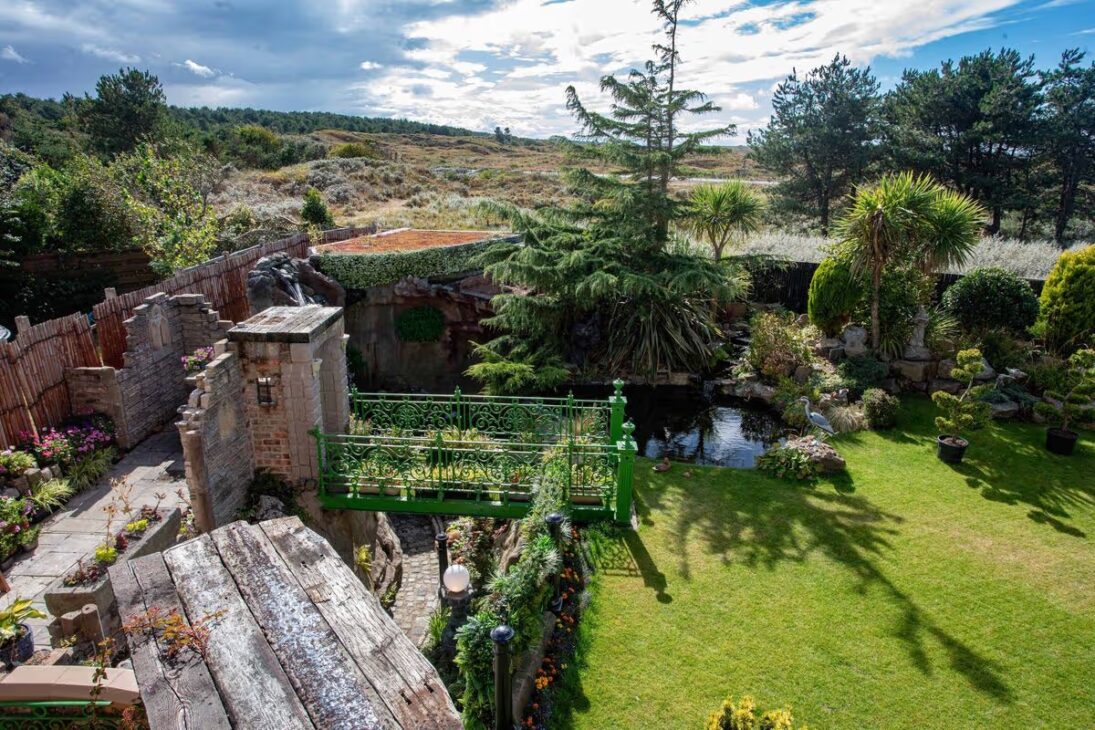
Inspiration from Blue John Cavern
Francis Proctor reported that the inspiration came from the Blue John Cavern in Derbyshire, known for its mineral formations and tourist visits.
After the trip, he began to imagine an underground room that could be accessed from the home garden.
The first version of the idea was smaller.
According to him, the initial goal was to have a room below the backyard, not a complete network of caves.
Over the years, the work expanded as the retiree continued to dig and add new areas.
“When we bought the house more than 50 years ago, I wanted to have an underground room where I could go down from the garden,” said Proctor, in an interview cited by The Sun.
The excavation was done manually, with simple tools.
The retiree does not describe the work as a professional project executed by a contractor, but as a personal project conducted at his own pace and with help from others at different times.
Over time, the chambers gained decorative elements.
Among the items cited by British media are objects brought from different places, a bridge, a waterfall, and even a scenic skeleton that supposedly came from a Hollywood film set.
Barbara’s calculations supported the work
The participation of Barbara is treated by Proctor as decisive for the safety of the construction.
According to him, his wife had training in mathematics and statistics and was responsible for guiding how the excavation could progress in a sandy terrain.
The solution involved shoring up the area from top to bottom, instead of digging first and reinforcing later.
This method, as described by Proctor, allowed the walls to be supported during the progress of the excavation.
“We wouldn’t have been able to do any of this if it weren’t for the fact that Barbara discovered how we could dig in the sand,” he said.
The phrase also explains why the garden came to be associated with her memory.
Barbara died four years before the British reports published in 2025, and the entrance to the space received a plaque with the inscription “Barbara’s Garden”, or “Garden of Barbara.”
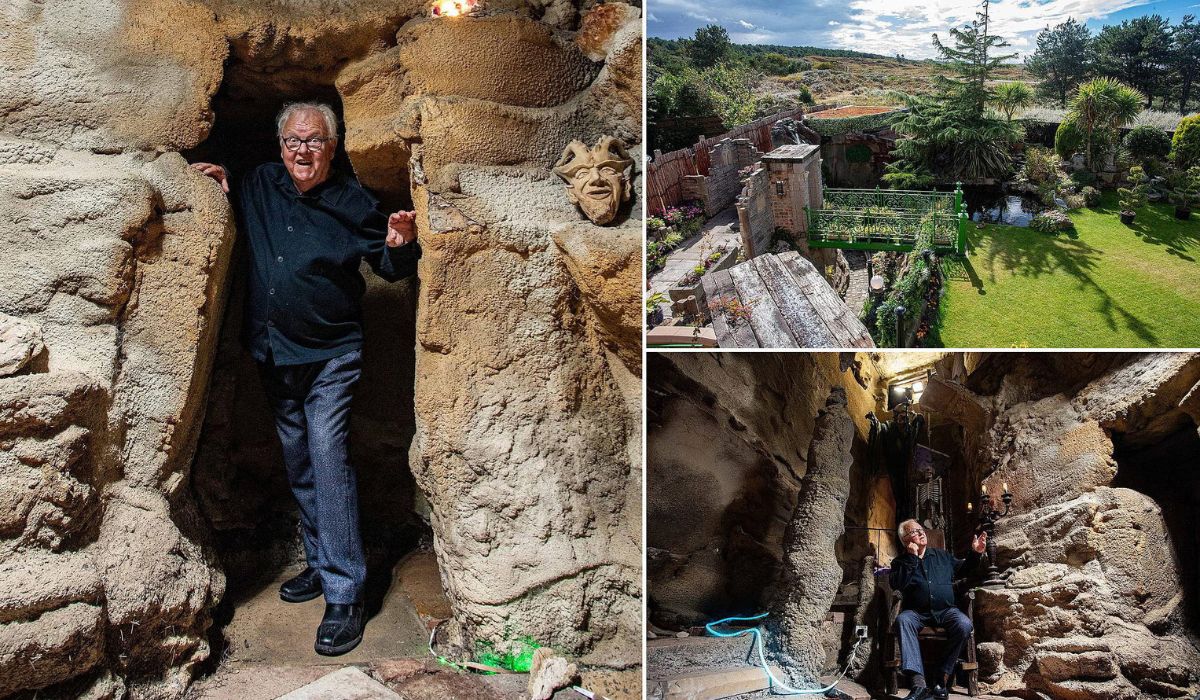
Another element mentioned in the reports is a historical cornerstone from Southport Hospital.
The piece was laid in 1922 by the Earl of Derby, later located by Proctor and dedicated to Barbara’s memory exactly one hundred years later.
Without his wife’s calculations, according to the retiree himself, the sandy terrain would have made the project unfeasible.
This attribution is important because it avoids treating the work merely as a result of improvisation: even though it was dug by hand, the structure depended on planning and concrete reinforcement.
Three Decades Digging by Hand
The underground network was built gradually, in a process that extended for approximately 30 years.
Proctor stated that he dug with shovels and hoes, expanding the space as the work progressed under the garden.
The depth mentioned in the reports is about 20 feet, equivalent to just over 6 meters.
In sandy soil, this data reinforces the importance of thick concrete walls and the shoring method mentioned by Proctor.
Over time, the construction ceased to be just an underground room.
The complex began to include passages, chambers, living spaces, and visual elements that led the garden to appear in reports and television programs.
The Sun reported that the house has already appeared on the program “Amazing Spaces”, on Channel 4, presented by George Clarke.
The information was also used by British media to explain the recent repercussion of the location.
Despite the publicity, Proctor claims he did not start the project to attract the public.
According to him, the construction was a personal activity done in his spare time.
“We had no intention of building this for the benefit of others. It was just something I worked on in my spare time with the help of others,” he said.
Visits by the National Garden Scheme
After the garden became known, visitors began to show interest in seeing the caves.
Proctor stated that the public’s reaction surprised him.
“It was something to do that I enjoyed. It was a surprise when people started to show a lot of interest, and now more and more people come to see,” he said.
The registration with the National Garden Scheme formalized part of these visits.
The organization lists Proctor’s garden as a private space with visits by appointment, groups accepted, and availability of refreshments, a term used in the UK to indicate the offering of drinks or light snacks.
The official description also highlights the use of recycled materials.
This point aligns with the visual composition of the garden, which combines collected pieces, masonry structures, ornamental elements, and underground areas built over decades.
As entry into the caves may have accessibility limitations, the National Garden Scheme itself advises visitors to contact for information before organizing the visit.
The notice is relevant because the route involves stairs and underground passages.
The public interest, therefore, is linked both to the appearance of the garden and the construction process.
The central curiosity is the existence of an artificial maze excavated beneath a common house, in an area where the sand required structural reinforcements to prevent collapse.

Barbara’s Garden and the tribute
After Barbara’s death, the garden gained a more explicit memorial layer.
The plaque with her name marks the entrance, and Proctor began to describe the work also as a way to keep her participation associated with the space.
This interpretation appears in the words of the retiree himself.
When explaining how the construction was possible, he refers back to his wife’s calculations and how she guided the reinforcement of the walls.
The case also shows how a domestic project can become known outside the neighborhood when it brings together unusual elements, such as manual excavation, depth, structural risk, scenic decoration, and public visitation.
Even so, there is no confirmation that the site functions as a permanent attraction open daily.
In practice, Francis Proctor’s garden remains a private property with limited visits organized by appointment.
The caves are part of this set, but circulation depends on the owner’s rules and the conditions informed by the National Garden Scheme.
What can be stated with certainty is that Proctor spent about 30 years digging and assembling the space at the back of the house, in Ainsdale, with concrete reinforcements and technical guidance attributed to his wife.
From there, the work ceased to be just a planned underground room in the garden and became a domestic maze that began to attract visitors.
For those who see the house from the street, the scene remains discreet.
What exists under the backyard only appears after crossing the garden and descending into the space dug in the sand.