Portuguese
  Spanish


In the Thar Desert, a 28-kilometer artificial reservoir uses plastic lining to store water from the Indira Gandhi Canal and reduce shortages in Jaisalmer and Barmer during maintenance periods.
In the Indian state of Rajasthan, supply authorities have built a large artificial reservoir in the Thar Desert to store water intended for the districts of Jaisalmer and Barmer, two areas marked by water scarcity in western India.
The structure is about 28 kilometers long, with a bottom lined by a plastic sheet of 300 microns and a reported capacity of approximately 1.41 billion liters.
The project was designed to function as a strategic reserve during periods when the Indira Gandhi Canal, one of the main water sources in the region, undergoes scheduled maintenance interruption.
-
12-year-old girl develops a virtual receptionist with artificial intelligence for small businesses and demonstrates how the combination of creativity, programming, and automation can boost productivity, reduce repetitive tasks, and expand access to digital transformation.

-
A rock weighing almost 500 tons seems to defy gravity for over 11,000 years in Finland and remains balanced on a tiny base without collapsing or moving.
-
At 76 years old, a retired man reveals a subterranean labyrinth he dug by hand for 30 years under his own garden, descending 6 meters into sand dunes, erecting 1.5-meter concrete walls with calculations from his mathematician wife, and transforming a “crazy” idea into a hidden cave with a bridge and waterfall.

-
Seen from space, an astronaut captures in Canada a geometric carpet of crops drawn over the backdrop of a ghost lake that disappeared 12,000 years ago, was once larger than all the Great Lakes combined, and left a scar of fertile mud that still sustains agriculture.


This annual stoppage, locally known as Naharbandi, usually affects the supply in areas dependent on the canal.
According to Indian reports, the reservoir was built by the Rajasthan state water supply department at an approximate cost of 242 crore rupees, equivalent to 2.42 billion rupees.
The forecast released by the consulted sources was for inauguration in July 2026, after the completion of the filling process, but no reliable public confirmation of the official opening was found.
The proposal is to capture and store water carried by the network associated with the Indira Gandhi Canal, process it at a filtration station, and distribute it to homes in Jaisalmer and Barmer.
Local authorities claim that the system was planned to benefit about 50 lakh people, an expression used in India for 5 million inhabitants.
The striking image is that of an artificial lake excavated in a desert area, where the sand could quickly absorb the stored water.
To reduce this risk, engineers covered the bottom of the reservoir with a layer of high-density polyethylene, a material used as a barrier against infiltration.
Artificial reservoir in the Thar Desert
The Thar Desert extends across northwest India and part of Pakistan.
On the Indian side, Jaisalmer and Barmer are among the regions most associated with arid landscapes, intense heat, and dependence on artificial water transport systems.
The construction of the reservoir in Jaisalmer was presented by Indian media as an attempt to create large-scale storage for periods of canal disruption.
Until then, according to statements attributed to executive engineer Rampal Mundhiyara, there was no structure of the same size available to store enough water during annual maintenance.
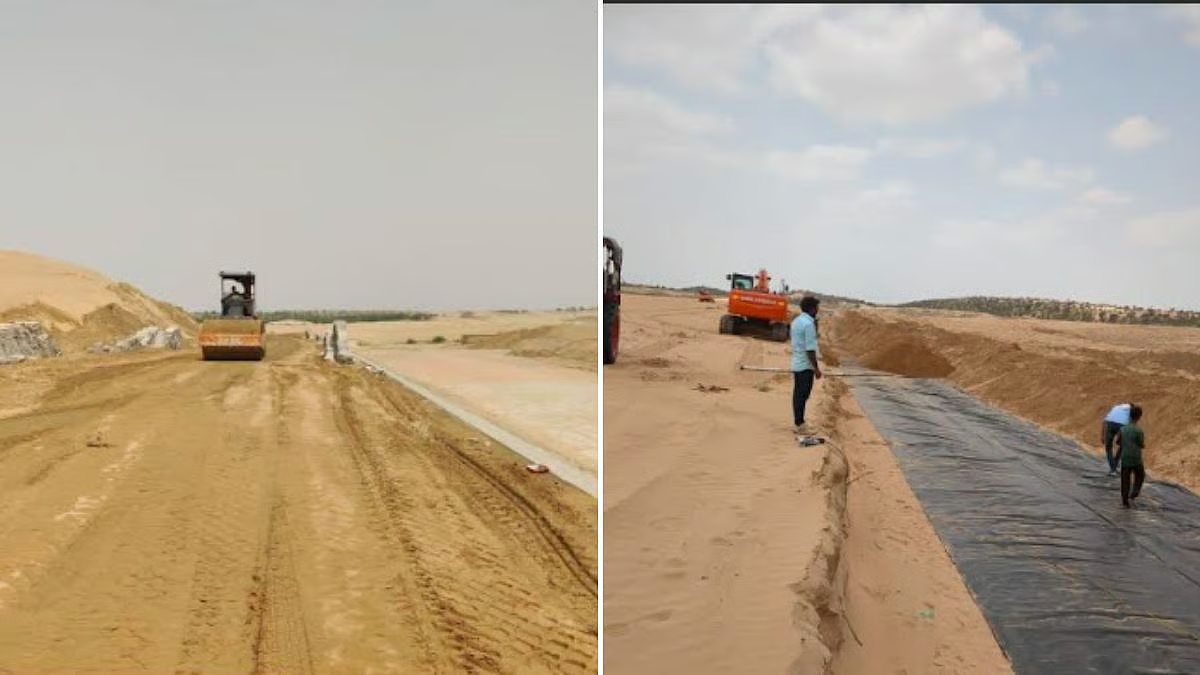
“Until now, there was no large-scale storage facility available to impound water for use during these maintenance periods. The need for this project arose specifically to address this persistent supply problem and the lack of adequate storage infrastructure,” stated the official, according to the Free Press Journal.
The statement summarizes the central point of the work.
The reservoir does not replace the Indira Gandhi Canal but functions as a large open tank to store water when it is available and release it later, according to the supply system.
The structure was integrated into an existing escape canal, used to connect the area to the Indira Gandhi Canal.
According to the information released, this canal allows excess water to be directed into the new reservoir.
300 Micron Plastic Liner
In a desert terrain, storing water in an open lake requires a solution to reduce losses from infiltration.
The sand allows water to penetrate the soil quickly, especially when there is not enough natural impermeable layer at the bottom.
To prevent this loss, the project received a 300 micron plastic liner at the bottom of the reservoir.
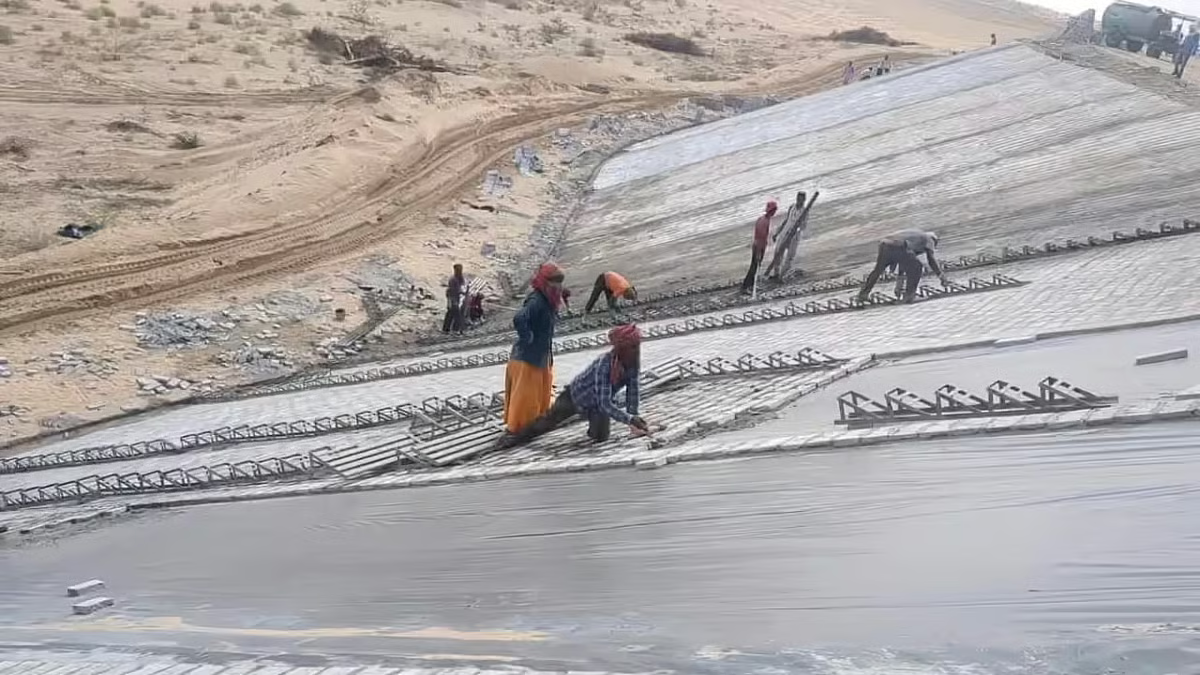
Indian reports identify the material as HDPE, the English acronym for high-density polyethylene.
The function of the liner is to create a barrier between the water and the sandy soil.
Without this coating, a significant portion of the stored volume could be lost before reaching the filtration and distribution system.
Indian publications also reported that a layer of soil was placed over the liner to protect the material.
This point is important because the reservoir needs to withstand heat, contact with water, maintenance, and the conditions of an open area in the desert.
The use of plastic lining in reservoirs is not a technical novelty, but the scale of the project in Jaisalmer made the work more visible.
The combination of large scale, desert, and attempt at continuous supply explains the case’s repercussion.
Indira Gandhi Canal and Naharbandi
The Indira Gandhi Canal is one of the main water transport works in Rajasthan.
It brings water to arid areas of northwestern India and has a direct impact on supply, irrigation, and occupation of regions in the Thar.
The dependence on this canal, however, creates vulnerability during the Naharbandi.
When the structure undergoes maintenance, the flow is interrupted for a period that can last weeks, affecting cities and communities that depend on the system.
In the case of Jaisalmer and Barmer, local authorities state that the annual shutdown causes water shortages.
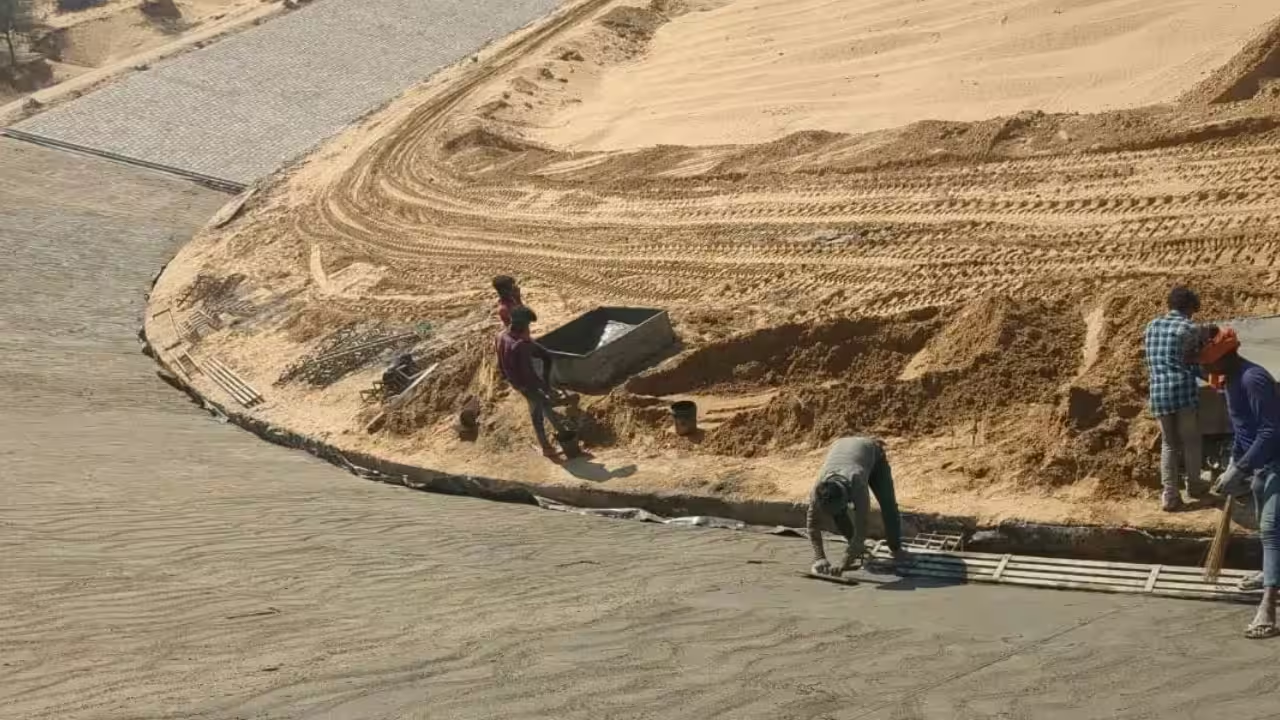
The new reservoir was planned precisely to maintain a reserve capable of bridging this interval.
The water stored in the artificial lake must then proceed to a filtration station before reaching homes.
This process is necessary because the reservoir functions as raw storage, not as a final point for direct consumption.
According to Indian reports, the water will be sent to treatment units and distributed through supply networks.
The effectiveness of this operation, however, depends on the completion of connections, pumping capacity, and system maintenance over time.
Dimensions of the artificial lake
The most repeated data in the sources consulted is the extension of approximately 28 kilometers.
The reported capacity appears as 1.41 billion liters, a figure also presented in India as 141 crore liters.
The depth, on the other hand, appears with variations in publications.
The Free Press Journal cites 33 feet of depth, which is equivalent to just over 10 meters.
However, other Indian publications have brought different numbers, including mentions of 13 feet and 13 meters.
For this reason, the depth needs to be treated with caution.
The 33 feet figure was maintained as a reference from the original text and Indian reporting, but the discrepancy between sources prevents confidently stating a single measurement without an official technical document.
There is also a difference in how the project is described.
Some outlets call it an artificial lake; others use the expression artificial reservoir in the desert.
From a functional point of view, the structure acts as a water reservoir for supply.
The most precise formulation is to say that local officials claim it could be among the largest artificial reservoirs in a desert region of Asia.
Cost and timeline of the project
The reported cost of the project is about 242 crore rupees.
This amount was attributed to the Rajasthan supply department in Indian reports published in May 2026.
The sources also associate the project with the Jal Jeevan Mission, an Indian national program aimed at expanding access to potable water through household connections.
In the case of Jaisalmer, the reservoir appears as support infrastructure for supply in areas facing periods of scarcity.
According to local publications, the project began in January 2023 and had its timeline adjusted during execution.
In May 2026, reports indicated that the project was in its final stage, with filling initiated and an inauguration scheduled for July of the same year.
Supply for Jaisalmer and Barmer
The promise associated with the reservoir is to ensure year-round supply to about 5 million people in Jaisalmer and Barmer.
The number was released by authorities and Indian media, based on the population served by the regional water system.
In practical terms, the reservoir functions as a stock to cover critical periods.
During canal maintenance or in phases of higher pressure on supply, the stored water can be directed for treatment and distribution.