Portuguese
  Spanish


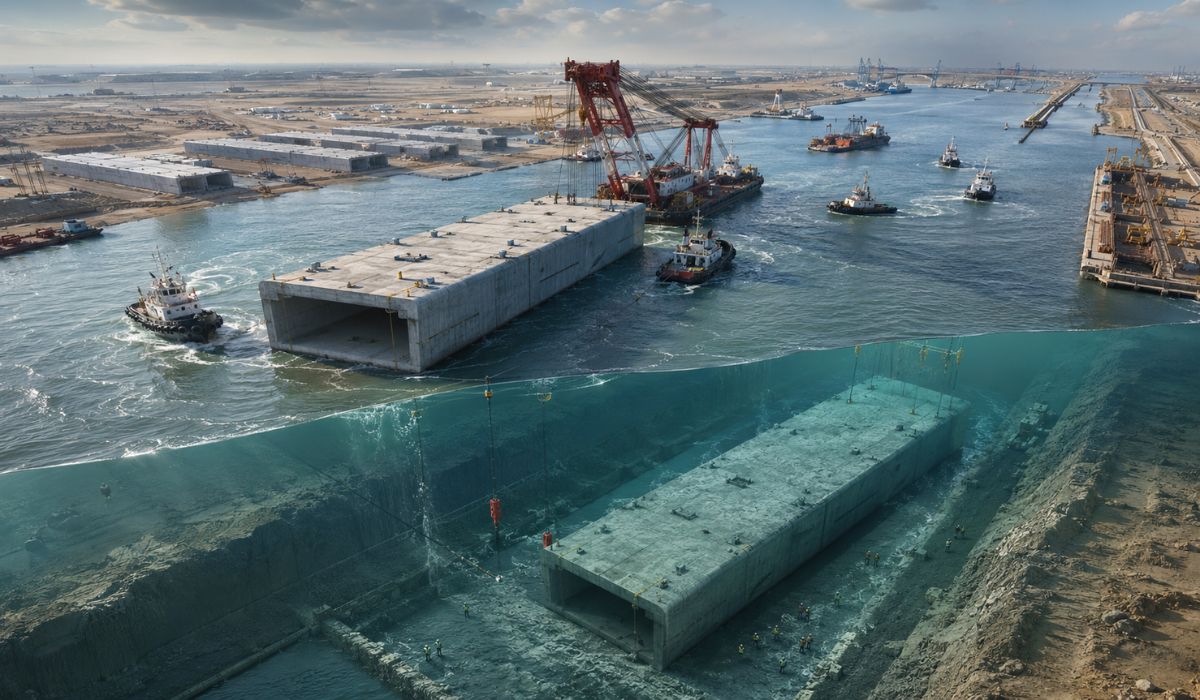

In southern Iraq, ten giant concrete modules were submerged to form a tunnel under the Khor Al Zubair, part of the route that aims to connect the Gulf to Europe by land.
In southern Iraq, an engineering project transformed ten giant concrete blocks into pieces of a submerged tunnel designed to connect the Port of Al Faw to the rest of the country via a new land route towards Turkey and Europe.
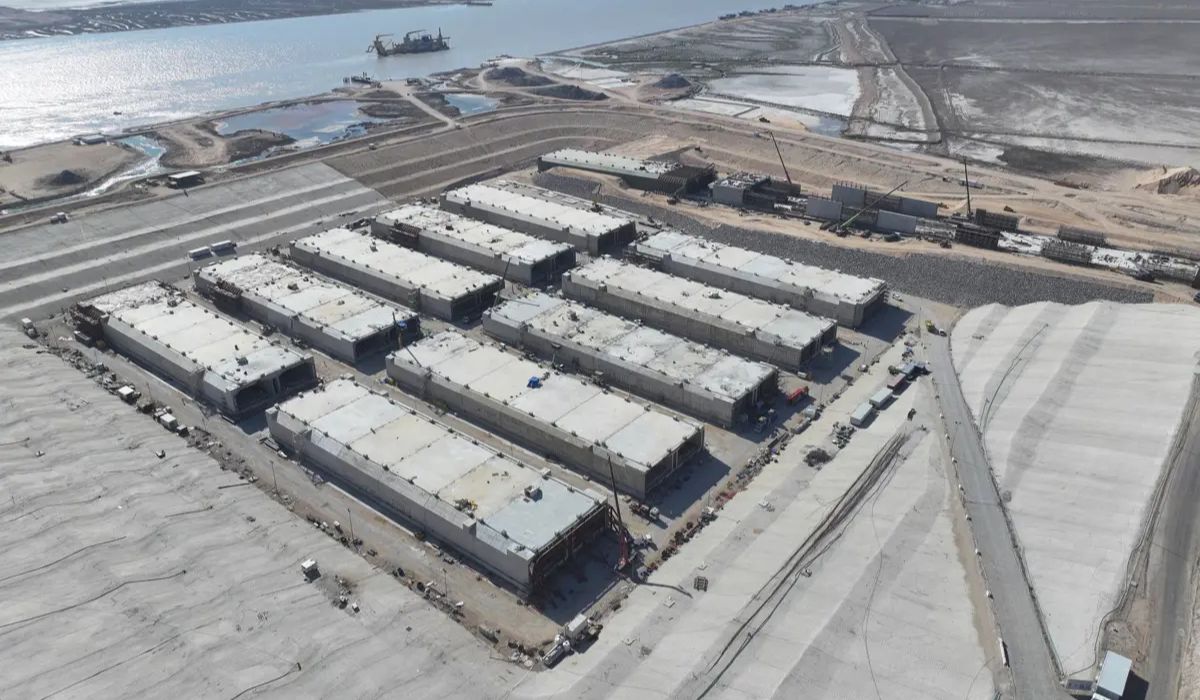
Each section is about 125 meters long and weighs approximately 46 thousand tons, according to Ballast Nedam, the Dutch company responsible for installing the tunnel elements in the Khor Al Zubair, in the Basra province.
The structure is part of the Iraqi plan known as Development Road, presented by the government as a road and rail corridor to connect the Gulf to Europe via Iraq and Turkey.
-
Scientists use more than 20,000 artificial birds and solar speakers to “trick” seabirds, reactivate nesting routes, and revive a colony on an island that seemed abandoned.

-
She spent 73 years breathing inside an iron lung, survived the aftereffects of polio, and became the last woman in the United States dependent on the equipment before dying at 78 years old.
-
Brazilian students created a $1 filter using pine bark, cotton, and 3D-printed parts to clean cassava wastewater, reduce the toxicity of a hazardous waste, and transform contaminated water into biofertilizer.

-
Astronaut from Artemis II steps down after mission to the Moon and decision surprises after a record of 406,771 km, a historic 10-day journey, and an unprecedented achievement for Canada.



The tunnel will have a total length of 2,444 meters, including accesses, of which 1,260 meters will be submerged under the Khor Al Zubair channel, according to the Iraqi Port Authority.
The most recent publicly confirmed stage occurred in November 2025, when the General Company for Ports of Iraq reported that the last segment had left the fabrication basin to be prepared before the final submersion phase.
Ballast Nedam presents the project on its website as completed and reports having installed the ten elements between 2023 and 2025.
The case draws attention for its scale and method.
Instead of drilling the ground as in tunnels excavated by tunnel boring machines, the project uses pre-cast concrete pieces, manufactured in a dock, floated, towed to the correct position, and sunk into a dredged trench in the channel bed.
The tunnel is treated by Iraq as a connecting piece between the future Port of Al Faw, at the southernmost part of the country, and the route that will follow through Baghdad to the border with Turkey.
In December 2025, Prime Minister Mohammed Shia al-Sudani inaugurated the first section of the Development Road, a stretch of 63 kilometers that connects the port to the tunnel still under construction at the time, according to the Xinhua agency.
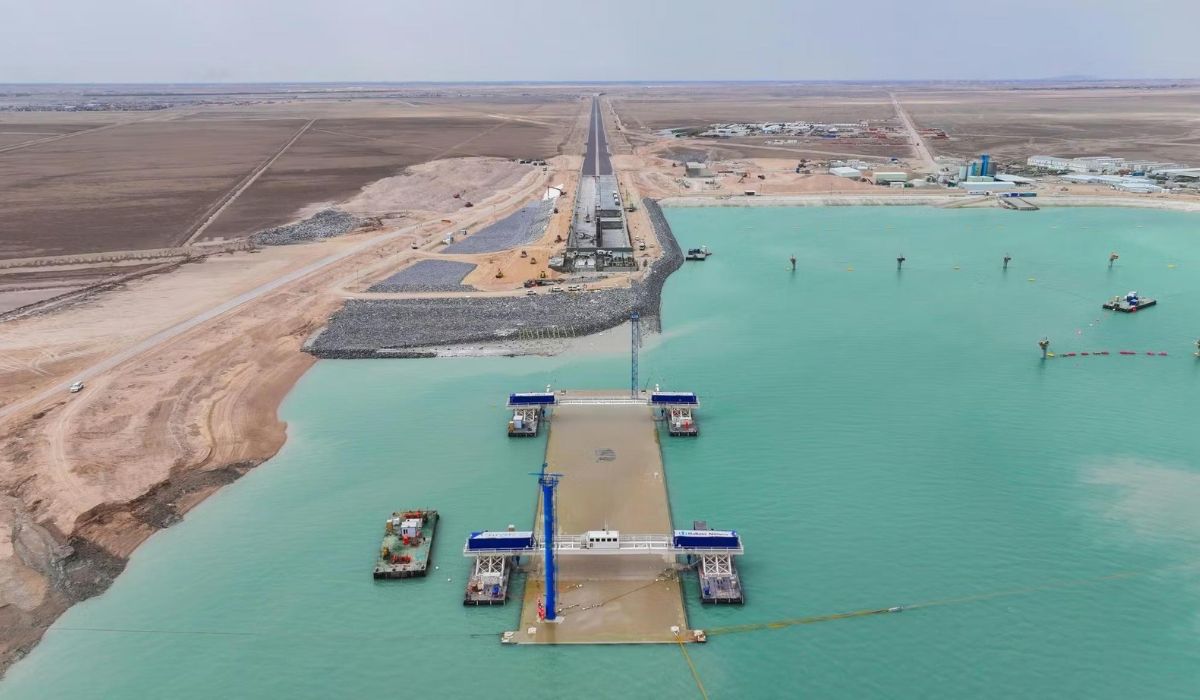
Submerged Tunnel in Khor Al Zubair
The tunnel is located in the Umm Qasr region, south of Basra, in a strategic area for Iraq’s outlet to the Gulf.
Ballast Nedam identifies the project as Immersed Tunnel Basrah, Iraq, and states that it executed the installation of the elements as part of the Grand Faw Master Plan.
The Port of Al Faw is one of the pillars of this plan.
In a November 2024 report, Reuters reported that the port is part of a $17 billion project launched by Iraq to connect the country’s southern coast to the Turkish border by railways and highways, aiming to reduce transportation time between Asia, the Middle East, and Europe.
The same report stated that South Korean Daewoo Engineering & Construction built five berths of the Port of Al Faw, delivered to Iraqi port authorities during a ceremony attended by the prime minister.
The forecast cited by the director of the General Company for Ports, Farhan al-Fartousi, was to start operations in 2026 and reach a maximum capacity of 3.5 million containers in 2028.
In this context, the tunnel serves to allow road traffic to cross the Khor Al Zubair without relying on a bridge at that point.
The route starts from the port, passes through the submerged crossing, and heads towards northern Iraq.
How an Immersed Tunnel Works
The method used in Iraq is known as an immersed tunnel.
First, the concrete elements are constructed in a dry area, within a fabrication dock.
Then, the dock is flooded so that the pieces float, even though they weigh tens of thousands of tons.
Martijn Smitt, CEO of Ballast Nedam, explained that the work involves floating the elements one by one, removing them from the dock with cables and winches, and positioning them using immersion techniques.
The company also stated that it creates a foundation under the modules through “sandflowing,” a process where layers of sand are injected between the bottom of the element and the river or canal bed.
“Our work involves the following: when the construction dock is flooded, we make the tunnel elements float one by one,” said Smitt, in a report published by Ballast Nedam.
He added that the pieces are removed from the dock and placed in position using immersion techniques.
In the next phase, each element is taken to the installation area by winch and pontoon systems.


At the immersion point, the piece is gradually lowered into a dredged trench at the bottom of the channel, where it needs to align with the previous module.
The connection needs to be watertight.
According to Ballast Nedam, the elements are joined with a GINA gasket seal, used to prevent water from entering the joint between sections.
Each immersion operation takes about 16 continuous hours, according to the company.
Precision to sink 46 thousand ton blocks
Despite the simple image of “floating and sinking” concrete blocks, the operation depends on calculation, preparation, and position control.
Ballast Nedam reported that it took almost two years of preparation, including engineering, planning, acquisition of pontoons, winches, topographic survey systems, and testing in the Netherlands.
During installation, the element needs to reach the correct point, descend at the planned speed, and rest on temporary structures and foundations prepared at the bottom.
Hydraulic systems allow for height adjustment before the final connection with the previous section.
The company also describes the formation of “sand pancakes” under each module, a step used to create the final foundation after the position is approved.
This base helps distribute the load of the concrete sections over the dredged bed.
Precision is relevant because small deviations can affect the fit between modules, the sealing, and the final alignment of the tunnel.
Therefore, the work combines heavy civil construction procedures, navigation, maritime operations, topography, and technical diving.
Heat, safety, and logistics in Umm Qasr
The location also imposes operational restrictions.
Umm Qasr is in a desert climate region, where temperatures can reach 50 ºC, according to a report by Martijn Smitt published by Ballast Nedam.
The company reported that workers need to adopt permanent measures to prevent burns and dehydration.
Besides the heat, Ballast Nedam cited safety conditions as part of the project’s challenges.
The company stated that the region is classified as a risk area by the Dutch Ministry of Foreign Affairs and, therefore, adopted transportation in armored vehicles, escorts, and 24-hour surveillance at work sites.
Logistics also depend on the arrival of equipment from other countries.
Xavier Szadkowski, project engineer at Ballast Nedam, stated that the components could not be easily obtained locally and that preparation needed to include a detailed check of each item before shipping to Iraq.
This context helps explain why the tunnel is treated by the company as a highly specialized work.
Besides the size of the modules, execution requires an international team, imported equipment, and coordination between the contractor, subcontractors, and local authorities.
Iraq Development Route
The submerged tunnel is not an isolated project.
It is part of the Iraqi strategy to transform the Port of Al Faw into a cargo entry point in the Gulf and connect this structure to the north of the country and Turkey through a land transport network.
The World Bank describes the Development Route as an initiative launched by Iraq in May 2023 to leverage its geographical position and improve regional trade connectivity.
The railway project document states that the initiative plans to connect the Port of Al Faw in the Gulf to Europe through Iraq and Turkey, in two stages of railway expansion and modernization.

The same document indicates a total cost of US$ 2.5 billion for a series of support projects, with US$ 930 million in the first operation, aimed at railway modernization.
The World Bank also records that the second stage foresees a new railway link of 1,200 kilometers between Al Faw and the Turkish border, with an estimated cost of US$ 17 billion.
According to Reuters, Iraq launched a $17 billion project in 2023 to connect the port to Turkish territory via railways and roads, aiming to create a shorter transport route between the Middle East and Europe and compete with the Suez Canal in certain cargo flows.