Portuguese
  Spanish




Two discarded electric bicycle motors become the “heart” of a garage-built solar car, reaching 48 km/h with all-wheel drive and making the vehicle travel 100 km using only solar energy, without a factory, without an investor, and with repurposed parts that fit the budget of a home project
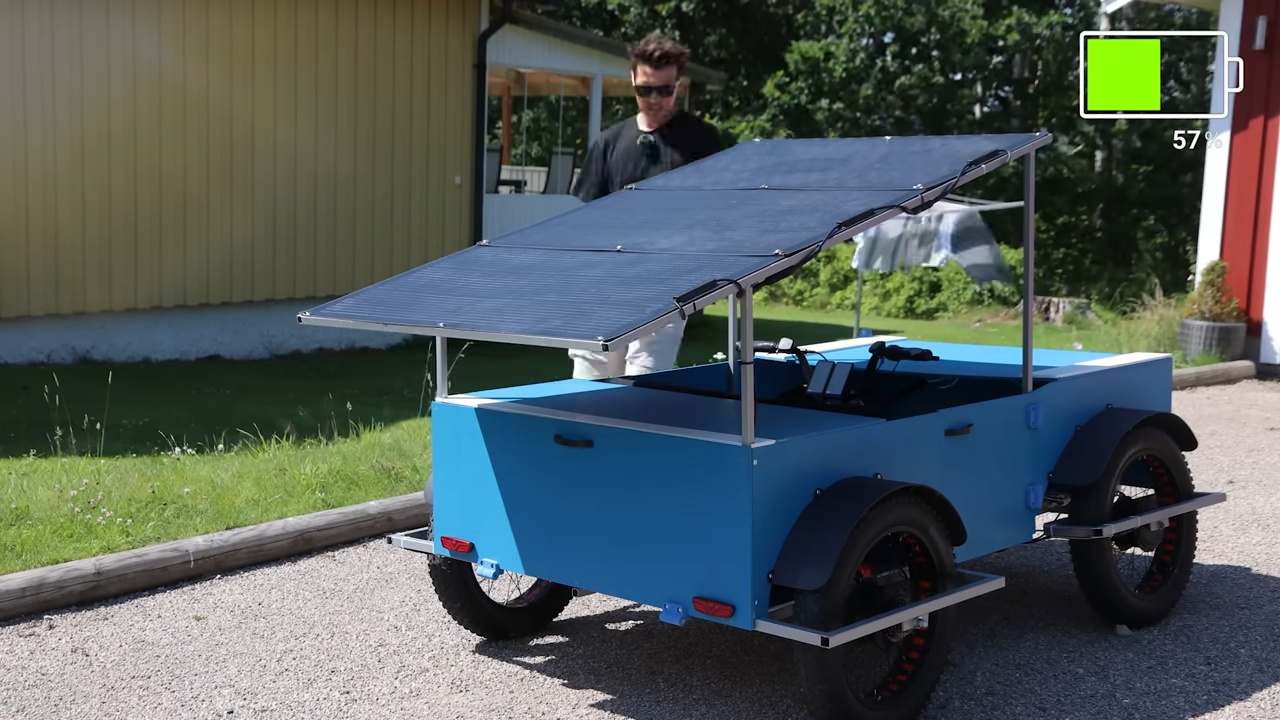
According to Popular Science, Swedish YouTuber Simon Sörensen, from the RCLifeOn channel, built a two-seater homemade solar car using transmission parts from two common electric bicycles, a 25 mm steel tube chassis welded by himself, and three flexible solar panels installed on the roof. The vehicle uses four 1,000 W hub motors, one in each wheel, allowing for front, rear, or all-wheel drive, depending on the controller configuration. The maximum speed reaches 48 km/h, with a range of 50 km under normal conditions and the possibility of exceeding 100 km on a sunny day.
In a test documented in the channel’s video, Sörensen traveled 29 km using only the energy generated by the solar panels, without consuming the battery. The vehicle also has doors, a trunk, hydraulic brakes, lighting, and enough torque to climb steep hills.
Homemade solar car uses electric bicycle motors and eliminates gearbox, chain, and gears
The choice of electric bicycle hub motors was the most efficient technical decision for building a vehicle from scratch without industrial tools. A hub motor is installed inside the wheel itself, eliminating chains, belts, gearboxes, cardan shafts, and other intermediate mechanical components.
-
Scientists Convert Food Waste into Aviation Fuel, Successfully Test 50% Blend with Conventional Kerosene to Cut Emissions and Promote Sustainable Flights

-
OnePlus N6 Smartphone to Launch in India with 8,000mAh Battery and 45W SuperVOOC Charging, Lasting Up to Three Days
-
Scientists Plan to Release Air Bubbles Underwater to Protect Antarctica’s “Doomsday Glacier” from Melting

-
Chinese R6000 Drone Combines Airplane and Helicopter Features, Carries Up to 12 People for Multiple Missions





By disassembling two electric bicycles with motors in the front and rear wheels, Sörensen obtained four ready-made motors, one for each corner of the vehicle. Each motor was connected to its own 1,000 W controller, creating a simple, modular, and functional system.
The result is a solar car with configurable all-wheel drive, made with parts that can be found in electric bicycle stores. Fewer components mean less complexity, less maintenance, and a lower risk of mechanical failure.
25 mm steel chassis was welded by a beginner during the construction of the solar vehicle
The structure that supports the motors, passengers, battery, and solar panels is a chassis made of 25 mm diameter steel tubes. The most surprising detail is that Sörensen had never welded before starting the project.
He learned during the construction itself, cutting the steel with an angle grinder, assembling motor mounts, and joining the chassis sections piece by piece. The steering uses Ackermann geometry, a system created in the 19th century to ensure that inner and outer wheels turn at different angles.

The solution prevents excessive tire slippage during maneuvers and shows that the project is not improvised without technical logic. The chassis underwent practical tests including steep descent, steep ascent, and emergency braking, all documented on the channel.
Flexible solar panels generate 300 W and reduce weight in the solar-powered car
The vehicle’s solar system consists of three flexible solar panels installed on the sloped roof, together generating about 300 W under direct sunlight conditions. The choice of flexible panels was essential to keep the weight low.

Equivalent rigid panels would be four to six times heavier, compromising project efficiency. Each flexible panel weighs about 10 pounds with the mount, keeping the vehicle light enough to be moved by electric bicycle motors.
Energy management between the panels and the 48 V battery is handled by a Victron solar charge controller, used in residential photovoltaic systems and boats. The sloped roof, inspired by the Tesla Cybertruck, allows for better accommodation of the panels and captures more light during travel.
29 km test without using battery proved the viability of the lightweight solar car
The most important test occurred when Sörensen disconnected the battery and drove exclusively on the energy generated by the solar panels on the roof. The result was a 29 km journey without consuming any battery storage.

This data is relevant because it shows that the 300 W panels can keep the vehicle in continuous motion under favorable sun conditions. In many solar projects, panels only recharge the battery complementarily; in this case, they sustained propulsion in real-time.
Total range with a full battery is 50 km under normal conditions and can reach 100 km on a strong sunny day. The battery serves as a reserve for night, shade, or cloudy skies, while the panels act as the primary source on favorable days.
Homemade solar mobility shows potential for ultralight, low-speed vehicles
Coverage by Popular Science, TechSpot, and Yahoo Autos didn’t happen just out of curiosity for an unusual DIY project. Sörensen’s vehicle demonstrates, in practice, a solution discussed for years by solar mobility engineers: reducing weight, cost, and complexity until panel energy is sufficient.
TechSpot highlighted that the approach keeps cost and complexity low while better utilizing the limited energy that solar panels can provide. This is the central point: large, heavy cars require too much energy for small panels, but ultralight vehicles change the equation.
Popular Science framed the project as proof that a category exists between electric bicycles and conventional cars. Lightweight, low-speed, short-range solar vehicles can be viable today, with readily available components, without relying on a factory or aerospace engineering.
Garage solar car doesn’t replace common vehicles, but proves a real low-cost alternative
Simon Sörensen’s solar car was not created to replace conventional street cars. It lacks the scale, regulatory safety, or performance required by modern commercial vehicles.
Even so, the project demonstrates something important: practical solar mobility can work in small, lightweight, and well-proportioned vehicles. The use of electric bicycle parts reduces cost, facilitates maintenance, and allows electric traction to be assembled with accessible components.


What he built is not just a glorified go-kart. It is a functional two-seater vehicle, with four motors, real range, and the ability to travel tens of kilometers on direct solar power.
The question that remains is how many other garage projects can emerge when simple parts, lightweight panels, and creativity begin to meet.