






 Portuguese
  Spanish
  5 min of reading
  0 comments


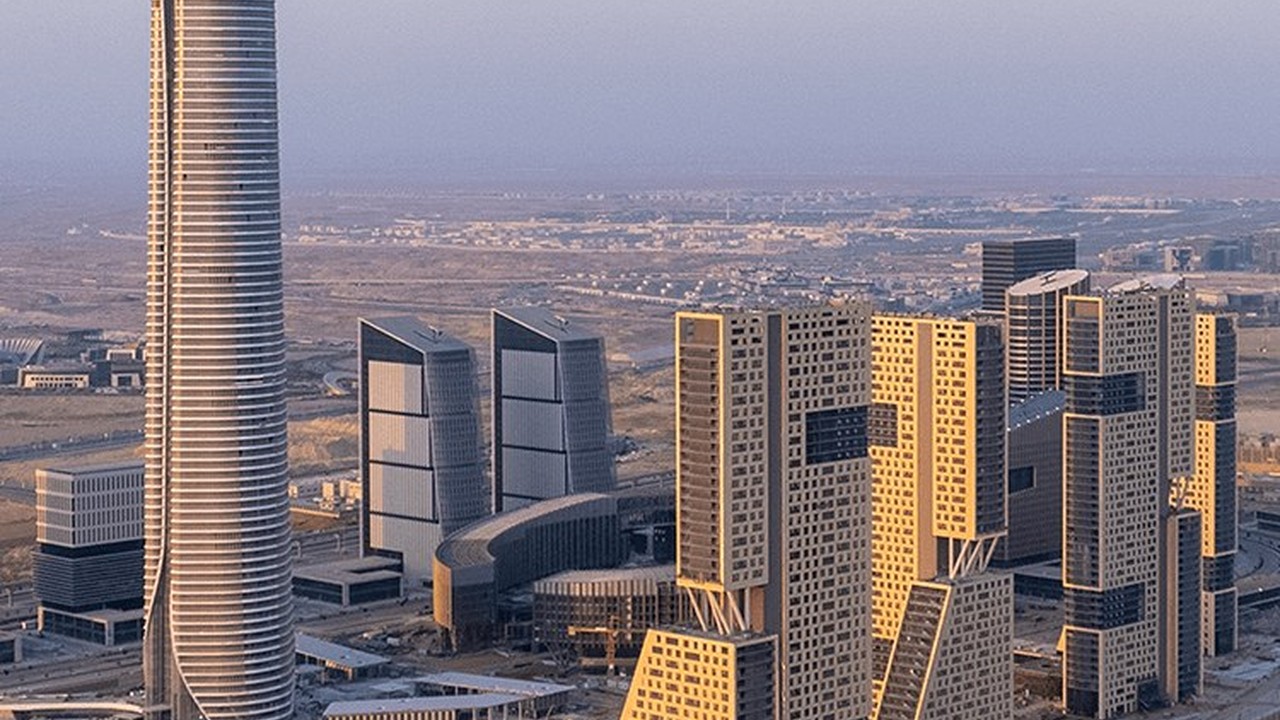
Tired of having one of the most suffocated cities on the planet, Egypt decided to do something radical: build an entire capital from scratch in the middle of the desert east of Cairo, crowned by a 70-story skyscraper that is already the tallest building in Africa and surrounded by avenues erected where there was once only sand.
Cairo is one of those cities that seem to hold people beyond any limit. More than twenty million people are squeezed into a tangle of traffic, pollution, and infrastructure at its limit, and the solution Egypt found was one of the boldest that exists: not to try to fix the old city, but to build a new one next to it. It is called the New Administrative Capital, now simply renamed The New Capital.
The symbol of this ambition is the Iconic Tower, a skyscraper of 70 stories that has become the tallest building in all of Africa. It dominates the new financial center, surrounded by other towers rising quickly from the desert floor. And the project doesn’t stop at height; it includes the largest cathedral in the Middle East and a massive mosque, in a deliberate gesture to show that a city designed to be a true capital is being born there.
Building a city from scratch
Raising a capital from scratch is one of those feats that seem like something from another era, but that some countries still dare to attempt. It means laying out avenues, water, energy, and sewage networks, government buildings, residential neighborhoods, and financial centers in a place that, until recently, was pure desert. Satellite images tell this story better than any text, showing an entire urban grid appearing where the map only recorded sand.
-
Without a mansion, without high investment, and without a traditional classroom, a teacher living in a 22 m² house taught students to build a 9 m² studio apartment with the equivalent of R$10,000.

-
Largest bridge in São Paulo reaches 75% completion and is expected to strengthen strategic connection in the interior of São Paulo.

-
Without her own home and pressured by rent, a 25-year-old bought a small 15-meter boat, gradually renovated the interior by herself, transformed the interior with paint, new flooring, a larger bathroom, and started living on the canals, paying much less per month.
-
Tired of seeing families sleeping on the street, São Paulo delivered 18 m² furnished microhouses and took 888 people off the streets: Vila Reencontro became the model social housing for the homeless population.


I confess I have a special fascination with this type of project because it exposes a decision of almost absurd courage. Instead of patching up the chaos of a historic metropolis, the government bets billions on a complete restart, transferring ministries, public agencies, and the country’s administrative machinery there. It’s about reorganizing the backbone of an entire nation by changing its address.

Why move the government from the old city
The logic behind moving the capital is usually similar. Historic cities like Cairo have grown chaotically for centuries, and there comes a point where unclogging them is practically impossible. Removing the government machinery and the thousands of employees it employs is a way to relieve pressure on the old city and, at the same time, create a new hub for investment and housing.
It’s not the first time a country has done this, and it’s easy to understand the temptation. A planned capital is born with wide avenues, room to grow, and modern infrastructure from day one, without the legacy of centuries of improvisation. The risk, of course, is that a city built by decree takes time to gain soul and life, taking years to stop being a construction site and become a place where people really want to be.
Brazil, by the way, knows this story well. That’s exactly what we did with Brasília in the 1960s, building an entire capital in the middle of nowhere to move the center of power from the coast and interiorize the country. It took time for the city to gain its own life, but today no one questions that it worked. Egypt is betting on the same formula that Brazil tested decades ago, that a capital can indeed be designed from scratch on a drawing board and rise from the ground where there was once nothing. It’s an idea that is daunting in its ambition, but has already proven to be possible. Perhaps that’s why the Egyptian project arouses such particular curiosity in those who live in a country that made the same bet and won.

From construction phase to city phase
The current moment of the project is precisely this delicate transition, the shift from pure construction to real operation. Government buildings are already receiving employees, neighborhoods are beginning to be occupied, and the city is taking its first steps as an inhabited place, not just a gigantic urban shipyard. It’s the phase where it is discovered whether the bet will succeed or become an overly expensive ghost town.
The Iconic Tower and the financial center are the showcase of this effort, the part that Egypt wants to show the world as proof that the project is serious and standing. Erecting the tallest building in Africa in the middle of the desert is, above all, a statement of intent, a way of saying that this is not just any suburb being born, but a new center of power.

A capital born from the desert
I imagine what it will mean, a generation from now, to say that the capital of Egypt is no longer the legendary Cairo on the banks of the Nile, but a gleaming city built from nothing in the desert. It’s a change on a scale that few countries would have the courage to undertake, mixing ambition, necessity, and a good dose of betting on the future.
Whether it will work or not, only time will tell, because planned cities have an irregular track record around the world. But it’s impossible not to be impressed by the determination to transform sand into a metropolis, raising skyscrapers, a cathedral, and a mosque where, a few years ago, there was absolutely nothing but horizon.
Would you live in a capital built from scratch in the desert, or do you prefer the history-filled chaos of an ancient city?


-

1 person reacted to this.