






 Portuguese
  Spanish
  5 min of reading
  0 comments


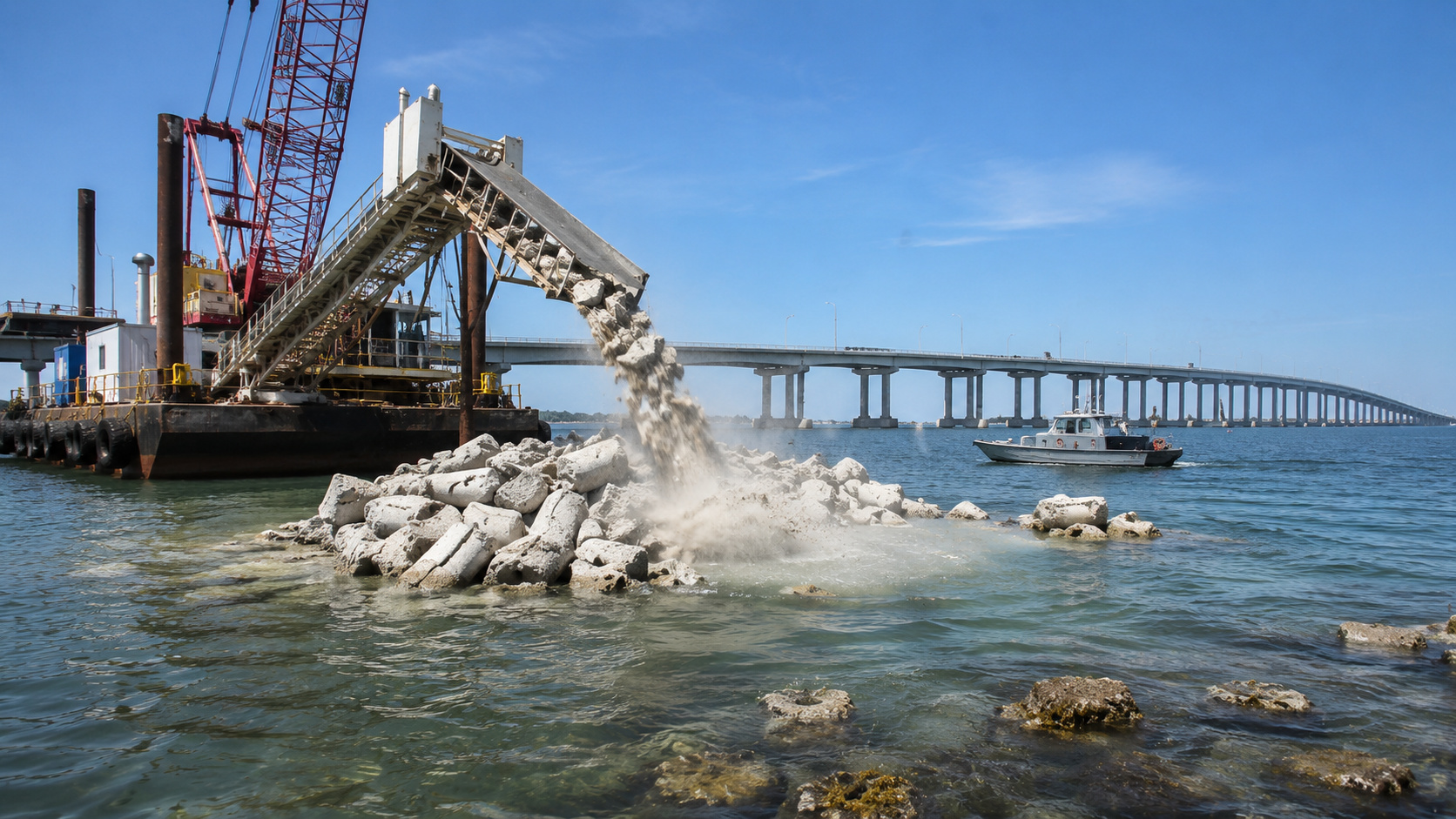
Expansion of the Hampton Roads Bridge-Tunnel repurposes 100,000 tons of demolished concrete to create artificial reefs in Chesapeake Bay and expand marine habitat.
According to WAVY News, the expansion of the Hampton Roads Bridge-Tunnel, the largest construction project in the history of the Virginia Department of Transportation, is generating an unusual byproduct. About 100,000 tons of demolished concrete from the old bridges are being placed at the bottom of Chesapeake Bay to create and expand artificial reefs at various points in the Hampton Roads harbor.
The material has already begun to be deposited in reefs like Blue Fish Rock Reef and Black River Reef, and other locations, such as Newport News Middle Ground Reef, East Ocean View Reef, and Cabbage Patch Reef, are expected to receive more concrete as the demolition progresses. Instead of becoming landfill waste, the old structure is being converted into marine habitat for fish and invertebrates.
Hampton Roads Bridge-Tunnel started becoming a reef even before disappearing
According to WAVY News, the Hampton Roads Bridge-Tunnel is the main connection between the two shores of the Chesapeake Bay in the Hampton Roads region, connecting Hampton, Newport News, and the northern peninsula with Norfolk, Virginia Beach, and the south. The original structure was inaugurated in 1957.
-
Space technology used to search for water on Mars is now hunting for invisible leaks under the streets of São Paulo, using satellites, AI, and chlorine signals to help Sabesp recover up to 6.7 billion liters of water.

-
Japan sends ship to extract mud rich in rare earths at nearly 6,000 meters deep in the Pacific, attempts to lift 350 tons per day from the seabed, and transforms sediments near Minamitori Island into a strategic weapon to reduce dependence on China.
-
Venus Aerospace promises a rotating detonation hypersonic engine that takes the Stargazer to Mach 9 and crosses oceans in 1 hour, but the flight that made history barely surpassed the speed of sound.

-
Brazilian student creates a cheap formula that makes plants grow up to 90% faster and wins an award in a global scientific competition.






The expansion to eight lanes required the construction of two new tunnels with the tunnel boring machine Mary, weighing 10 million pounds, as well as the expansion of artificial islands, new elevated bridges, and the progressive demolition of the old bridges. It is precisely at this demolition stage that the artificial reefs project comes into play.
Each section of the old bridge that is demolished no longer goes to conventional disposal and instead takes on another function at the bottom of the bay. The structure that once transported cars now begins to serve as a physical base for marine life.
Demolished bridge concrete creates hard substrate for marine life in Chesapeake Bay
According to WAVY News, the repurposing works because the bridge concrete was manufactured to withstand decades of contact with saltwater and heavy loads. This means the material already has adequate resistance to marine corrosion and can be used as a substrate without the need for complex additional treatment.

The irregular structure of the demolished pieces, with broken pillars, cut beams, and deck fragments, creates the topographic complexity that marine organisms need to attach, grow, and find shelter. This hard relief is lacking in much of the bay’s bottom, dominated by mud and sand.
In practice, the concrete that would be waste from a heavy construction project starts to function as a base for artificial reefs that can support fish, crustaceans, and invertebrates for many years.
How 100 thousand tons of demolished concrete become a marine ecosystem
According to WAVY News, the transformation of a demolished bridge into a marine ecosystem does not happen instantly. The process takes years and begins with the formation of a biofilm of algae and bacteria on the submerged surfaces.
This biofilm attracts larvae of barnacles, mussels, oysters, and polychaetes, which attach to the substrate. Then come sponges, anemones, and soft corals, increasing the biological and structural complexity. With each new layer of life, more species start to use the site for feeding, shelter, and reproduction.
In artificial reefs already established in the Chesapeake Bay, this maturation takes two to five years. The sites that have already received material from the HRBT are still in the early stages of this colonization.
Project unites VDOT, Seaward Marine, and VMRC in a circular chain without landfill
According to WAVY News, the project only works because three different agents act in a coordinated manner. Hampton Roads Connector Partners needs to dispose of a huge volume of demolished material, VMRC needs substrate to expand the reefs, and Seaward Marine has the means to transport and position the concrete precisely.
If these 100 thousand tons of concrete were sent to a landfill, there would be a high cost and no environmental gain. By being donated and repositioned at the bottom of the bay, they cease to be construction waste and become an ecological resource, with no significant extra cost to the taxpayer.
Hunter Smith, an artificial reef specialist at the Virginia Marine Resources Commission, summarized the benefit by stating that the material starts to create habitat for marine organisms and also generates opportunities for divers and fishermen to enjoy these environments.
Chesapeake Bay needs artificial reefs because it lost much of its natural hard structure
According to WAVY News, Chesapeake Bay is the largest estuary in the United States, with 320 km in length, 48 km at its widest point, and fed by over 150 rivers. It is also one of the most degraded estuaries in the Americas, pressured by agricultural nutrients, sediments, and pollution.

Much of the bay’s bottom is composed of mud and sand, without a rigid structure where reef organisms can attach. Before European colonization, vast native oyster reefs provided this three-dimensional architecture, but they were practically destroyed throughout the 19th and 20th centuries.
The artificial reefs managed by VMRC attempt to partially restore this ecological function, creating hard surfaces where there was previously only poorly structured sedimentary bottom.
Hampton Roads project surpasses by 25% one of the largest artificial reefs on the east coast
According to WAVY News, the volume of material from the Hampton Roads Bridge-Tunnel is so large that it surpasses by 25% the demolition of the Bonner Bridge in North Carolina, one of the largest comparable artificial reef projects on the American east coast, which generated 80 thousand tons distributed across eight sites.

In the case of Virginia, the concrete will be distributed at various points in and around the largest port on the east coast of the United States, expanding the ecological and territorial scale of the intervention.
The substantial completion of the HRBT expansion is scheduled for September 2026, with the flow of material to the reefs continuing throughout 2026 and 2027.
When the project is finished, the bridge will continue to exist in two forms: in the new lanes where drivers will pass and in the underwater reefs where fish and crustaceans will live for decades.




-

6 people reacted to this.