Portuguese
  Spanish


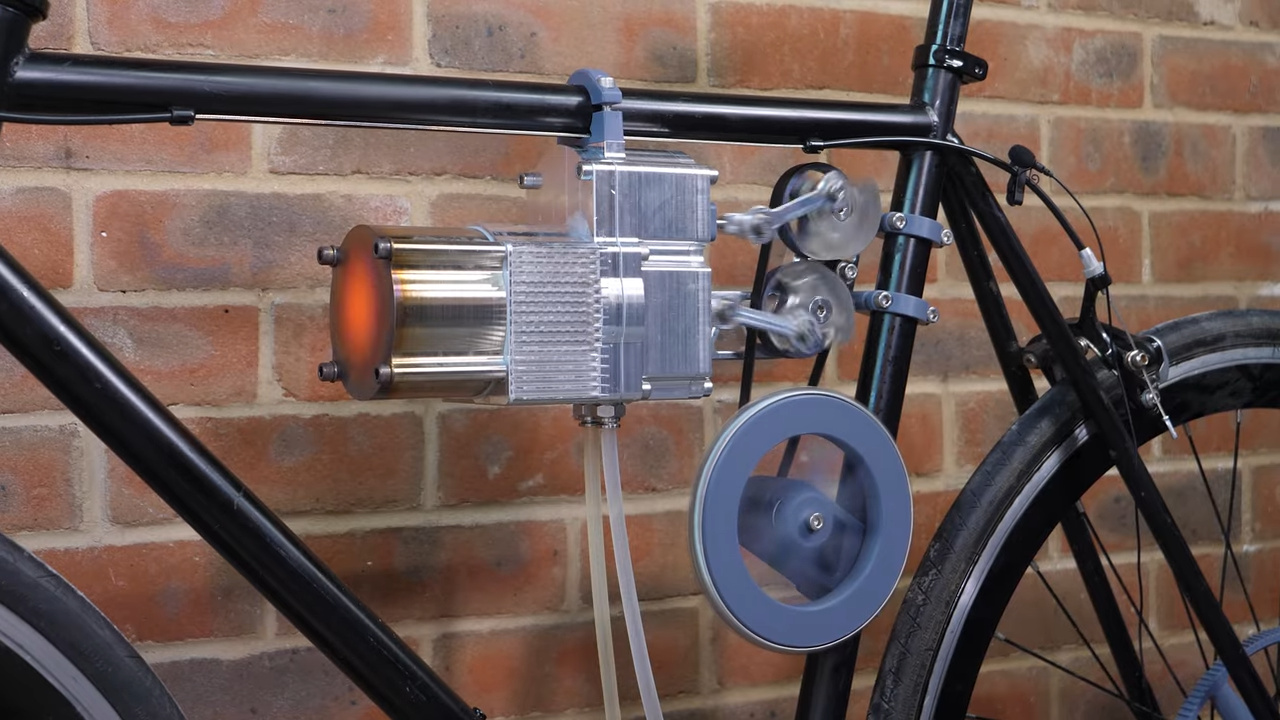


YouTuber transforms bicycle into vehicle with 150 W Stirling engine, using heat and air as “fuel” in a real home engineering experiment.
In 2025, aerospace engineer and content creator Tom Stanton brought a rare mechanical experiment to a common bicycle: adapting a homemade Stirling engine to try and generate real movement using heat, expansion, and contraction of air in a closed system. The project was documented on his YouTube channel, in the videos Building a Stirling Engine Bike Part 1 and Building a Stirling Engine Bike Part 2, and reported by Hackaday on July 17, 2025, which highlighted the central construction challenge: aiming for 150 watts of power, equivalent to about 0.2 hp, a level sufficient to try and move a bicycle at approximately 15 mph, or 24 km/h.
The proposal seems simple at first glance, but it exposes an engineering much more complex than the idea of a “heat-powered engine” suggests. Unlike an internal combustion engine, the Stirling engine does not rely on explosions inside the cylinder or direct burning of gasoline or diesel in an internal chamber; it operates from an external heat source and the movement of a working fluid, such as air, between hot and cold zones.
In Stanton’s case, according to Hackaday, the project involved machined parts, 3D printed components, aluminum, Teflon, water cooling, and a steel hot chamber manufactured by third parties, showing that transforming a common bicycle into a functional thermal prototype requires control of friction, sealing, temperature, and mechanical losses.
-
World Cup Ball Chip Uses Technology to Detect Invisible Touches, Confirms Offside, Secures Portugal’s Victory Over Croatia

-
36-Meter Hydrogen-Powered Superyacht Arrives in Brazil to Debut German Engines and Showcase Future of Clean Navigation

-
Indian Students from Jaipur Win Top Prize at World’s Largest Science Fair with EcoFog, an Affordable Mesh to Harvest Fog Water Without Energy

-
Italy Sinks Massive 11-Story Concrete Structures in the Ligurian Sea to Create a 6.2 km Barrier, Clearing the Way for 400-Meter Ships in Genoa



Stanton’s goal was direct and measurable: to achieve enough power to propel the bicycle at a moderate speed, close to 24 km/h, without resorting to the traditional internal combustion setup.
How a Stirling engine works and why it attracts attention outside traditional industry
The Stirling engine is one of the oldest concepts in thermal engineering, having been invented in the 19th century. Unlike internal combustion engines, it does not rely on the direct burning of fuel inside cylinders. Instead, it works with a gas, usually air, helium, or hydrogen, which is cyclically heated and cooled.

This process creates pressure variations within the system, which are converted into mechanical movement through pistons or equivalent mechanisms. In technical terms, it is an external combustion engine, as the heat source is not inside the cylinder.
Interest in this type of engine has never completely disappeared, but it is rarely used in large-scale commercial applications due to practical limitations, such as low power density and the need for precise thermal control. However, in experimental environments, such as makerspaces and independent laboratories, it becomes extremely attractive.

In the case of Stanton’s project, the Stirling engine was chosen precisely because it allows for an alternative approach: generating movement without relying on gasoline, diesel, or batteries, something that reinforces the technical and conceptual appeal of the experiment.
The real challenge was not building the engine, but achieving useful power of 150 W
One of the most critical points of the project was not just making the engine work, but achieving a level of power that had practical utility. Generating movement is relatively easy on an experimental scale, but producing enough energy to move a person on a bicycle is a completely different challenge.


The 150-watt goal was not chosen by chance. This value corresponds approximately to the average power a human cyclist can sustain for prolonged periods. In other words, for the bicycle to move autonomously, the motor would need to replace, even if partially, human effort.
To achieve this goal, Stanton had to deal with multiple factors simultaneously. The thermal efficiency of the engine needed to be maximized, which implies minimizing heat loss. The mechanical system needed to have the least possible friction, as any additional resistance could completely compromise performance.
Furthermore, the engine’s design required precision in construction. Small imperfections in sealing, alignment, or materials could result in internal pressure loss, drastically reducing its power generation capacity.
Garage engineering with industrial precision level
Despite being a home project, the level of engineering involved is far from improvised in a simplistic sense. Stanton used advanced manufacturing techniques, including machining metal parts and using components specifically designed to withstand thermal and mechanical variations.
The engine needed to maintain a stable thermal cycle, with well-defined hot and cold regions. This required not only a consistent heat source but also an efficient thermal dissipation system.

Another relevant point was the transmission of power from the engine to the bicycle wheel. This mechanical coupling needs to be efficient to avoid losses, which involves the appropriate choice of gears, belts, or direct drive systems.
The project demonstrates that the difference between a curious idea and a functional application lies in technical execution, especially when it comes to transforming physical principles into real, usable motion.
24 km/h speed is not a random number, but a functional milestone
The goal of approximately 24 km/h has important practical significance. This speed represents an efficient urban commuting standard, comparable to that of everyday cyclists.
Achieving this level means that the system is not just a static or demonstrative experiment, but a prototype with real application potential, even if still in an early stage.

It is important to note that, according to the available project data, the engine was designed with this objective, but not all real-use conditions guarantee constant performance at this level, as factors such as thermal stability, load, and efficiency vary over time.
This reinforces an essential point: it is a technical experiment with clear goals, but not a final product ready for commercial use.
What this type of invention reveals about the advancement of independent engineering
Projects like this show a growing trend: the ability of individuals or small groups to develop complex technical solutions outside traditional industrial environments.
Access to manufacturing tools, such as 3D printers and CNC machines, combined with the availability of technical information, allows independent inventors to advance in areas that were previously restricted to large companies or institutions.
However, this does not mean that these inventions immediately replace consolidated technologies. Instead, they function as decentralized experimental laboratories, where ideas can be tested, refined, and eventually inspire larger applications.
In the specific case of the Stirling engine applied to a bicycle, the value lies not only in the final result but in the development process, the challenges overcome, and the possibilities that open up from this experience.
Practical limitations prevent immediate large-scale application, but do not reduce technical relevance
Despite the visual and conceptual impact of the project, there are clear limitations that prevent its large-scale adoption in its current state. The need for thermal control, low power density, and construction complexity are factors that hinder mass replication.
Furthermore, the overall efficiency of the system is still below alternatives such as electric motors powered by modern batteries.
This does not invalidate the project. On the contrary, it reinforces its role as a frontier experiment, exploring alternative paths and demonstrating what is technically possible outside traditional standards.
The history of engineering is full of examples where initially experimental solutions evolved over time to become commercially viable.
Given this, the direct question remains: does this type of garage engineering represent merely technical curiosity, or can it, with evolution and refinement, open space for new forms of mobility in the future?