






 Portuguese
  Spanish


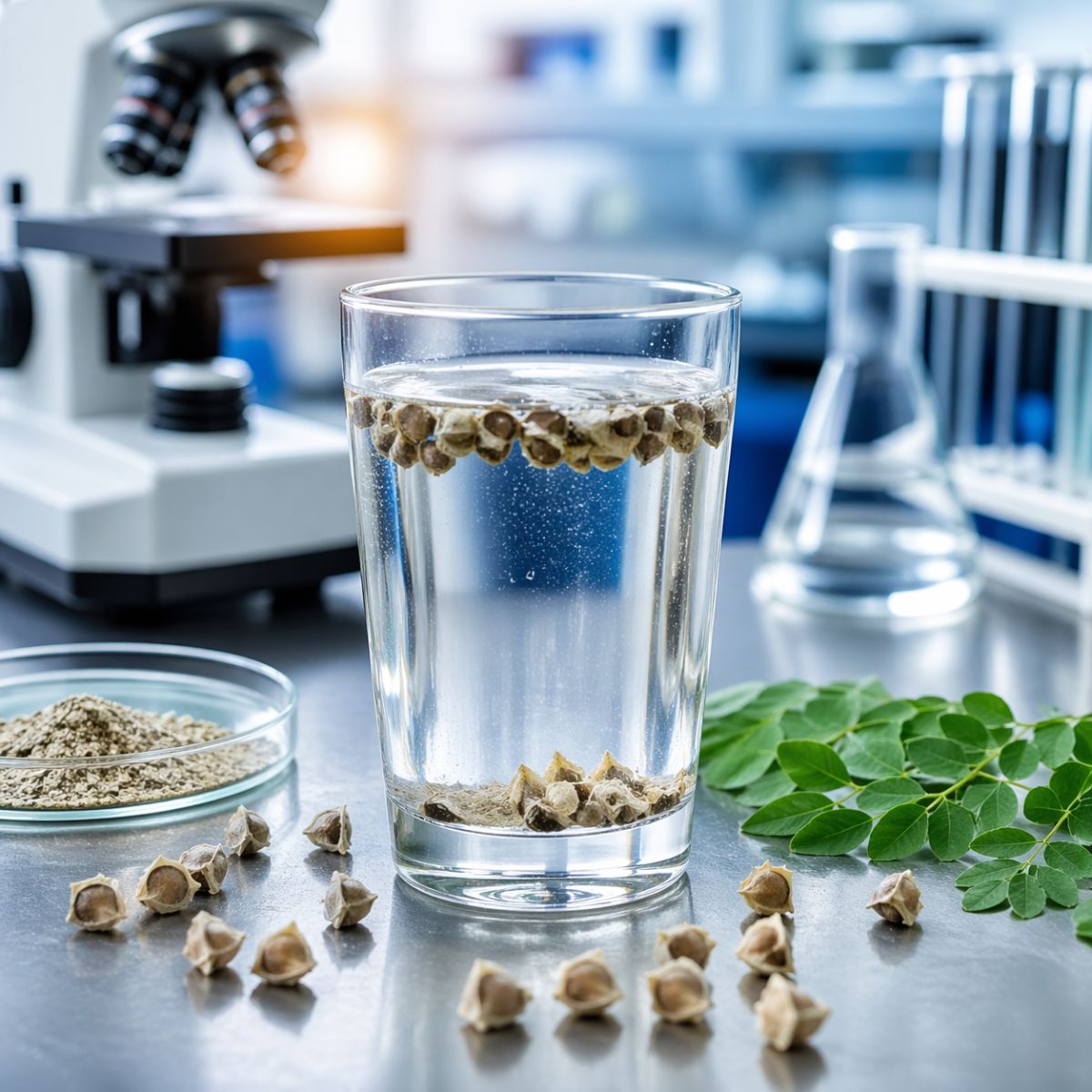

UNESP research shows how moringa seeds remove microplastics from drinking water with a sustainable solution created by Brazilian scientists.
Brazilian science has taken an important step in tackling water pollution. Research conducted by Brazilian scientists from São Paulo State University (UNESP) revealed that moringa seeds can remove microplastic particles from drinking water naturally and efficiently.
The study, published in the ACS Omega journal and reported by ScienceDaily, indicates that the plant’s saline extract acts as a coagulant capable of grouping microscopic particles, facilitating their removal. Most importantly, this process avoids the use of aggressive chemical substances, paving the way for more sustainable solutions in water treatment.
Brazilian scientists from UNESP reveal natural alternative against microplastics in drinking water
The research was conducted by Brazilian scientists at UNESP’s Institute of Science and Technology, located in São José dos Campos. The objective was to evaluate whether moringa seeds could replace traditional chemical coagulants in removing microplastics from drinking water.
-
World’s Most Powerful MRI Machine in France, Weighing 132 Tons and Generating 11.7 Tesla Magnetic Field, Offers Unprecedented Clarity of the Human Brain

-
Hong Kong Converts Former Coastal Landfill into Desalination Plant Producing 135 Million Liters of Drinking Water Daily
-
Texas Teens Win $50,000 at World’s Largest Science Fair for Developing Non-Surgical Brain-Controlled Bionic Prosthesis with 98% Accuracy
-
Samsung Galaxy A27 Launches with 6.7-inch Super AMOLED Display, Full HD+ Resolution, Android 16, Six Years of Updates, Snapdragon 6 Gen 3, and Dust and Splash Resistance; Available for Pre-order in the US for $350


In the experiments, researchers used tap water artificially contaminated with polyvinyl chloride particles, known as PVC. To simulate real conditions, this material was exposed to ultraviolet radiation, reproducing the natural aging that occurs in rivers and lakes.
The results were surprising: the performance of the plant extract was comparable to that of aluminum sulfate, widely used in treatment plants. In waters with more alkaline characteristics, the natural method even showed superior performance.

How moringa seeds act in the removal of microplastics from drinking water
The functioning of moringa seeds involves a relatively simple but highly efficient mechanism. According to Brazilian scientists from UNESP, the extract obtained from the plant has the ability to neutralize the negative electrical charges present in microplastic particles in drinking water.
This process promotes the formation of larger flocs, facilitating removal by conventional filtration. In practice, this means that existing systems can be adapted without major structural changes.
Researcher Gabrielle Batista, linked to UNESP’s Civil and Environmental Engineering postgraduate program, contributed directly to conducting the tests. Professor Adriano Gonçalves dos Reis coordinated the project, with support from the São Paulo Research Foundation (FAPESP).
Proven efficiency in the laboratory puts UNESP in scientific prominence
To validate the results, researchers used advanced analysis techniques, including scanning electron microscopy and laser diffraction measurements. These methodologies confirmed the effective removal of microplastic particles from drinking water after using moringa seeds.
The tests showed efficiency levels similar to those obtained with traditional chemical coagulants. This data reinforces the potential of the natural solution as a viable alternative in different contexts.
Among the main points observed during the experiments, the following stand out:
- Significant reduction in the presence of microplastics
- Efficient floc formation for filtration
- Consistent performance in different water conditions
- Direct comparability with consolidated chemical methods
Why moringa seeds are seen as a sustainable solution
One of the biggest advantages of moringa seeds is their reduced environmental impact. Unlike conventional coagulants, such as those based on aluminum and iron, the natural method does not generate persistent toxic waste.
The Brazilian scientists involved in the study warn that chemical substances used in water treatment may not be biodegradable and, in some cases, can leave unwanted traces in the environment.
Moringa, on the other hand, is a plant widely found in tropical regions, and its seeds are already used in human food, which reinforces its safety. This factor expands the possibilities for large-scale application, especially in countries with limited resources.
Use of moringa seeds can contribute to access to drinking water
The discovery opens space for more accessible solutions in drinking water treatment, especially in rural communities or regions with limited infrastructure.
According to Brazilian scientists, the use of moringa seeds can be adapted for simple systems, allowing families to access water with less microplastic without relying on expensive technologies.
Among the possible practical applications are:
- Domestic use in small communities
- Simplified treatment systems in rural areas
- Complement to conventional treatment plants
- Low-cost alternative for developing countries
This versatility makes the solution especially relevant in a global scenario where millions of people still face difficulties in accessing quality water.
Tests with water from the Paraíba do Sul river reinforce effectiveness in real conditions
After positive laboratory results, the UNESP team moved on to real-world tests. Water samples were collected directly from the Paraíba do Sul river, an important water supply source for the region.
Even in a more complex environment, with the presence of organic matter and different types of contaminants, moringa seeds maintained their ability to remove microplastic from drinking water.
This advance is essential to validate the practical application of the technology outside the controlled laboratory environment.
Technical limitations still challenge Brazilian scientists
Despite the promising potential, Brazilian scientists recognize that there are still challenges to be overcome. The main one is the increase in dissolved organic matter after using the moringa seed extract.
This effect may require additional treatment steps, which could impact costs in industrial applications. Nevertheless, researchers continue to work to optimize the process and reduce these limitations.
The expectation is that, with new adjustments, the technology can become even more efficient and competitive compared to traditional methods.
Microplastic in drinking water concerns Brazilian scientists and specialists
The presence of microplastic in drinking water is a growing problem on a global scale. These particles have already been identified in different water sources, including urban supply and bottled water.
Although the impacts on human health are still being investigated, specialists point out potential risks related to the continuous ingestion of these particles.
In this context, initiatives like the one developed by Brazilian scientists at UNESP stand out for offering a practical, sustainable solution based on natural resources.
A sustainable path born from Brazilian research
The discovery involving moringa seeds represents more than a scientific advance. It shows that simple, nature-based solutions can tackle complex problems like microplastic contamination in drinking water.
With the support of UNESP and FAPESP, Brazil reinforces its role in producing relevant knowledge for the world. Although challenges exist, the results obtained so far indicate a promising path.
By combining efficiency, low cost, and sustainability, this technology has the potential to transform access to clean water in different regions of the planet.


