Portuguese
  Spanish


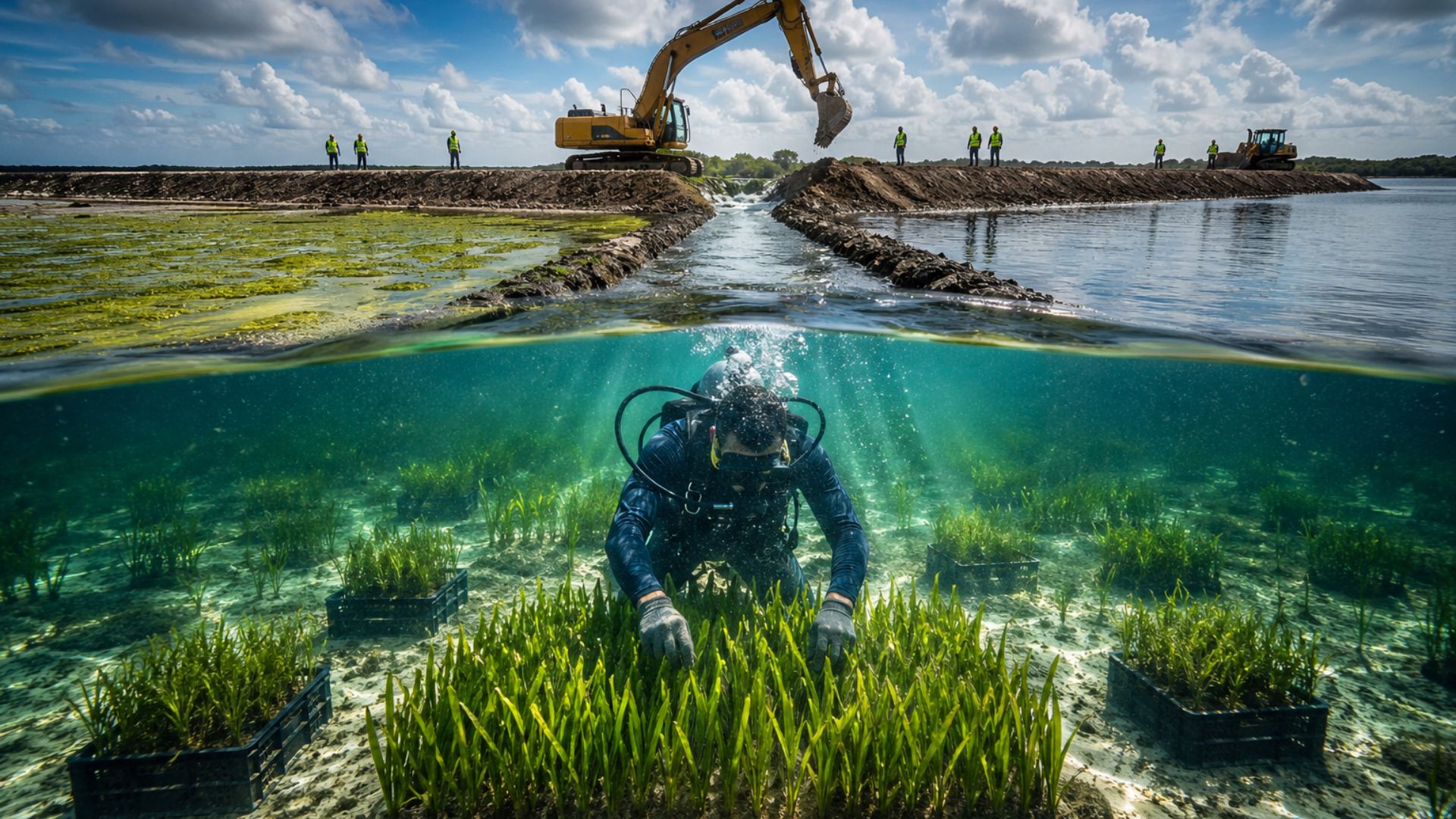

Large-scale environmental recovery attempts to reverse loss of submerged vegetation and restore natural water functions in Florida’s coastal lagoon, with direct impact on environmental quality, sediment control, and flood reduction.
On Florida’s east coast, a new phase of Indian River Lagoon restoration combines two simultaneous fronts to recover lost environmental functions: the replanting of 23 acres of seagrass and the reconnection of wetlands previously isolated by dikes.
According to NOAA, the U.S. oceanic and atmospheric agency, the project aims to improve water quality, stabilize sediments, and enhance natural flood protection in communities near the estuary.
Loss of submerged vegetation raised environmental alert
Over the last decade, the lagoon has faced a continuous degradation process that significantly altered its ecological balance and compromised natural functions essential for maintaining water quality and local biodiversity.
-
Brazilian Designers Turn Urban Waste into Vegan Fashion, Diverting Nearly 1 Ton of Waste and Earning $2.2 Million in 2024

-
Farmer Discovers Rare Roman Mosaic in England, Unveiling Scenes from the Trojan War and Transforming British Archaeology After Decades of Mystery

-
Low-Cost Concrete Panel House Goes Viral: Investor Reveals Prefabricated Kit Structure for Around $1,500, Assembled in 30 Days, with Plans for Rental and Resale Income
-
Brazilian Lottery Winner Ordered by Court to Share $22 Million Jackpot with Ex-Partner, Sparking Major Legal Battle



Between 2011 and 2020, a sequence of severe algal blooms eliminated nearly 75% of the lagoon’s seagrass, a submerged cover essential for keeping the water clearer and sustaining habitats used by fish and other species.
Seagrass planting focuses on strategic areas of the lagoon
Within this scenario, the most visible front of the work focuses on Big Slough, near Sebastian Inlet, and Preacher’s Hole, near Wabasso Causeway, areas considered most favorable for initial recovery.

At these points, Indian River County teams and partners planted approximately 13 acres and 10 acres of seagrass, respectively, resuming vegetation cover in locations where this type of vegetation historically existed.
In addition to the environmental history, the choice considered the degree of natural protection against currents, a factor that reduces physical impact on seedlings and increases the chances of sediment fixation during the first months.
This type of vegetation plays a direct role in the lagoon’s dynamics by trapping particles at the bottom, reducing turbidity, and facilitating light entry, an indispensable condition for the recovery of the submerged ecosystem itself.
Without the presence of seagrass, sediments remain in suspension more easily, which compromises water transparency and hinders the natural regeneration of plant and animal species.
Protection and maintenance structures ensure initial survival
Despite the progress of planting, the operation requires constant monitoring and adaptations according to the depth and access characteristics at each selected point within the lagoon.
In shallow areas, the work can be carried out directly by teams on the bottom, while deeper regions require coordination between surface professionals and divers responsible for installing the seedlings.
To reduce initial losses, metal structures were positioned over the newly planted sections, creating a temporary barrier that protects the vegetation until it establishes itself more stably.
These devices can remain for up to a year, a period considered sufficient for the plants to develop roots and remain anchored even in the face of variations in water conditions.
Throughout this interval, teams regularly return to the restored sites to remove encrustations that block light passage, ensuring adequate conditions for the growth of submerged vegetation.
Wetland reconnection changes water dynamics

Parallel to the planting, another front of the project addresses old modifications imposed on Florida’s coast, which altered the hydrological functioning of the Indian River Lagoon over decades.
Historically, coastal wetlands were isolated by dikes built for mosquito control, which interrupted the natural flow of water and reduced these environments’ ability to act as natural filters.
With NOAA funding, the St. Johns River Water Management District reconnected approximately 2,000 acres of wetlands in the complex formed by the Kennedy Space Center and the Merritt Island National Wildlife Refuge.
In practice, the process involves reducing the height of dikes to the appropriate ground level and filling previously opened ditches, allowing water to circulate more naturally again.
With this reconnection, sediments and nutrients are retained by wetland vegetation before reaching the lagoon, reducing pressure on the estuary and contributing to improved water quality.
Furthermore, the system recovers part of its capacity to absorb larger volumes of water during flood periods, which can reduce impacts associated with floods in nearby regions.
Technology reduces costs and expands restoration scale
During the execution of the works, the use of GPS-guided equipment brought significant operational gains by making ground leveling more precise and continuous throughout the restored areas.
Previously, operators had to interrupt work multiple times to measure elevation with conventional instruments, which increased execution time and associated costs.
With the adoption of this technology, the estimated cost dropped from approximately 20 dollars to about 6 dollars per linear foot of dike removed, increasing the project’s economic viability.


This reduction allowed for planning the expansion of interventions to other areas within the same environmental complex, increasing the scale of restoration.
Environmental benefits and impact on coastal communities
The expected gains go beyond the visual recovery of the lagoon and include direct effects on essential environmental services for system balance and the safety of nearby urbanized areas.
According to the economic analysis cited by NOAA, reconnected wetlands can generate approximately 78 thousand dollars per acre per year in environmental benefits, with a cost-benefit ratio close to 60 to 1.
These effects include improved water quality through natural filtration, support for aquatic species habitats, and protection of homes and infrastructure against flood events.
Part of a 156-mile estuarine system, the Indian River Lagoon is surrounded by urban areas, conservation units, and economic activities related to tourism and fishing.
In this context, environmental recovery is also directly related to the maintenance of economic activities and the quality of life of local populations.
Among the projects funded by NOAA, the effort integrates 15 restoration projects in different habitats, including seagrass beds, oyster reefs, mangroves, and natural shorelines.
While it does not solely solve all the estuary’s problems, the reestablishment of submerged vegetation and the reconnection of wetlands restore natural processes that had been interrupted, contributing to the system’s gradual recovery.