






 Portuguese
  Spanish


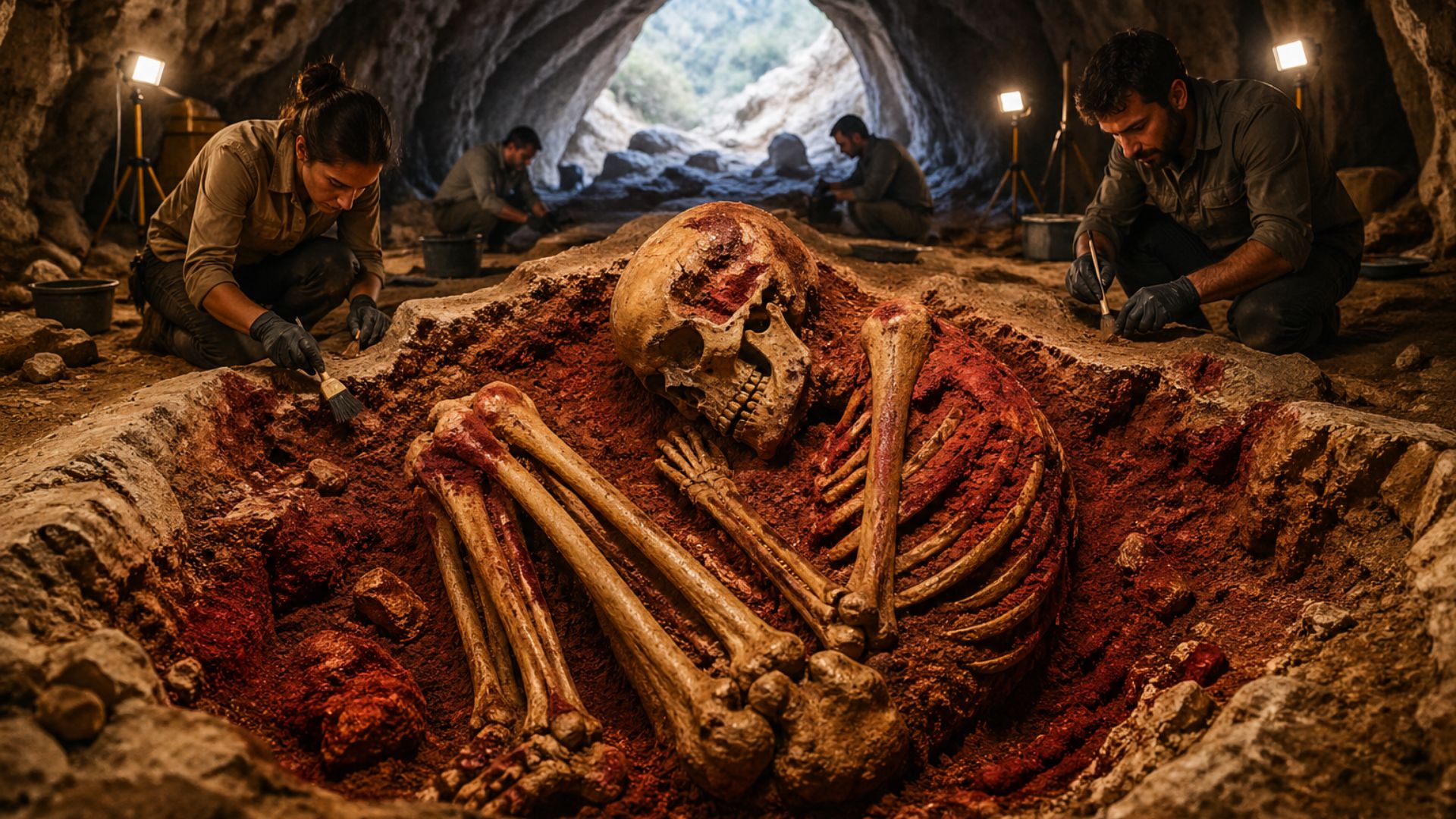

Discovery in Israeli cave reveals highly organized human burials from approximately 100,000 years ago, including the use of pigments, repeated body patterns, and evidence of structured funerary practices, expanding understanding of symbolic and social behavior of prehistoric populations in the Levant.
A cave located in central Israel has preserved human burials dating back approximately 100,000 to 110,000 years, with bodies positioned in graves and accompanied by materials indicating organized funerary practices during the Middle Paleolithic period.
Known as the Tinshemet cave, the area contains the remains of at least five individuals, including two nearly complete skeletons and three skulls in different states of preservation, which expands the possibility of detailed analysis of the archaeological context.
Researchers are struck by the repetition of a pattern in the arrangement of the bodies, suggesting that the burials followed specific procedures, rather than occurring randomly or as a result of natural processes within the cavity.
-
Bruno Guimarães, 28, Misses Crucial Penalty Against Norway in World Cup After Replacing Vinicius Jr.

-
Inspired by a school lesson on Africa’s water crisis, a young boy raised money through chores to fund a well that transformed a Ugandan community.

-
Brazilian Construction Worker Moves to France, Earns Up to €2,500 Monthly with Home Renovations, Gains Social Media Attention

-
US Navy Sinks USS Oriskany with 230 kg of C-4, Creating World’s Largest Artificial Reef in 37 Minutes





According to a study published in 2025 in the journal Nature Human Behaviour, adults and children were buried on their sides, with legs strongly flexed, arms turned towards the chest, and faces tilted downwards, indicating a recurring pattern.

Furthermore, the partial preservation of the joints reinforces the hypothesis that the bodies were deposited shortly after death, ruling out the possibility of casual accumulation of human remains over time within the cave.
Middle Paleolithic burial patterns
More than the presence of ancient bones, what differentiates the site is the organization of the remains, which appear in defined graves, with repeated body positions and clear signs of intentional deposition over time.
This set of evidence allows Tinshemet to be classified as one of the most relevant records of funerary practices in the Levant, a region that has already revealed other ancient burials, but rarely with this level of preservation and repetition of patterns.
Although sites like Skhul and Qafzeh have already provided important data, the new finding stands out for the combination of multiple burials, associated materials, and preserved context, which allows for a more comprehensive understanding of human practices.
The scientific relevance lies precisely in the convergence of these evidences, which, analyzed together, help to reconstruct social behaviors linked to the treatment of the dead in very ancient periods of human history.
Based on the analysis of lithic artifacts and dating methods, researchers situated the occupation of the cave between approximately 130,000 and 80,000 years ago, with some of the burials concentrated between 110,000 and 100,000 years ago.
Use of ochre in ancient funerary rituals

Among the most significant elements found during the excavations, ochre stands out for its quantity and direct association with the burials, indicating a possible symbolic role in the funerary practices of these human groups.
Thousands of fragments of the pigment were identified, mainly in red and orange tones, distributed more intensely in the layers where the burials were located, reinforcing this contextual relationship.
In one of the analyzed cases, a block of ochre was found among the leg bones of an individual, evidence that strengthens the interpretation that the material was part of the funerary ritual.
This direct proximity reinforced the interpretation that the material was part of the funerary context.
Furthermore, analyses indicate that part of this ochre may have been obtained from areas distant from the cave, implying displacement and planning for its collection, increasing its relevance within this context.
When materials are consistently transported and associated with the dead, they begin to indicate recognized social practices, possibly shared among different group members.
Alongside the pigment, lithic artifacts, basalt stones, and animal remains were also recorded, elements that help compose the archaeological scenario and offer additional clues about the use of the space.
Social organization and symbolic behavior
The interpretation of the site goes beyond its function as a natural shelter, as the organization of the burials suggests a structured social use, linked to collective practices related to death and the memory of individuals.
The organization of the burials suggests a social function linked to shared practices surrounding death.
This understanding is supported by the repetition of funerary gestures, with bodies positioned similarly and accompanied by specific elements, indicating a recognizable procedure possibly transmitted across generations.


There is still no definitive consensus on the identification of the human groups responsible for the burials, with hypotheses including Homo sapiens, Neanderthals, or other populations present in the region during the Middle Paleolithic.
Nevertheless, the importance of the site does not depend on this definition, as the body of evidence reveals complex behaviors shared among ancient human groups inhabiting the Levant.
Rare archaeological preservation in a cave
The quality of preservation is one of the factors that most contribute to Tinshemet’s scientific value, as natural processes frequently compromise the integrity of archaeological sites over thousands of years.
In many cases, water, erosion, animal activity, and later interventions alter the original position of remains, making it difficult to accurately interpret the human practices recorded at these sites.
In the studied cave, however, the arrangement of the bodies and their association with materials were maintained sufficiently clearly, allowing for a detailed analysis of the original context of the burials.
This level of preservation is uncommon in such ancient records.
Excavations are ongoing and indicate that new layers may yet reveal more evidence, expanding knowledge about the relationships between burials, pigment use, and the dynamics of human groups in the region.
Thus, Tinshemet consolidates itself as one of the main sites for the study of the first cemeteries and the symbolic practices associated with death throughout human prehistory.





