





 Portuguese
  English
  Spanish
  4 min of reading
  0 comments


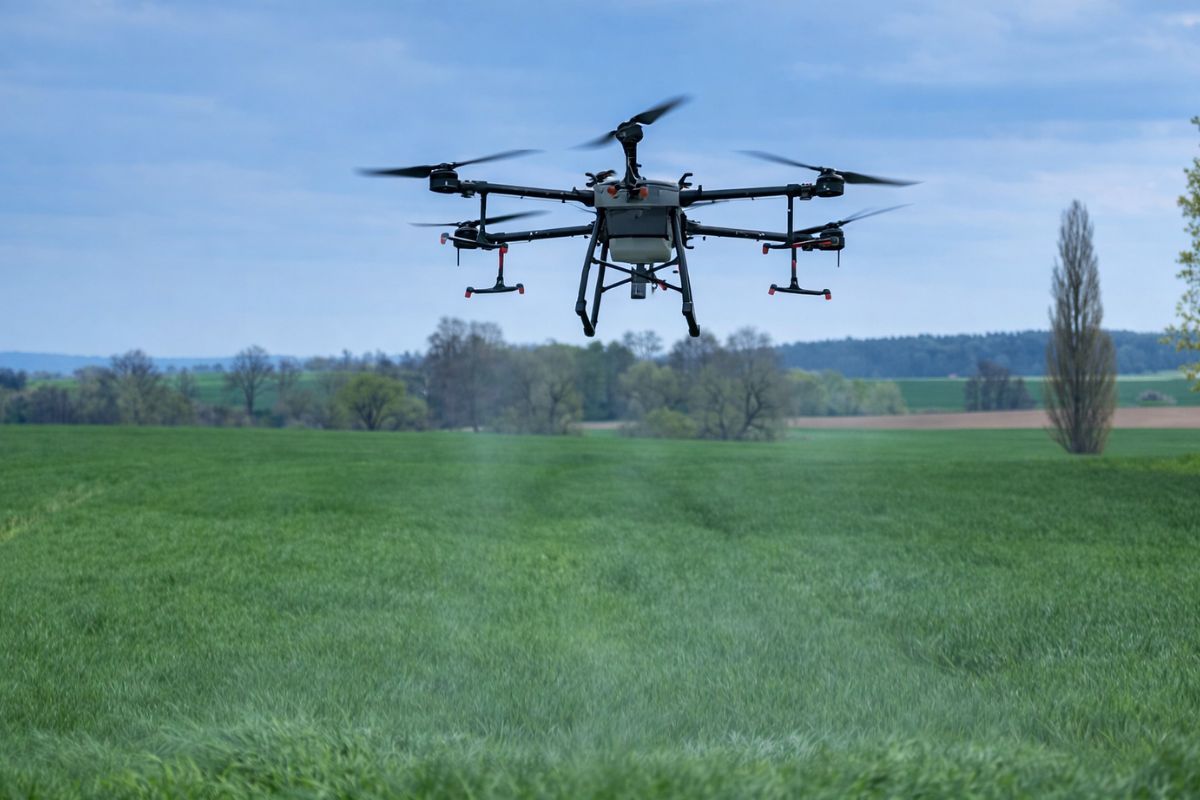
Agricultural drones reduce waste, prevent compaction, and speed up spraying, but require a complete kit with extra batteries, recharging logistics, and care with wind and obstacles to avoid losses in the crop
Agricultural drones have ceased to be a curiosity and have become a work tool in many regions of Brazil. In the video from the YouTube channel Naturando, the technology appears as a way to gain localized application, less waste, and more safety, as the operator tends to be less exposed to direct contact with chemical products.
However, the same content gives a clear warning: it is not equipment to buy on impulse. Agricultural drones can require an investment that reaches R$ 300,000, in addition to training, flight planning, extra batteries, and a maintenance routine. A simple mistake, such as strong wind, an electric wire, or poorly managed batteries, can end with the equipment on the ground and the operation halted.
What agricultural drones are already delivering in practice
According to the Naturando channel, there are models that can cover 200 to 500 hectares per day under favorable conditions. The gain is not just speed, but also precision: localized application, less drift, and greater coverage, which helps save inputs and reduce waste.
-
Fishing prohibited! Government announces end of trawling, sets deadline for boats to return, and raises alert about record limit of 5,216 tons of mullet in Brazil

-
At 94 years old, Seu Luiz still takes hold of the hoe, tends to the vineyards, and makes his own wine in the countryside, and he assures that staying idle indoors is precisely what tires him the most.
-
Will China ‘hit the brakes’ on soybean and meat purchases from Brazil? Understand the movement and learn what experts say after a projected cut of 23.5 million tons, despite the $50 billion annually generated by Brazilian agribusiness.
-
Scientists from Russia and Egypt have proven that the aquatic fern is capable of cleaning soils contaminated by heavy metals and even boosting rice cultivation, which yielded almost 64% more in tests.



The video also emphasizes the safety aspect: when spraying is done by agricultural drones, the work tends to occur with less exposure of the operator to chemical products compared to more manual methods.
Where they make more difference than tractor and backpack sprayer
In the Naturando content, agricultural drones appear as a solution mainly in situations where the tractor struggles: hills, mud, tall crops, and periods right after rain, when the soil is still wet and the risk of getting stuck or compacting the ground increases.
Another strong point mentioned is compaction. The video highlights 0% compaction, because the equipment leaves no trace in the crop.
It also mentions the vortex of the propellers, which can help the application penetrate better into the crop, in addition to the practicality in transport, as the drone fits in the bed of a pickup truck.
How much it costs and why the “drone price” is not the real price
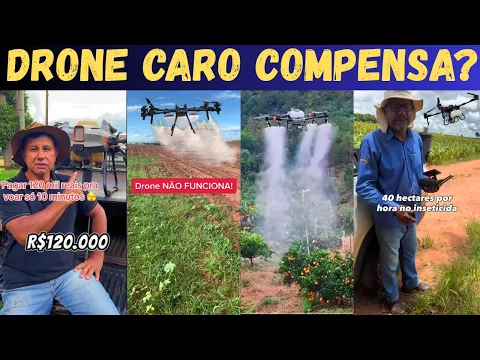

Naturando shows that the cost varies greatly depending on capacity, battery kit, and charger. Among the examples mentioned in the video:
DJI T25, capacity 20 L, between R$ 60 thousand and R$ 120 thousand depending on the kit
DJI T50, capacity 40 L, flight time of 10 to 15 minutes per flight, between R$ 120 thousand and R$ 150 thousand
DJI T100, capacity 50 to 70 L, estimated between R$ 150 thousand and R$ 300 thousand
Chag PC Pro, capacity 40 to 60 L, between R$ 200 thousand and R$ 280 thousand
New Holland P150, capacity 70 L, quoted at R$ 300 thousand
AGO H30, capacity 30 L, between R$ 100 thousand and R$ 150 thousand
King 100, capacity 40 to 70 L, between R$ 180 thousand and R$ 250 thousand, with the claim of spraying up to 500 hectares in a day
The message is that agricultural drones almost always require a complete package: extra batteries, charging, field logistics, and infrastructure for recharging. Therefore, the “showroom” price does not always represent the actual cost of operating well.
Batteries, recharging, and operational pace in the field
The Naturando channel emphasizes the most practical limitation of day-to-day use: battery. The video mentions short flights, with examples like “8 minutes in the air” on one model, and also a DJI T10 with about “10 minutes flying,” even with fast recharging and several batteries in the kit.
In practice, this becomes logistics: extra batteries, a recharging station in the field, and supply organization. There’s also the tip to work earlier and at the end of the day due to temperature, and even nighttime spraying in some scenarios.
What brings down drones and how to reduce the risk
In the Naturando video, the warning is clear: many people buy drones thinking of them as tractors, and this often goes wrong. The causes of accidents mentioned include collisions with trees or power lines, strong winds, calibration failures, poorly managed batteries, and excess weight.
The result can be severe: total equipment failure, high losses, and interruption of operations. To reduce risk, the channel recommends flight planning, avoiding strong winds, always calibrating sensors, keeping a distance from obstacles, and taking battery management seriously.
Maintenance and care after application
Naturando also reminds us that it’s not just about flying. There’s a maintenance routine: cleaning after use without using chemical products, periodic reviews, preference for original parts, and specialized maintenance when necessary.
This contributes to the total cost and the reliability of the equipment over time, especially for those who work frequently.
When it makes sense to invest and when it doesn’t replace everything
The video summarizes well: the drone does not replace everything, but in many situations it becomes the best tool. It appears as a solution for rainy periods, to reduce bruising, for localized application, and for difficult areas.
There is also the possibility of increasing returns by providing services to third parties and using it in higher value crops, combining with precision agriculture.
If it were on your property, what would weigh more in the decision: being able to apply right after the rain, cutting losses due to bruising, or gaining precision to reduce input waste?




Be the first to react!