Portuguese
  Spanish


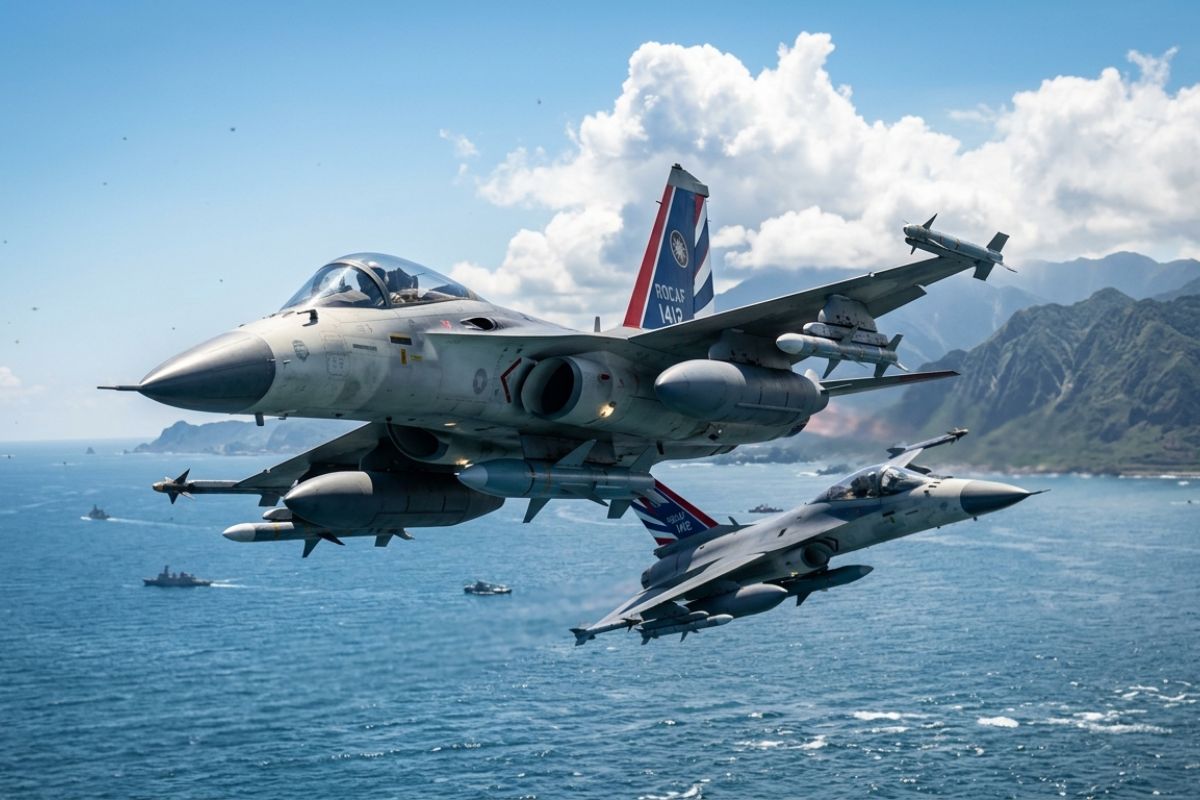

The indigenous fighter F-CK-1 emerged in Taiwan when the F-16 was out of reach and became an air defense piece in the strait, with Mach 1.8, a 150 km radar, and BVR missiles.
Taiwan went through a moment when it was practically isolated and without access to the most modern fighters from the West. And, when the purchase of the F-16 did not advance, the island was pushed into a decision that was not exactly “romantic”: either it created its own path, or it waited for authorization that might never come. It was from this pressure that the indigenous fighter F-CK-1 Tiengkuo was born, designed to react quickly in the Taiwan Strait, take off in a few minutes, and maintain active air defense even under pressure.
Over time, the F-CK-1 ceased to be just a project to “fill a gap.” It became a symbol of autonomy and resistance, because it was born precisely when Taiwan needed to prove that it could sustain its own readiness. And what sustains that readiness is not rhetoric, but operational capability, radar, armament, and rapid response.
The isolation that pushed Taiwan to forge its own path
After the Chinese civil war and the subsequent diplomatic changes, Taiwan saw the situation become more difficult. In 1979, the United States officially recognized Beijing as the only legitimate government of China, which led to the end of the mutual defense treaty with Taiwan.
-
New Brazilian Frigate Equipped with Advanced Missiles and Radars to Safeguard Strategic Maritime Areas

-
New Brazilian Frigate Equipped with Advanced Missiles and Radars to Protect Strategic Maritime Areas, Including the Blue Amazon and Pre-Salt Reserves
-
China Unveils Laser Weapon Capable of Instantly Neutralizing Military Drones, Marking a Significant Advancement in Air Defense Technology
-
U.S. Navy’s Ticonderoga-class Cruiser Becomes a 9,800-Ton Missile Fortress with Advanced Aegis System Capable of Tracking Hundreds of Targets



For the Taiwanese air force, this hit directly at the fleet. F-104 and F-5 were starting to become outdated, while combat aviation was evolving. The need was clear: a replacement with modern radar and real combat capability beyond visual range. The F-16 was the option that fit, but the sale was not approved at that time. That’s when the plan for an indigenous fighter became urgent.
From XF-6 to An Siang, the program that became the F-CK-1

In the late 1970s, the XF-6 program was born. In 1980, President Chiang Ching-kuo tasked AIDC with continuing development. Taiwan already had some industrial base because it produced the AT-3 trainer and manufactured the F-5 under license, but designing a fourth-generation fighter was a big leap.
On January 11, 1982, the United States again denied Taiwan’s request, and alternatives like the F-20 Tiger Shark and the Israeli Kfir fighter also did not advance. In July 1982, the so-called “six assurances” allowed for a limited transfer of technology, which was crucial for the program to gain formal structure.
The project was named An Siang, “safe flight,” and was divided into four fronts: fuselage, radar and avionics, weapons and missiles, and engine. Without a modern engine sold by the U.S., Taiwan needed to find its own way to make the indigenous fighter truly exist.
The F125 engine and the most difficult part of the project
The United States refused to sell engines like the F404 and F100, so Taiwan sought another solution and formed an industrial partnership that led to the creation of the International Turbine Engine Corporation, responsible for the F125 engine.
This matters because the engine is not a detail in a fighter. And, in the case of the F-CK-1, the choice was for two engines, seen as strategic to increase safety in case of failure and improve survival in combat.
The first flight, the delays, and the number that becomes “fleet”
The first flight of the F-CK-1 took place on May 28, 1989. The production of 10 pre-series aircraft began in 1990, with deliveries in 1992 and 1993. In 1994, the air force received the first production unit and the aircraft reached operational capability.
The program faced difficulties and production was halted in 1995 due to issues with the fuel management system. After corrections, manufacturing resumed in 1996 and continued until 1999. In total, 134 units were produced. This number is what transforms the indigenous fighter into a constant readiness asset, not just “a nice project” in a few units.
Mach 1.8, 150 km radar, and the logic of rapid response

The F-CK-1 was designed as a lightweight multirole fighter. The base specifies a maximum speed of Mach 1.8 and an operational ceiling of approximately 16,800 meters. The structure combines aluminum alloy with steel and titanium in specific areas and features air intakes designed to reduce radar signature.
A strong operational detail is the capability for alert takeoff and interception in up to 5 minutes. And the mentioned radar is the GD-53 Golden Dragon, multimode pulse Doppler, with aerial target detection at about 150 km, tracking up to 10 targets, and engaging two at the same time.
BVR and anti-ship: what changed with the upgrades
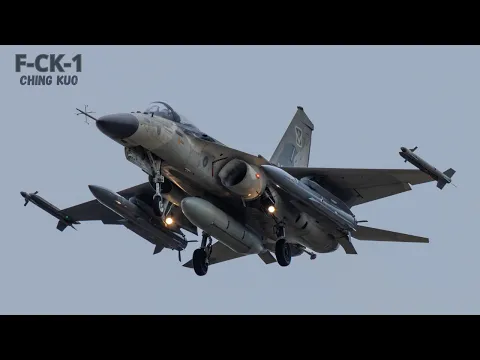

In the early 2000s, Taiwan decided to update its fleet in light of Chinese modernization. The base cites the capability to carry four medium-range air-to-air missiles with BVR capability, compared to two in previous versions, mounted under the fuselage in a semi-recessed position to reduce drag and signature.
For ground attack missions, a GPS-guided cruise missile appears with a cited range between 200 and 240 km. And in the anti-ship role, the text mentions the Hsiung Feng 2, with a range of about 160 km in the original version and up to 250 km in the latest variant, with the possibility of carrying up to three.
This is where the indigenous fighter stops being just an interceptor and becomes a piece to deny air and maritime space.
Why the indigenous fighter did not lose space even with imported fighters
Taiwan intended to acquire 256 units of the F-CK-1, but in 1992, with the authorization to sell F-16s and the approval of the Mirage 2000, that number was reduced. Still, the F-CK-1 continued to have a specific role.
The base is honest: it is not the most modern fighter in the region and does not have advanced stealth like fifth-generation fighters. Nevertheless, it maintains long-range engagement capability, has anti-ship strength, and can act as a saturation element in a defensive scenario, buying time in a confrontation where Taiwan would not be able to sustain a prolonged war on its own.
And now, without pretense: if you were a pilot or a defense planner there, would you trust more in buying a fighter when they are released or in keeping an indigenous fighter always ready to never depend on the mood of other countries?