Portuguese
  Spanish


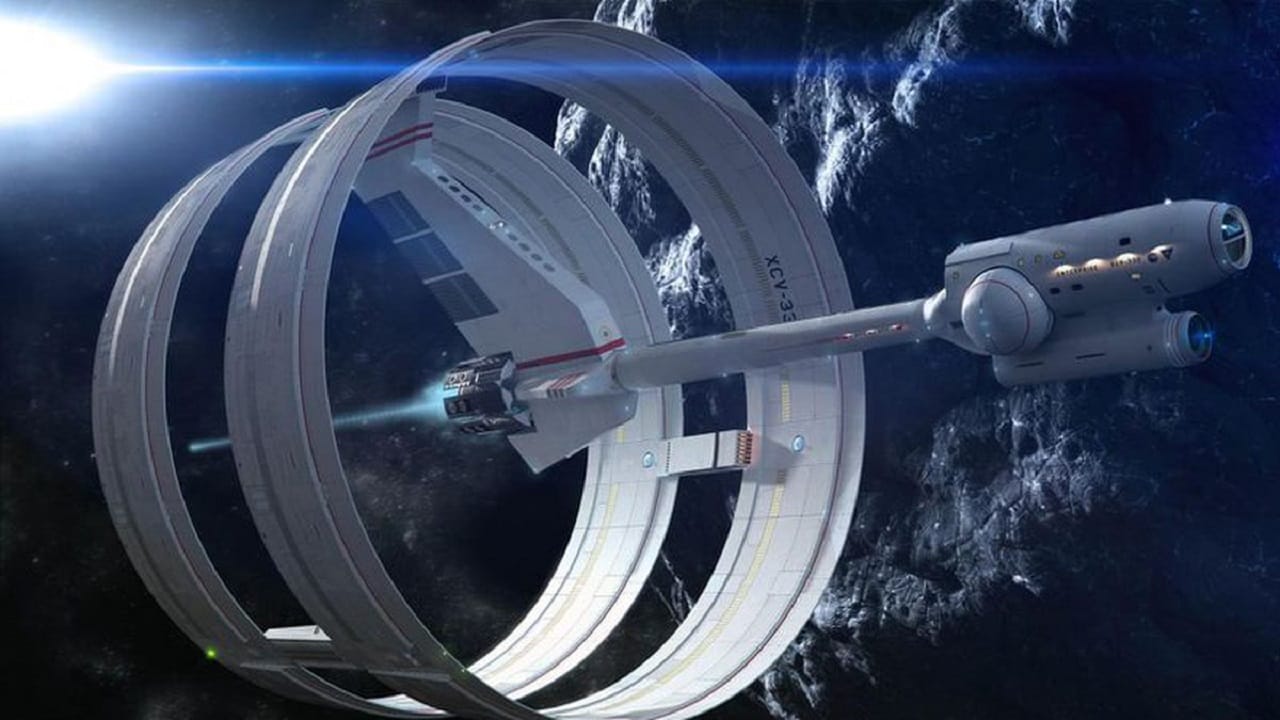


German Physicist Surprises Space Sector With Revolutionary Theory of New Warp Drive Engine, Bringing Concept Closer to Practical Reality.
Until recently, the idea of traveling faster than the speed of light was a concept reserved exclusively for science fiction movies. For humanity to realize the dream of exploring other parts of the galaxy, it would be necessary to achieve speeds previously unimaginable. The warp drive engine, a common element in science fiction, emerges as a potential solution to this challenge. However, this notion has ceased to be purely theoretical with the recent proposal by a German physicist, who presented an innovative design for a viable warp drive engine, bringing the concept one step closer to reality.
New Warp Drive Engine Operates Within the Laws of Physics

The physicist Dr. Erik Lentz outlined a way in which a rocket could, in theory, travel much faster than light, that is, over 300,000 kilometers per second. At this speed, astronauts could reach other stellar systems in just a few years, enabling humanity to colonize and explore distant planets. For example, current rocket technology would take around 6,300 years to reach Proxima Centauri, the closest star to our Sun, according to the NY Post.
So-called warp drive engines have been proposed before; however, they often rely on theoretical systems that break the laws of physics. This is because, according to Einstein’s general theory of relativity, it is physically impossible for any object with mass to travel faster than the speed of light. Dr. Lentz, a scientist at the University of Göttingen in Germany, claims that his new engine would operate within the limits of physics. While other theories rely on concepts like negative energy, he circumvents this problem by using a new theoretical particle.
-
Indian Inventor, 58, Develops Steering Wheel-Free Agricultural Machine Operated by Levers, Offering Cost-Effective Alternative to Expensive Tractors

-
Scientific Breakthrough: Bacteria Found in a Rio de Janeiro Lagoon Guide Mars Research After Scientists Identify Similarities to Extreme Environments, Expanding Understanding of Extraterrestrial Life Possibilities

-
Brazilian Mechanic Wins Indian Presidential Award for Inventing Fuel-Efficient Agricultural Machine

-
Brazilian Polilaminin Reaches 100 Spinal Cord Injury Patients Through Compassionate Use, Shows Progress After 6 Months, Highlighting UFRJ’s Role in Experimental Regeneration Research




Understand How It Works
A soliton, also known as a warp bubble, is a compact wave that acts like a particle while maintaining its shape and moves at a constant speed. These hyper-fast solitons can travel at any speed while obeying the laws of physics, according to a press release from the University of Göttingen. Dr. Lentz states that he developed the theory of the new warp drive engine after reviewing existing research and found gaps in previous studies of warp propulsion.
He believes that solitons can travel faster than light and develop conducting plasma and classical electromagnetic fields. Both concepts are understood by conventional physics and comply with Einstein’s theory of relativity. Despite its warp drive offering the tempting possibility of faster-than-light travel, it is still in the idea phase.
Challenges Found in the New Warp Drive Engine
The model will require an enormous amount of energy that is not currently obtainable with modern technology. According to Lentz, the energy economy would need to be enormous, approximately 30 orders of magnitude within the reach of modern nuclear fission reactors.
Fortunately, several energy-saving mechanisms have been proposed in previous research, potentially reducing the energy required by nearly 60 orders of magnitude. The astrophysicist claims that he is now focusing his efforts on developing a viable version of the technology.
Lentz asserts that this work on the new warp drive engine has shifted the problem of faster-than-light travel from theoretical physics research towards engineering. The next step is to figure out how to reduce the astronomical amount of energy needed to fit within the range of current technologies, such as a large modern nuclear fission plant. This way, it will be possible to talk about building the first prototypes.