






 Portuguese
  Spanish
  4 min of reading
  0 comments


The resistant structure of Arapaima gigas, studied by science and valued by fashion, transforms an old residue of Amazonian fishing into a noble raw material for sustainable leather, luxury pieces, and nature-inspired solutions
The skin of the pirarucu, once discarded after the meat was used, has found a new place in the sustainable fashion chain. The material, taken from one of the largest freshwater fish on the planet, has gained value by combining natural resistance, exclusive texture, and ecological potential.
Scientifically known as Arapaima gigas, the pirarucu lives in Amazonian rivers and has developed, over the course of evolution, an unusual dermal protection. This structure helps the fish resist severe attacks, including piranha bites.
According to scientific studies on the species, including research published in 2011 and later commented on by the University of California in San Diego, the strength of the skin lies in the combination of a mineralized outer layer and a flexible inner base, formed by collagen fibers.
-
Farmers in the USA refuse millions to not give up lands that carry a lifetime of work, while the data center rush targets farms in Australia and turns AI into a new pressure force on areas that still produce food.

-
Son of a farmer from a remote village who barely spoke English scores 98.2%, earns a full scholarship to Cornell, and moves India

-
The richest man on the planet has already sent cheese into space: SpaceX placed a wheel of Le Brouère inside the Dragon capsule, kept the cargo a secret, and turned a NASA test into one of the most unusual missions in history.
-
After almost 40 years, the cable that helped build the modern internet begins to be removed from the ocean





This composition has sparked interest beyond biology. Currently, the material is being observed by researchers of biomaterials and also by sectors related to design, haute couture, and the global luxury market.
Pirarucu skin combines hardness, flexibility, and natural engineering
The structure of the pirarucu skin functions as a natural armor. The outer layer has high hardness, while the inner part maintains flexibility thanks to the arrangement of collagen fibers.
This balance is essential. After all, the fish’s protection does not rely solely on rigidity. On the contrary, resistance also arises from the ability to absorb impact without easily breaking.
Researchers point out that this natural model can inspire new materials. Therefore, the pirarucu has come to be seen as an example of biological engineering applied to innovation.
Moreover, the geometric texture of the skin creates a unique visual pattern. This characteristic has made the fish’s leather especially attractive for fashion.
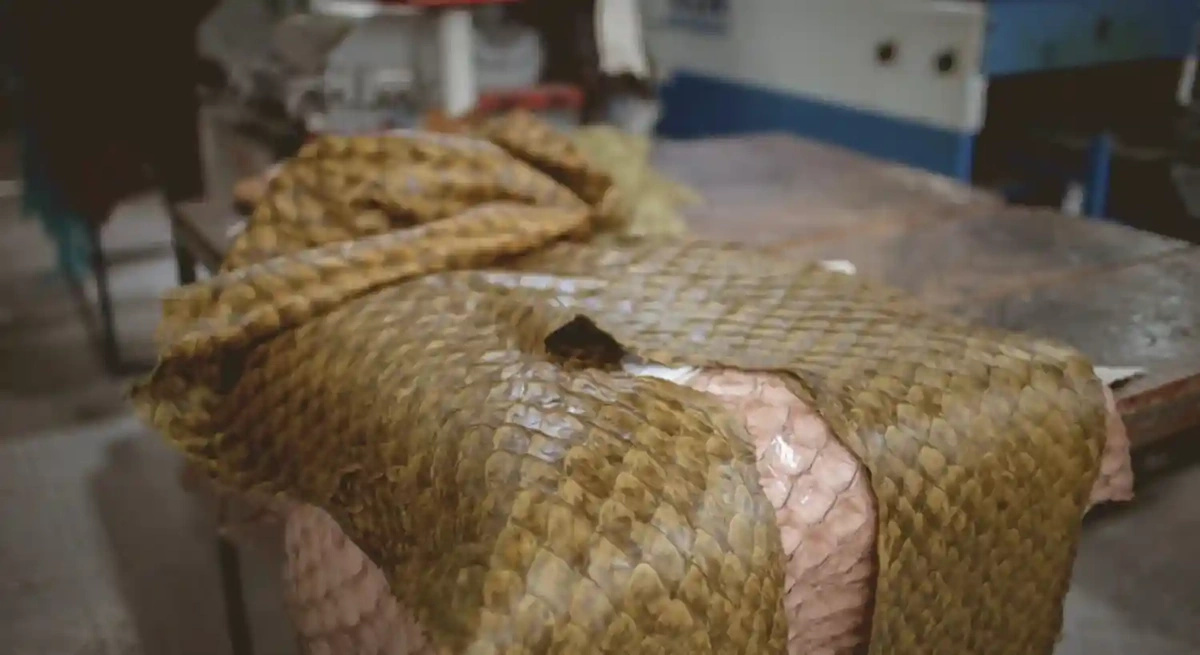
Old fishing waste becomes valued exotic leather
For a long time, the meat of the pirarucu was used for food, while the skin was discarded. The lack of proper processing prevented the commercial use of this material.
Currently, specialized tanneries transform the raw skin into high-standard exotic leather. The process preserves the original texture and enhances the natural marks formed by the species itself.
This reuse strengthens the idea of full use of the fish. Consequently, the production chain reduces waste and creates new economic possibilities.
The transformation also reinforces the concept of community-based green economy. In this model, natural resources can generate income without breaking the logic of responsible management.

High fashion finds sustainable alternative in the Amazon
International fashion has started to see pirarucu leather as an elegant and sustainable alternative. Bags, shoes, and clothing items have gained prominence due to the striking texture of the material.
Major brands and designers have found in the fish skin an option with strong visual appeal. Moreover, the leather carries a narrative associated with environmental conservation.
This aspect has made the material even more relevant. After all, contemporary luxury has come to value not only appearance but also the origin of the raw material.
Items made with pirarucu leather can symbolize a new idea of sophistication. In this scenario, beauty, durability, and environmental responsibility walk hand in hand.
Why pirarucu leather draws so much attention
The appreciation of pirarucu skin is linked to a set of technical, environmental, and aesthetic factors. Among the main points, the following stand out:
- high natural resistance, associated with the mineralized outer layer;
- structural flexibility, linked to internal collagen fibers;
- exclusive geometric texture, preserved in the final leather;
- waste utilization, after the meat is used;
- potential for sustainable fashion, with a focus on conscious luxury;
- inspiration for biomaterials, from the natural engineering of the species.
Conscious luxury enhances the value of Amazonian biodiversity
The skin of the pirarucu shows how Amazonian biodiversity can inspire modern solutions. The material connects science, fashion, and sustainability in a single value chain.
Sources like WWF Brazil, University of California San Diego, scientific studies on the Arapaima gigas, and publications specialized in sustainability highlight the ecological and technological importance of this Amazonian fish.
In the luxury market, the skin gains strength by offering visual differentiation and environmental narrative. In science, in turn, the resistant structure of the pirarucu continues to inspire research on new materials.
In this way, the Amazonian giant is no longer seen just as a food resource. Now, it also represents a bridge between conservation, innovation, and haute couture.
The journey of the pirarucu skin reveals an important change. Often, the most sophisticated innovation does not start in laboratories or on runways. It first emerges in nature, especially in the waters of the Amazon.





Be the first to react!