Portuguese
  Spanish


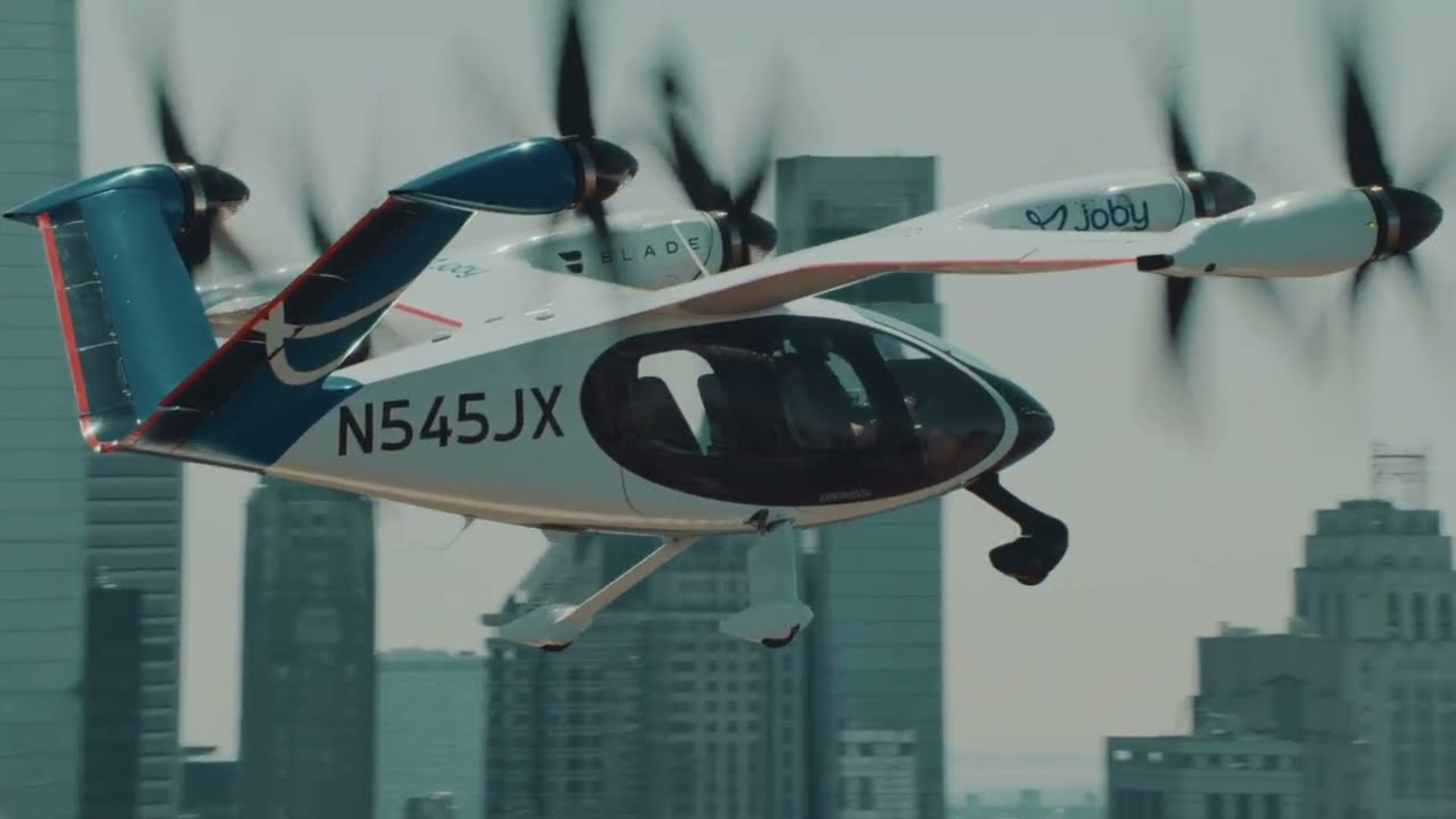


Joby Aviation’s electric air taxi completed the JFK-Manhattan route in under 10 minutes in New York’s first public eVTOL demonstration, part of the Electric Skies Tour 2026, with commercial launch planned for 2026 via Uber Air, while Embraer’s Eve leads global orders with 2,900 vehicles.
An electric air taxi took off from John F. Kennedy International Airport and landed in Manhattan in under ten minutes, completing a journey that in New York traffic can take up to two hours by car. The flight carried out by Joby Aviation marked the first public demonstration of an electric air taxi (eVTOL) in the city and inaugurated a series of tests across the local heliport network, with the aircraft departing from JFK and landing at Downtown Skyport and two other heliports in Chelsea and Midtown, simulating the commercial routes the company intends to operate after obtaining certification from the FAA (Federal Aviation Administration), the federal aviation agency of the United States. The financial market’s enthusiasm for the demonstration boosted Joby Aviation’s shares by 6% on the day of the flight, a sign that investors consider the air taxi closer to commercial operation than to science fiction.
The flight is part of the Electric Skies Tour 2026, a national tour commemorating the 250th anniversary of the United States, whose first stage took place over San Francisco Bay with a pass over the Golden Gate Bridge. “New York has always been a benchmark for innovation, demanding improvements. With the flight between JFK and Manhattan, we showed what the eIPP initiative enables and offered a glimpse of the future for the city,” declared JoeBen Bevirt, founder and CEO of Joby Aviation, referring to the eVTOL Integration Pilot Program, a federal program that aims to accelerate the commercial implementation of air taxis in the United States and in which Joby participates in five projects distributed across 12 states. The choice of New York for the federal program reinforces the city’s potential as a priority market for urban air taxi operations, given the volume of daily commutes between airports and the financial center that traffic makes time-consuming and that electric aviation promises to resolve in minutes.
What is Joby Aviation’s air taxi and how does the aircraft work


The aircraft that performed the flight in New York accommodates four passengers and one pilot, operates with zero carbon emissions, and produces significantly less noise than traditional helicopters. Joby’s air taxi was designed with multiple redundant systems to ensure safety and reliability, and the test fleet has already accumulated over 50,000 miles in flights conducted throughout the certification process the company is pursuing with the FAA, including previous public demonstrations in Dubai and tests in various weather and terrain conditions. Joby recently completed the first compliant aircraft flight for Type Inspection, a step that paves the way for FAA pilots to conduct official tests, with certification and commercial launch of the air taxi expected in 2026.
-
A Japanese governor single-handedly stalled the construction of the world’s fastest train for nine years, and only now has he agreed to allow a tunnel excavated at a depth of 1,400 meters.

-
Almost 1 billion euros, two gigafactories, and a million-dollar public investment, Chinese company aims to turn Spanish city into Europe’s new battery hub.

-
Advancement in the industry: Brazilian company creates ultralight material comparable to steel and paves the way for hydrogen cylinders up to 70% lighter, with a direct impact on logistics, the energy industry, and national competitiveness – learn about Forza Composites

-
In Brazil’s backyard: Tesla, by Elon Musk, announces official operations in Uruguay, where electric vehicles already make up 20% of new cars but still leaves out the largest market in the region.





The eVTOL (electric Vertical Take-Off and Landing) category, to which the air taxi belongs, is designed to take off and land vertically like a helicopter but fly horizontally like an airplane, a combination that allows operation from urban heliports without the need for runways. Electric propulsion eliminates fossil fuel combustion and drastically reduces noise, two characteristics that make the air taxi viable for frequent operation in densely populated urban areas where helicopters face time and route restrictions due to the noise they produce. The autonomy and cruising speed of Joby’s aircraft are suitable for short urban routes like JFK-Manhattan (about 20 kilometers in a straight line), a mission profile that does not require large battery capacity and maximizes the number of trips each aircraft can make per day.
How much will it cost to fly by air taxi and who will be able to use the service
The price issue is what separates air taxi as a technology demonstration from an accessible mode of transport. Sachin Kansal, Uber’s head of product, revealed that the service will be called Uber Air and will be priced similarly to Uber Black (premium category), although the final fare is still undefined, a positioning that in the short term places the air taxi as an alternative for passengers willing to pay more to avoid traffic, not as a substitute for public transport or conventional apps. The partnership between Joby Aviation and Uber aims to integrate ground and air mobility on a single platform: the passenger would request the air taxi through the Uber app, be driven by car to the nearest heliport, fly to the destination, and complete the final leg by land, an experience that the partnership with Delta Air Lines also intends to offer for commercial flight passengers.
The operating cost of air taxis faces challenges that explain why the price will not be popular initially. Certification, high-capacity batteries, and heliport infrastructure represent investments that need to be diluted into ticket prices, and according to Sarfraz Maredia, Uber’s global head of autonomous mobility, the financial viability of the model depends on keeping aircraft in constant use because an air taxi sitting on the ground does not generate revenue. The expectation is that prices will be close to executive helicopter services in the initial phase, with gradual reduction as the scale of operation increases and manufacturing and battery costs decrease, a trajectory similar to what smartphones and electric vehicles have followed in recent decades: they started as a luxury and became accessible with mass production.
How Brazil positions itself in the global air taxi race
The competition for the urban air taxi market involves companies from various countries, and Brazil plays a relevant role in the dispute. Eve Air Mobility, an Embraer subsidiary, leads the sector in order volume with over 2,900 vehicles ordered by operators from various countries, a position that reflects Embraer’s reputation as an aircraft manufacturer and Eve’s good relationship with civil aviation regulatory bodies in multiple jurisdictions. Anthony El-Khoury, Joby executive in the United Arab Emirates, highlighted interest in the Brazilian market, especially São Paulo, a city whose traffic and tradition in helicopter services create natural demand for the electric air taxi that both Joby and Eve intend to explore.
The air taxi market in cities like New York, Dubai, and São Paulo depends on factors beyond aircraft technology. Urban airspace regulation, licensing of heliports for eVTOL operation, integration with existing transport systems, and public acceptance of noise and low-altitude air traffic are challenges that each city will need to resolve according to its specific conditions, and the federal eIPP program in the United States is an attempt to create a regulatory framework that other nations can use as a reference. Joby’s demonstration in New York accelerates the debate by proving that the technology works in a real urban environment: ten minutes between JFK and Manhattan are not an engineer’s promise in a slide presentation, they are a recorded fact with a certifiable aircraft and routes that simulate commercial operation.
What’s missing for air taxis to start commercial operation
The distance between public demonstration and regular commercial air taxi operation is measured in certifications, not technology. Joby is in the final phase of the FAA certification process, with most tests completed and awaiting official validation, and the acquisition of Blade Air Mobility in 2025 (a company that transported 90,000 passengers in New York using helicopters) gave Joby ready infrastructure in Manhattan and nearby airports that can be converted for electric air taxi operation once certification is obtained. The combination of an aircraft in the final approval phase, already operational heliport infrastructure, and partnerships with Uber and Delta Air Lines for passenger distribution places Joby in a position to begin commercial air taxi operation potentially as early as 2026, a timeline that the financial market priced in with a 6% rise in shares on the day of the demonstration.
The question that remains is whether air taxis will, over time, become accessible beyond the executive public who can afford helicopter prices. Large cities evaluating the implementation of the service need to decide whether to incentivize the scale of operation with public heliport infrastructure, initial subsidies, or regulation that reduces entry barriers, measures that would accelerate the price drop that only mass production can provide. For now, ten minutes between JFK and Manhattan is a demonstration that proves the technical feasibility of air taxis. Transforming these ten minutes into a daily routine for thousands of passengers is the challenge that the coming years will determine.
And you, would you use an electric air taxi to avoid traffic? Do you think the price will become accessible? Leave your opinion in the comments.