






 Portuguese
  Spanish


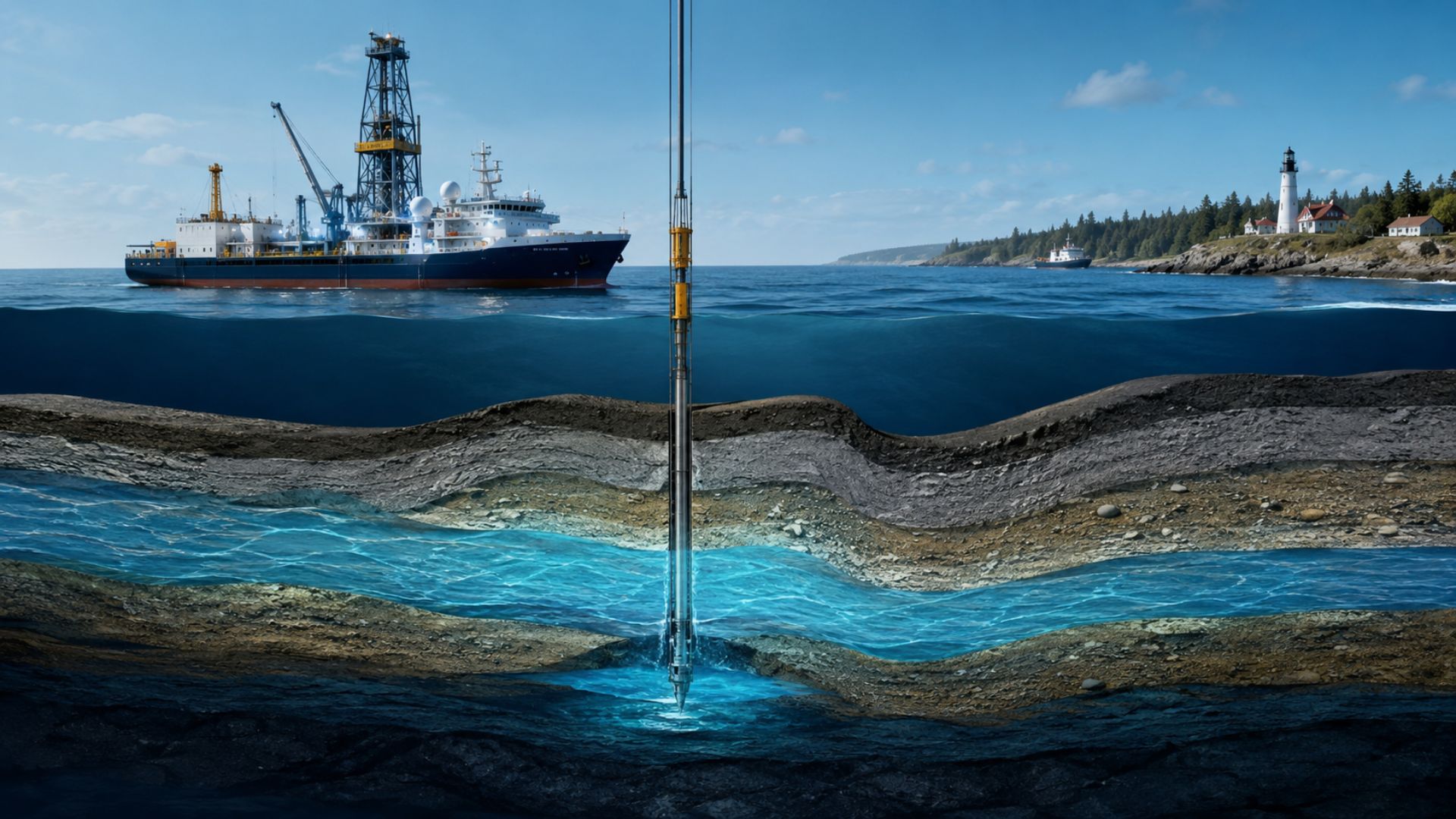


According to information from the apnews portal, Expedition 501, a $25 million scientific collaboration involving more than a dozen countries, drilled into the North Atlantic seabed nearly 400 meters deep and found freshwater beneath the salty ocean. The aquifer, which stretches from New Jersey to northern Maine, could be large enough to supply a metropolis the size of New York for 800 years, according to scientists. Samples recorded salinity of up to 1 part per thousand, a level compatible with freshwater bodies on land, and nearly 50,000 liters were collected for analysis in laboratories around the world.
An unprecedented scientific expedition drilled into the North Atlantic seabed nearly 400 meters deep and found freshwater hidden beneath the salty ocean, a discovery that could change how the planet deals with the water crisis in the coming years. The giant aquifer, which stretches from New Jersey to Maine along the eastern coast of the United States, was confirmed by Expedition 501, a $25 million project supported by the U.S. National Science Foundation and the European Consortium for Ocean Drilling and Research.
Scientists began the project believing the aquifer could supply a city the size of New York for 800 years, and what they found exceeded expectations. Brandon Dugan, co-chief scientist of the expedition and geophysicist at the Colorado School of Mines, stated that the teams looked “in one of the last places you’d probably expect to find freshwater on Earth” and found it. The samples recorded salinity of up to 1 part per thousand — a level compatible with freshwater from lakes and rivers — at greater and shallower depths than anticipated, suggesting an even larger supply than estimated.
What Expedition 501 Did and What It Found on the Seabed

Expedition 501 operated for three months from the Liftboat Robert, an offshore platform that typically services oil platforms and wind farms. The vessel lowered three pillars to the seabed and remained fixed above the waves while teams drilled into the submarine sediment at three different locations, 30 to 50 kilometers off the coast, between May and July 2025.
-
A fossil kept for years in a small museum in Montreal concealed 450-million-year-old soft tissue, a discovery that has only happened once before in history.

-
Three teenagers transform cut cardboard into Japanese origami-style packaging that promises to retire styrofoam and bubble wrap, win a $12,500 prize, and target giants like Amazon, FedEx, and Home Depot after a robot motor arrived broken.

-
The large jar blender has a rival: Oster Ultra Power bets on 1,000 W, six stainless steel blades, and two portable cups with leak-proof lids.

-
Tesla injected an additional $250 million into the German factory, doubled the battery cell target, and opened its own production line for startups.


The drilling penetrated the Earth below sea level up to 393 meters (1,289 feet), and samples of waterlogged sediment revealed progressively lower salt concentrations as the teams advanced. At the very first site, salinity registered 4 parts per thousand, well below the 35 parts per thousand typical of the ocean, a fact Dugan described as a “revelation moment” because it indicated that the water must have been connected to a terrestrial system. At subsequent sites, the concentration dropped to 1 part per thousand or less.
Where the Freshwater Under the Ocean Comes From
The origin of the aquifer is the central mystery that scientists from Expedition 501 will investigate in the coming months. The main hypothesis is that the water was trapped when glaciers melted and sea levels rose thousands of years ago, flooding a landscape that was once dry land. The alternative is that the aquifer is still connected to terrestrial groundwater systems and is being slowly replenished.
The answer matters because it determines whether the resource is renewable or finite. Researchers will date the water in the lab: if it’s “young,” it means it was a raindrop 100 or 200 years ago and the aquifer recharges, Dugan said. If it’s primordial, it’s a trapped resource that doesn’t renew. Nearly 50,000 liters of samples were collected and will be analyzed in laboratories in more than a dozen countries, with a meeting scheduled in Germany to consolidate initial results.
Why the world needs freshwater hidden under the ocean
The discovery is not academic curiosity: it is a potential answer to a crisis that the UN projects as imminent. In just five years, global demand for freshwater will exceed supply by 40%, according to the United Nations. Rising **sea** levels contaminate coastal **freshwater** sources with salt, and data centers that power artificial intelligence and cloud computing consume **water** at a rate that strains supply in entire regions.
The scale of the problem is concrete. Cape Town, South Africa, was close to running out of drinking water for 5 million inhabitants in 2018. Jakarta, Prince Edward Island (Canada), and Hawaii face compromised supply that coexists with potential submarine **aquifers**. In Virginia, **USA**, alone, a quarter of all **energy** produced is allocated to data centers, and each medium-sized unit consumes as much **water** as a thousand homes.
The obstacles between discovery and a glass of water
Finding **freshwater** under the **ocean** is one thing; extracting it is another entirely different matter. Scientists warn that it will take years to bring this water to shore on a useful scale, if feasible. The issues are technical (how to drill and pump without contaminating the **aquifer** with **saltwater**), environmental (groundwater that surfaces on the **seabed** provides nutrients to marine ecosystems), and legal (who owns the **water** under international or federal waters).
Rob Evans, a Woods Hole geophysicist whose 2015 research helped map the contours of the **aquifer**, sees warning signs. “If we started pumping these waters, there would almost certainly be unforeseen consequences,” he stated. Exploration could divert **water** from onshore reserves, affect ecosystems that depend on submarine discharge, and create regulatory disputes between coastal states that would claim access to the resource. Even so, Evans acknowledges that “there’s a lot of excitement that they’ve finally gotten **samples**”.
What’s next and why the discovery matters to Brazil
**Expedition** 501 is not the end: it is the beginning of an investigation that could last decades. After six months of laboratory analyses, all scientific teams will gather in Germany for a month of collaborative research, seeking initial results on the age, origin, and quality of the **water**. Dating will determine whether the resource is renewable or fossil, and microbiological analysis will tell if it is safe for consumption.
For **Brazil**, which has a coastline of over 8,500 **kilometers** and faces recurrent water crises in the Northeast and Southeast, the discovery raises a question not yet on policymakers’ radar: **are there freshwater aquifers under the Brazilian continental shelf?** The geology of the Brazilian coast, with extensive sedimentary basins formed over millions of **years**, is theoretically compatible with the presence of **freshwater** trapped under the **sea**. No drilling **expedition** with this objective has been carried out in **Brazil** so far.
Did you know there’s freshwater hidden beneath the ocean that could be enough to supply New York for 800 years? Tell us in the comments if you think Brazil should investigate whether there are aquifers under the Brazilian coast and what you think about drilling the seabed in search of drinking water.


