






 Portuguese
  Spanish
  3 min of reading
  6 comments


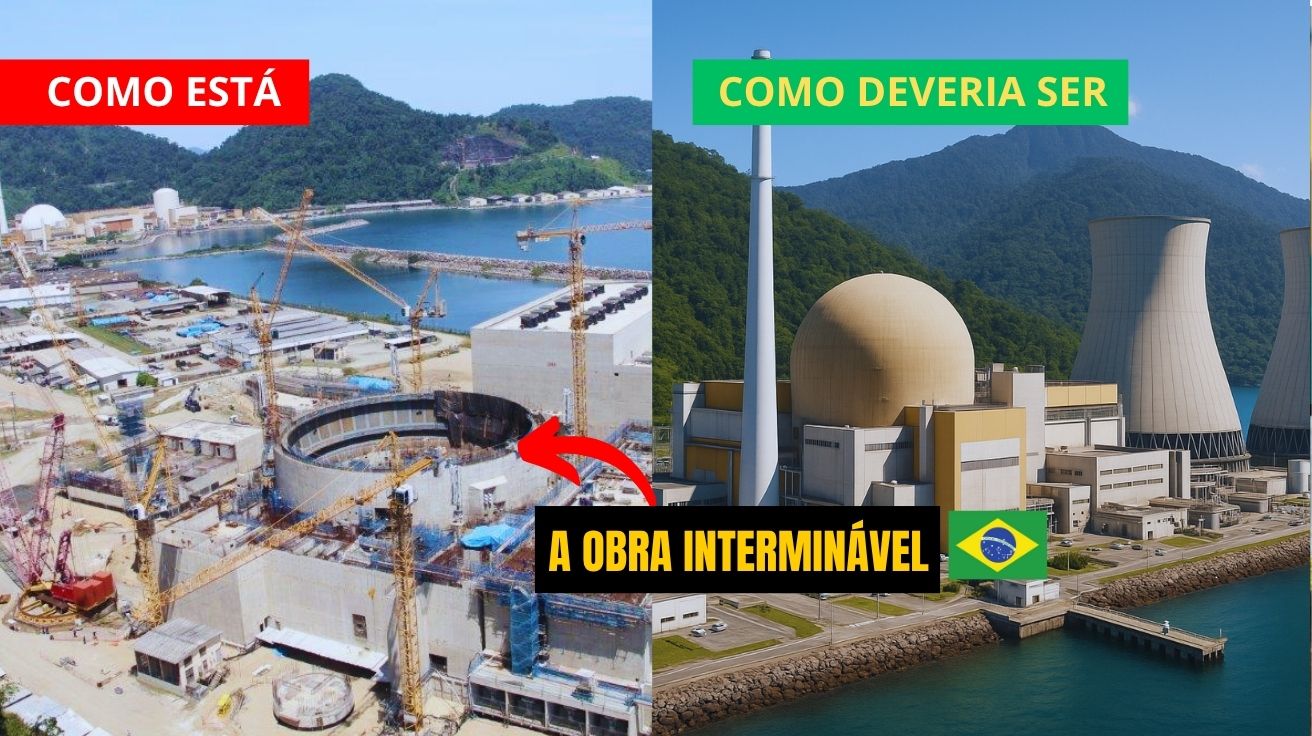


Nuclear Plant Angra 3 Remains Incomplete Since 2015, Accumulating Billion-Dollar Costs and Uncertainties. While Decisions Are Not Made, The Project Continues As A Symbol Of The Technical, Financial, And Political Obstacles That Challenge Major Public Works In Brazil.
The nuclear plant Angra 3, in Angra dos Reis (RJ), remains inactive even after decades of construction and billions of reais already invested.
With about 67% of the structure completed and 85% of the equipment purchased, the project continues without producing energy.
Meanwhile, maintenance costs and financial burdens can exceed R$ 1 billion per year, according to data from Eletronuclear and the National Bank for Economic and Social Development (BNDES).
-
Survivor of 1966 SS Daniel J. Morrell Shipwreck in Lake Huron Recounts 38-Hour Ordeal in Extreme Cold

-
The Greatest Hoax in World Cup History? The Film That Denied Brazil’s 1958 Victory and Exposed How Fake Evidence Can Seem Convincing on TV
-
Fake South Korean Online Stores Offer Shopping Thrill Without Spending Money or Receiving Products
-
Brazilian Joins Homeownership Consortium, Faces Decade of Dual Payments Totaling $141,000, Surpassing Traditional Mortgage


The construction work at the plant has been halted since 2015, after investigations by Operation Car Wash revealed irregularities in the construction contracts.
Since then, Angra 3 has become the focus of technical and economic discussions about its viability and impact on the Brazilian energy sector.
Billion-Dollar Maintenance Of The Nuclear Plant
Currently, the annual costs related to the plant include approximately R$ 800 million in debt interest with BNDES and Caixa Econômica Federal.
Another R$ 120 million is allocated to equipment maintenance.
And about R$ 100 million is used to cover the payroll of professionals assigned to the project.
Industry experts point out that the definitive cancellation of the project would also entail significant costs.
A survey by BNDES estimates that discontinuing Angra 3 could generate expenses between R$ 21 billion and R$ 30 billion, including contractual terminations, return of tax incentives, and demobilization of structures.
Economic Viability And Government Decision
The responsibility for continuing or terminating the project is under evaluation by the National Energy Policy Council (CNPE).
The decision is expected by the end of 2025, after the analysis of a new version of the feasibility study conducted by BNDES.
The study updates the economic and technical premises of the plant and will be decisive for determining the future of the project.
Since May 2025, Eletronuclear has no longer counted on the support of Eletrobras, which formally withdrew from the project.
The Brazilian Company of Nuclear Energy and Binational Participation (ENBPar) has become the main institutional responsible for the plant.
In an interview with Reuters, the president of Eletronuclear, Raul Lycurgo Leite, stated: “The worst type of infrastructure project is one that remains paralyzed.”
He also emphasized that keeping Angra 3 idle costs more than R$ 1 billion per year, which represents a significant burden on public finances and the sustainability of the company.
Energy Potential And Environmental Impact
If completed, Angra 3 could generate up to 1,405 megawatts of electrical power, enough to supply approximately 4.5 million people.
The project would also contribute to diversifying the national electric matrix, which still heavily relies on hydroelectric and thermal sources.
From an environmental perspective, nuclear energy has one of the lowest greenhouse gas emission rates per kilowatt-hour.
It is about 12 g of CO₂ per kWh, according to data from the International Energy Agency (IEA).
This figure is significantly lower than that of coal plants, which emit about 820 g of CO₂ per kWh.
Necessary Investment And Financial Scenario
To complete the work, the necessary investment is around R$ 23 billion.
The BNDES study projects an estimated tariff of R$ 653 per megawatt-hour (MWh), a figure considered viable in comparison to other generation sources.
However, Eletronuclear’s financial situation is concerning.
In 2025, the company projects an operating deficit of R$ 2.1 billion, even after initiating a series of austerity and internal restructuring measures.
A new business plan, with a horizon until 2029, has been approved to ensure greater sustainability and transparency in the state’s operations.
Future Of Angra 3 Still Undefined
With the BNDES study expected to be completed by December 2025, the CNPE will be responsible for defining the fate of the nuclear plant.
Until then, Angra 3 remains as an example of the technical, financial, and institutional challenges faced by large infrastructure projects in Brazil.
Which path do you believe is more viable for the country: completing Angra 3 or definitively ending this project?




Continuar
Claro de essa obra deveria ser concluída. Pelo que já foi gosto terminar seria mais viável .
Interdita,sem pararalizacao do projeto!