






 Portuguese
  Spanish


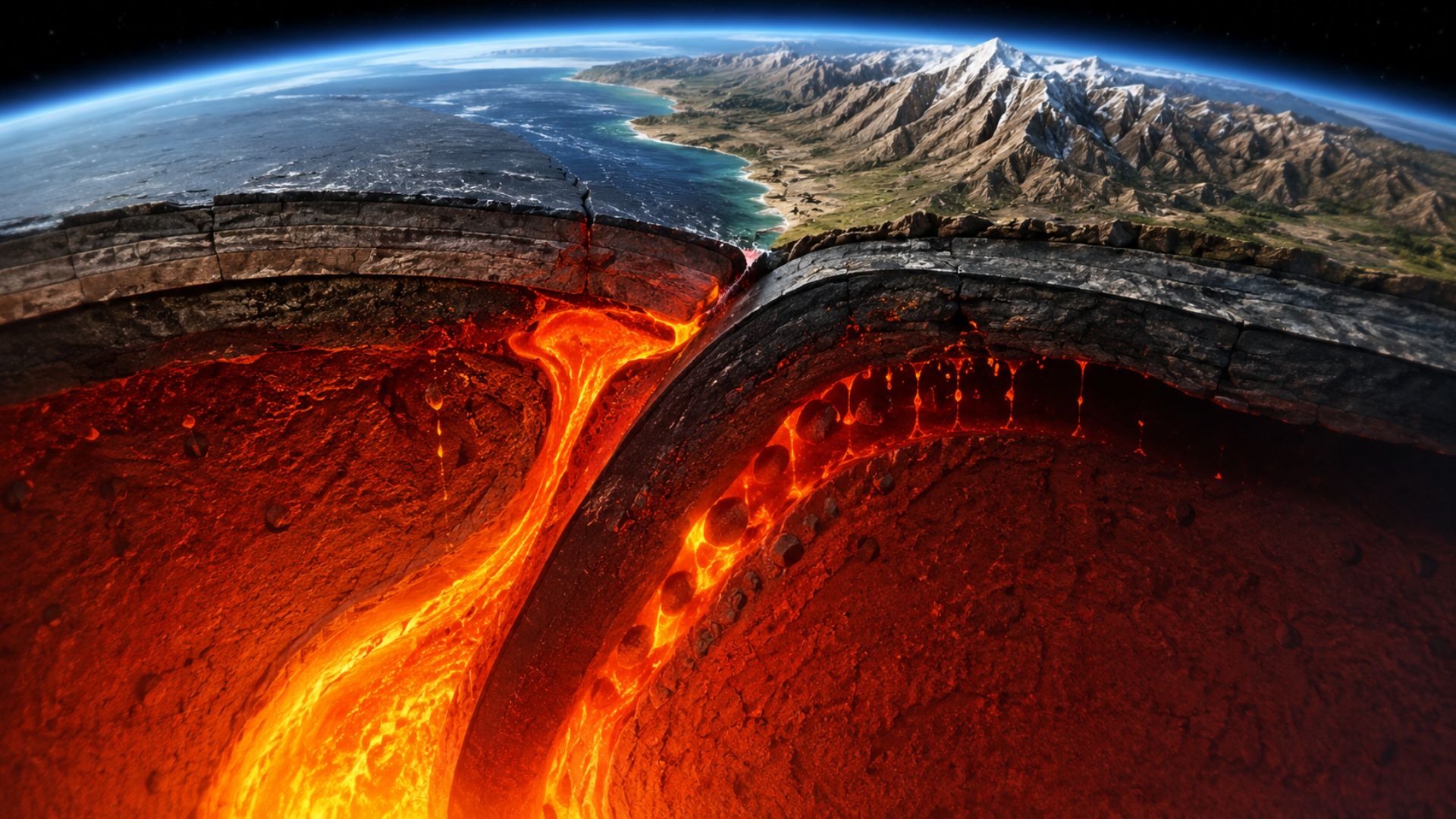


The most curious detail is the delay: the magma only reappears on the surface about 16 million years after the collision between the continents. And the finding goes further, because the rocks generated by this process resemble others from almost 3 billion years ago, pushing the origin of plate tectonics earlier in the planet’s history.
Scientists have discovered new evidence that the Earth recycles its own continents in the depths, dragging pieces of continental crust down during plate collisions and returning part of this material, millions of years later, in the form of magma. The mechanism, named relamination, helps explain how continents have been constructed and reshaped over billions of years of the planet’s history.
The discovery was published in May 2026 in the scientific journal Nature Geoscience, in a study led by an international team from the National Museum of Natural Sciences in Madrid, the MNCN-CSIC, in Spain, in partnership with institutions such as ETH Zurich, in Switzerland, and the University of Portsmouth, in the United Kingdom. The work was led by researcher Daniel Gómez-Frutos, who conducted the study while working at the Spanish museum.
What happens when two continents collide

What was missing to understand was what happens to the material that sinks during this process. When two plates meet, one dives under the other, in a movement called subduction, taking part of the continental crust into the depths of the Earth.
-
Pennsylvania Mine Creates Ice in Summer Heat and Melts in Winter, Turning a Mountain Crevice into a Reverse Natural Refrigerator

-
China Accelerates Global Expansion of Robotics: From Smart Vacuums to Industrial and Humanoid Machines, Millions Exported to Over 150 Markets
-
Polar Air Mass to Hit Brazil: Temperatures to Plummet in Nine States, Near Freezing in the South with Frost Risk Until Monday
-
Chinese “dark factories” produce electric cars 24/7 with minimal human intervention, as Zeekr assembles 800 units daily, raising concerns in Brazil.




The study shows that this crust dragged downward does not simply disappear. Being lighter and rich in silica, it tends to detach from the sinking plate and rise again, sticking to the base of the plate above. It’s as if a piece of the continent were swallowed by the Earth and then glued beneath the surface, in a process that scientists compared to a deep recycling of the continents themselves.
How relamination works
This mechanism of detachment and reattachment of the crust at the base of the upper plate is what researchers call relamination. By attaching to the bottom of the upper plate, the crust material mechanically mixes with peridotite, the rock that forms the Earth’s mantle. The result is the creation of a hybrid zone, where crust and mantle ingredients combine, two reservoirs that normally have very different compositions.
It is precisely in this hybrid zone that the key to the discovery lies. Millions of years after the collision, this mixed material can melt and give rise to the so-called post-collisional magmas, which rise and solidify forming granitic rocks. A curious fact revealed by the simulations is the waiting time: post-collisional magma usually appears about 16 million years after the continental collision and continues to be produced for tens of millions of years.
Simulations and experiments that matched reality


To reach these conclusions, the team combined two approaches. On one hand, they used advanced thermomechanical computer simulations, which recreate in detail the behavior of rocks under extremely high pressure and temperature over geological time. On the other, they conducted laboratory fusion experiments, mixing various proportions of mantle peridotite and continental crust to physically reproduce the interaction described by the models.
The results were conclusive: the magmas artificially produced in the laboratory chemically corresponded to the post-collisional igneous rocks found in mountain belts worldwide. These rocks have a very peculiar chemical signature, rich in magnesium and potassium and poor in calcium, a pattern that geologists have cataloged for decades, but for which no one had proposed a physical mechanism capable of explaining it consistently.
The clue that comes from 3-billion-year-old rocks
The most intriguing finding of the study is the bridge it creates with Earth’s distant past. The analyzed post-collisional rocks closely resemble sanukitoids, a type of magnesium-rich granitic rock formed during the Archean Eon, about 2.5 to 3 billion years ago, when the planet was still young. This similarity did not go unnoticed by the researchers.
The interpretation is that if the ancient and recent rocks share the same chemical signature, then the mixing process between crust and mantle likely already operated at the beginning of Earth’s history. This suggests that complex plate tectonics interactions, involving the subduction of continents and the hybridization between crust and mantle, may have started much earlier than previously thought, shedding new light on one of the most debated questions in geology.
Why This Discovery Matters
The origin of modern plate tectonics, the system that moves continents and shapes Earth’s surface, is one of the most controversial topics in science. Knowing when and how this mechanism began helps to understand not only the formation of continents but also the evolution of the climate, oceans, and even the conditions that made the planet habitable over billions of years.
By offering a clear physical mechanism for the recycling of continents, the study also provides scientists with a better tool to interpret the chemical record preserved in ancient rocks scattered around the world. Each rock formation becomes a page of this long history of sinking, mixing, and rebirth of the crust, helping to reconstruct how Earth’s face has changed since its beginnings.
The discovery of relamination shows that Earth is, in essence, a planet that recycles itself, swallowing pieces of continents into the depths and returning them transformed into magma and new rocks. More than a technical detail of geology, this mechanism helps to tell the story of how continents formed and why our planet has the face we know today. It is a reminder that, even beneath our feet, Earth never stops reinventing itself.
Did you ever imagine that Earth is capable of recycling entire continents into its depths over millions of years? What impresses you more about this discovery, the mechanism itself or the clue that it was already functioning nearly 3 billion years ago? Leave your comment, tell us what you think, and share the article with those interested in geology, science, and the mysteries of our planet.







I thought pangea showed that all the land pretty much is accounted for, but that could just be the recent theory (even though geology has linked the lands via mineral deposits being of the same type with vast oceans between them and they fit together like a puzzle broke apart (like maybe, I dunno a huge extraterrestrial body collision tore the planet asunder)..
But who really knows what about the history of the land, we barely know about our ocean depths but we have stripped the upper waters of the life needed to fill the depths with food..
That it was already functioning nearly 3 billion years ago?
Never knew about lamination, this article has been enjoyed thoroughly. Thank you for providing such insightful knowledge. Please keep sharing.
Margaret
Amazing article. I had no clue about re-lamination, though I am a Geologist. Great to find out this term,and greater even to learn its mechanism. Thanks again