






 Portuguese
  Spanish
  5 min of reading
  0 comments


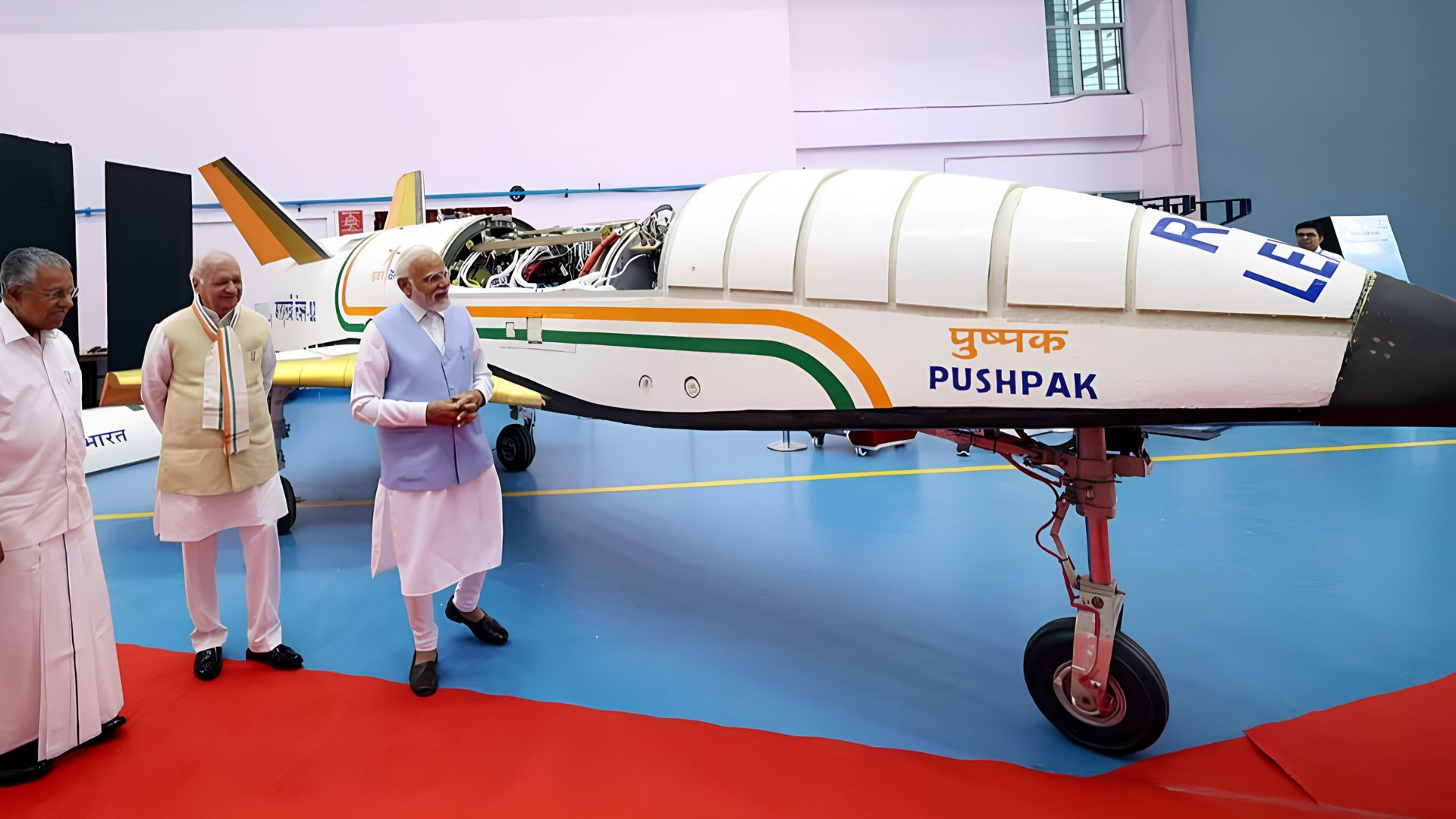
Pushpak, from ISRO, landed on its own at over 320 km/h after being released from 4.5 km altitude and reinforces India’s commitment to reusable space vehicles.
While the United States and China invest billions in mega rockets, lunar bases, and reusable systems capable of drastically reducing the cost of access to space, India is advancing on a different path. Instead of starting with giant launchers, the Indian space agency decided to train a winged craft to do something that remains one of the greatest challenges of modern aerospace engineering: returning to the runway on its own after a space mission.
The vehicle is called Pushpak, part of ISRO’s Reusable Launch Vehicle (RLV) program, and completed in June 2024 the third and most complex autonomous landing test of the series. Released by an Indian Air Force Chinook helicopter at 4.5 km altitude and 4.5 km from the runway, the craft corrected its own trajectory, aligned itself with the runway, and landed at high speed without a pilot on board.
Pushpak was launched from a military helicopter and had to find its own way to the runway
The experiment took place at the Aeronautical Test Range in Chitradurga, in the state of Karnataka. After being carried by a Chinook helicopter to the programmed altitude, the vehicle was released in flight. From that moment, there was no pilot controlling the aircraft.
-
Space technology used to search for water on Mars is now hunting for invisible leaks under the streets of São Paulo, using satellites, AI, and chlorine signals to help Sabesp recover up to 6.7 billion liters of water.

-
Japan sends ship to extract mud rich in rare earths at nearly 6,000 meters deep in the Pacific, attempts to lift 350 tons per day from the seabed, and transforms sediments near Minamitori Island into a strategic weapon to reduce dependence on China.
-
Venus Aerospace promises a rotating detonation hypersonic engine that takes the Stargazer to Mach 9 and crosses oceans in 1 hour, but the flight that made history barely surpassed the speed of sound.

-
Brazilian student creates a cheap formula that makes plants grow up to 90% faster and wins an award in a global scientific competition.




According to ISRO, Pushpak autonomously executed lateral trajectory corrections, adjusted its approach, and performed a precise horizontal landing on the centerline of the runway. The goal was to replicate the approach and landing conditions that an orbital vehicle would face when returning from space.
Spacecraft landed at over 320 km/h before decelerating with parachutes and brakes
The test did not only simulate navigation. The Indian space agency reported that the vehicle performed a high-speed landing exceeding 320 km/h, a value close to that faced by space vehicles during the final phases of atmospheric re-entry.


After touching down on the runway, the Pushpak deployed a braking parachute to quickly reduce speed.
It then used the landing gear brakes and the nose wheel steering system to stay aligned with the center of the runway throughout the deceleration.
Mission served to simulate the return of a spacecraft from space
The Pushpak did not actually come from orbit. The helicopter replaced the space phase to reproduce only the most critical part: the final approach and autonomous landing.
Even so, ISRO considers the experiment essential because the return of a reusable spacecraft requires extremely precise corrections of trajectory, speed, altitude, and alignment.
According to the agency, the LEX-03 simulated precisely the approach and landing interface of a vehicle returning from space.
Vehicle used multiple sensors to navigate without human intervention
The complexity of the test lies in the onboard systems. The Pushpak used a combination of inertial sensors, radar altimeter, NavIC receiver, India’s satellite navigation system, and data fusion technologies to calculate its position in real time.

The mission also validated advanced error correction algorithms in different flight axes.
According to ISRO, this capability will be crucial for future reusable orbital missions, where small deviations during reentry can cause huge errors in the final approach.
India’s reusable program aims to drastically reduce the cost of access to space
The goal of the project goes far beyond landing. ISRO states that the RLV program was created to develop technologies capable of significantly reducing the cost of space launch.
Reusable vehicles prevent entire rockets from being discarded after each mission. It was precisely this logic that transformed SpaceX into a powerhouse in the sector.
By recovering and reusing rocket stages, the company reduced operational costs and increased the frequency of launches. India is trying to build its own version of this technological revolution.
Pushpak is just one step of a much larger space project
The vehicle used in the tests is a technology demonstrator. ISRO describes Pushpak as an experimental platform created to validate hypersonic flight technologies, autonomous landing, navigation, and future reusable operations.

The next big planned step is the Orbital Re-entry Experiment (OREX). In this phase, a reusable vehicle should actually reach space before returning to the atmosphere to perform a complete sequence of re-entry and landing.
India enters the race for reusable space vehicles at a time of global transformation
The advancement of Pushpak comes amid a profound change in the space industry. The United States, China, and Europe are increasingly investing in reusable systems because launching disposable rockets remains one of the most expensive operations in modern engineering.
Whoever manages to efficiently reuse vehicles, engines, and structures will have an economic and strategic advantage in the coming decades.
India is still far from the operational scale achieved by SpaceX, but the success of the LEX series shows that New Delhi does not intend to stay out of this race.
Technical specifications of Pushpak (RLV-TD)
- Program: Reusable Launch Vehicle Technology Demonstration (RLV-TD)
- Agency: Indian Space Research Organisation
- Vehicle name: Pushpak
- Function: reusable winged demonstrator
- Objective: validate autonomous landing and space reuse technologies
- Most recent test: RLV-LEX-03
- Date: June 23, 2024
- Location: Aeronautical Test Range, Chitradurga, Karnataka, India
- Release altitude: 4.5 km
- Distance from runway at release: 4.5 km
- Launch platform: Indian Air Force Chinook helicopter
- Landing speed: over 320 km/h
- Type of landing: horizontal and fully autonomous
- Validated technologies: lateral trajectory correction, autonomous navigation, sensor fusion, parachute braking, and runway roll control.
While much of the world is only looking at giant rockets and lunar missions, India is training something equally important: a craft capable of returning home on its own. And, in the race to reduce the cost of space, learning to land can be as valuable as learning to take off.


-

-

-

-

12 people reacted to this.