






 Portuguese
  Spanish


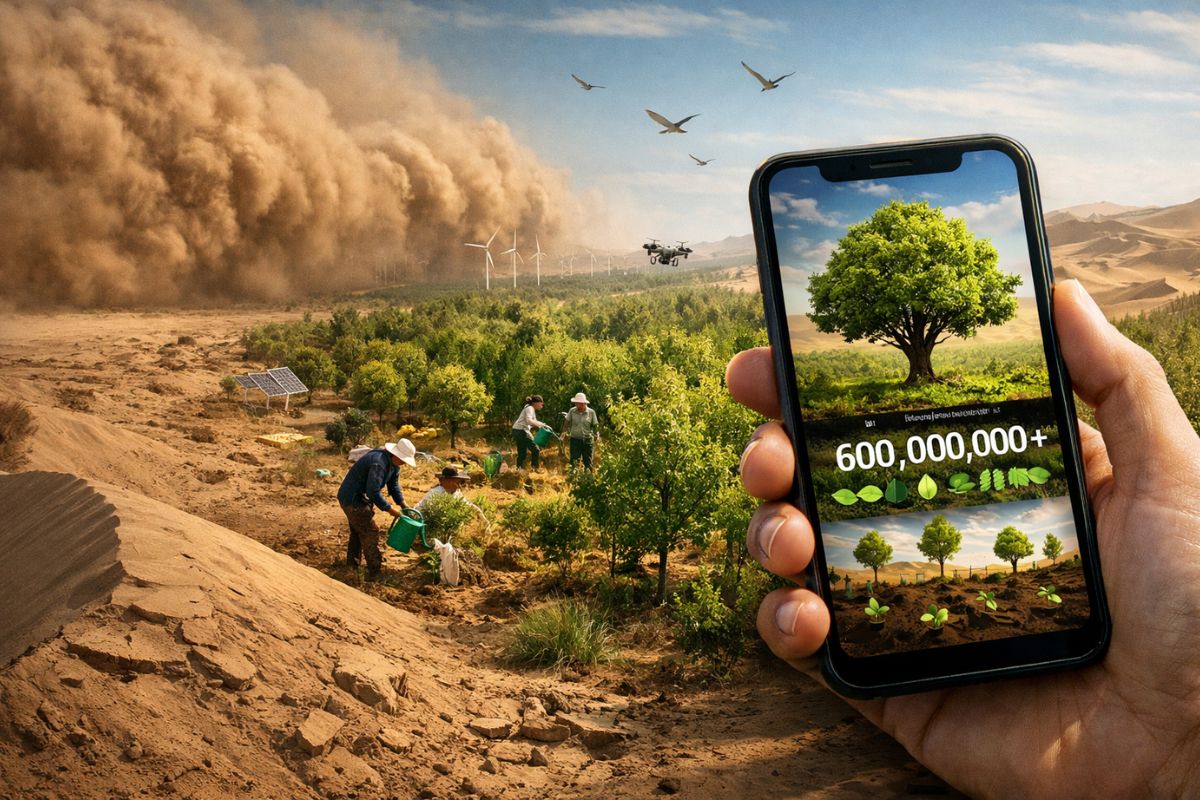


In The Northern Chinese Desert, An App Converts Steps, Payments, And Daily Choices Into Saxaul Trees, Mobilizes Millions Of People, Moves Billion-Dollar Figures In Local Currency, Creates Rural Jobs, And Reignites The Debate About Real Environmental Impact, Lasting Scale, And Dependence On Digital Platforms In Urban Protection Against Dust.
What seemed improbable began to take concrete shape in the Gobi Desert: common everyday actions, done via cellphone, began to fuel a large-scale reforestation system. Instead of an isolated campaign, the process combined a payment platform, metrics of avoided emissions, and gaming mechanics to transform daily habits into the actual planting of trees.
The result drew attention because it united three fronts that rarely move together at such speed: popular engagement, environmental recovery, and local income. As sand loses ground in critical areas, a central question is also growing: to what extent can the digital logic sustain, for decades, the restoration of an ecosystem that has always advanced over cities, roads, and rural communities?
When The Sand Crisis Was Routine And The Desert Set The Pace

Before the digital turn, the advance of sand was treated as a long-term structural problem. Storms coming from northern China, especially from arid zones linked to the Gobi and the Alashan region, affected major urban centers with episodes of low visibility, suspension of activities, and direct impact on public health. It was not figurative language: it was literal sand in the air, on a continental scale.
-
Crab Trapped in Plastic Bottle for 62 Days Near Okinawa Highlights Little-Known Impact of Marine Pollution on Small Animals

-
Esperanza’s Bamboo Barrier in Oaxaca Redirects River and Reduces Erosion by 85% in Five Years

-
Family Builds Homemade Wind Turbine to Power Off-Grid Home, Video Reaches 555,000 Views on Ngô Thị Huyền’s Channel
-
Indian Brand Creates Sneakers from Recycled PET Bottles and Discarded Tires, Repurposing Over 1 Million Bottles and Raising $4 Million for Expansion



The official strategy to contain the desert had existed for decades, with reforestation programs beginning in the late 1970s. The effort was enormous, with high investment, mass planting, and the expansion of green belts. Still, there was an evident social bottleneck: most of the population observed from the outside. Planting occurred with centralized planning but without incorporating the daily behavior of millions of people into the recovery process.
How The Cellphone Transformed Urban Routine Into Real Tree In The Desert

The turning point came in August 2016 when Ant Forest was launched within the Alipay ecosystem, which already encompassed hundreds of millions of users. The premise was straightforward: if the platform was already capturing transactions and movements, it could also convert lower-emission actions into “green energy” points. Walking, using public transport, paying bills online, and adopting digital services began to have visible environmental returns in the app.
This behavioral design was crucial because it took the climate agenda out of the abstract field. Instead of just discussing global targets, the system began to show personal progress in almost real-time. The person saw the impact on the screen on the same day they changed their habit. And the social layer accelerated even more: friends tracked each other’s performance, competed for points, and maintained usage frequency through a sense of competition and belonging.
The most symbolic conversion point was the accumulated energy goal to unlock physical planting. Upon reaching the required level of 17.9 kg of green energy for certain cases, the virtual tree turned into a real tree in the desert, with registration and tracking coordinates. This bridge between gaming and territory gave materiality to the project.
Why The Saxaul Became The Protagonist In The Fight Against Desert Advancement

The planting was not random. The species chosen in many areas was the Saxaul, a shrub known for withstanding extreme arid conditions. The plant is strategic for three technical reasons: deep rooting, high resilience, and the ability to stabilize sandy soil. Practically speaking, a single Saxaul plant can stabilize about 10 m² of sand, while roots can reach up to 10 meters in search of water.
This characteristic explains why the landscape may appear “sparse” to an observer from afar. In desert areas, densifying seedlings beyond the local ecological capacity can kill the very planting due to water competition.
In certain sections, the spacing follows a wide grid, with low visual density, precisely to increase long-term survival. In other words: what seems empty is often technical management adapted to the limits of the environment.
This difference between appearance and function became a point of public debate when field videos questioned the effectiveness of the planting.
The technical response was that the less dense design did not indicate the absence of trees but a survival model in a low-water ecosystem. The case showed that in the desert, ecological efficiency does not always align with immediate visual impact.
Scale Achieved, Participation Numbers, And Local Economic Effects

The expansion was rapid. In four years, the platform had already gathered hundreds of millions of participants and accumulated hundreds of millions of trees planted over an area equivalent to hundreds of thousands of hectares.
In subsequent cycles, the numbers continued to grow, surpassing 750 million users and 619 million trees, according to the data released within the program’s ecosystem.
On the climate axis, the reported balance points to tens of millions of tons of CO₂ avoided. On the social axis, the program also gained relevance: over 730,000 jobs were associated with planting, maintenance, and forest patrol activities in rural areas.
Additionally, significant financial movement was reported in the areas served, including reference to more than R$ 600 million in the Gobi in the context of the cited project, directly impacting the income of local communities.
Individual stories help translate this scale. There are reports of urban users who changed their commuting routine, lost weight, and converted personal goals into trees in the desert.
On the other hand, rural workers who had been living with land degradation for decades began to receive compensation for management and conservation efforts. This connection between city and countryside explains part of the engagement: those who accumulate points feel progress; those who plant in the territory feel economic results.
What Sustains The Model And Where The Strongest Criticisms Are
Despite the gains, the model is not immune to criticism. The first is methodological: it measures better what happens within the digital ecosystem itself.
If someone adopts a sustainable practice outside the platform, part of that effort may not be included in the count. This creates tension between promoting environmental behavior and simultaneously strengthening the use of a specific service.
The second criticism is strategic: to what extent do companies use programs like this to improve environmental reputation without proportionately reducing structural corporate emissions? It’s a legitimate discussion that remains open.
The third is temporal: reforestation in the desert requires long-term maintenance. The question is not only “how many trees were planted,” but “how many will remain alive in 20, 50, or 100 years.”
There is also the dimension of public perception. When a planted area appears sparse, distrust grows among those who expect a “closed forest.”
Therefore, technical transparency, continuous monitoring, and territorial validation are essential for maintaining social trust. In the desert, credibility depends as much on data as on understandable ecological explanation.
From Local Experiment To International Reference In Environmental Engagement
The model has inspired adaptations outside of China. Similar projects have emerged in other countries with digital wallets and planting targets associated with user behavior, even with high-visibility annual goals.
In parallel, the logic was expanded to fronts beyond the desert, such as marine conservation, demonstrating that the mechanics of “everyday action + reward + verifiable impact” can be transferred to different environmental agendas.
The international relevance also grew when the program received high-level recognition in the environmental field, consolidating the idea that mass technology can act as civic infrastructure.
The central point is not to treat the app as a total solution but as a collective adoption accelerator. When millions participate, small decisions begin to have systemic effects.
In the end, the case teaches that traditional environmental campaigns and digital tools do not need to compete.
The combination of ecological science, field logistics, and behavioral design can reduce friction, increase the frequency of good practices, and fund local maintenance. In arid regions, where every mistake is costly, this integration can be the difference between symbolic planting and consistent restoration.
The story of the desert receding with the help of a cellphone game does not eliminate contradictions but exposes an important turn: mass environmental participation depends on concrete experience, not just discourse.
When a person sees the effect, they return; when the local community receives income and work, conservation gains continuity; when planting respects ecological limits, the landscape changes without shortcuts.
Now it’s worth bringing this to your reality: in your city, which daily habit would have the best chance of becoming real environmental impact if gamified: mobility, energy consumption, recycling, or water use? And what metric would you consider fair to prove that the change moved off the screen and actually reached the territory?


