Portuguese
  Spanish


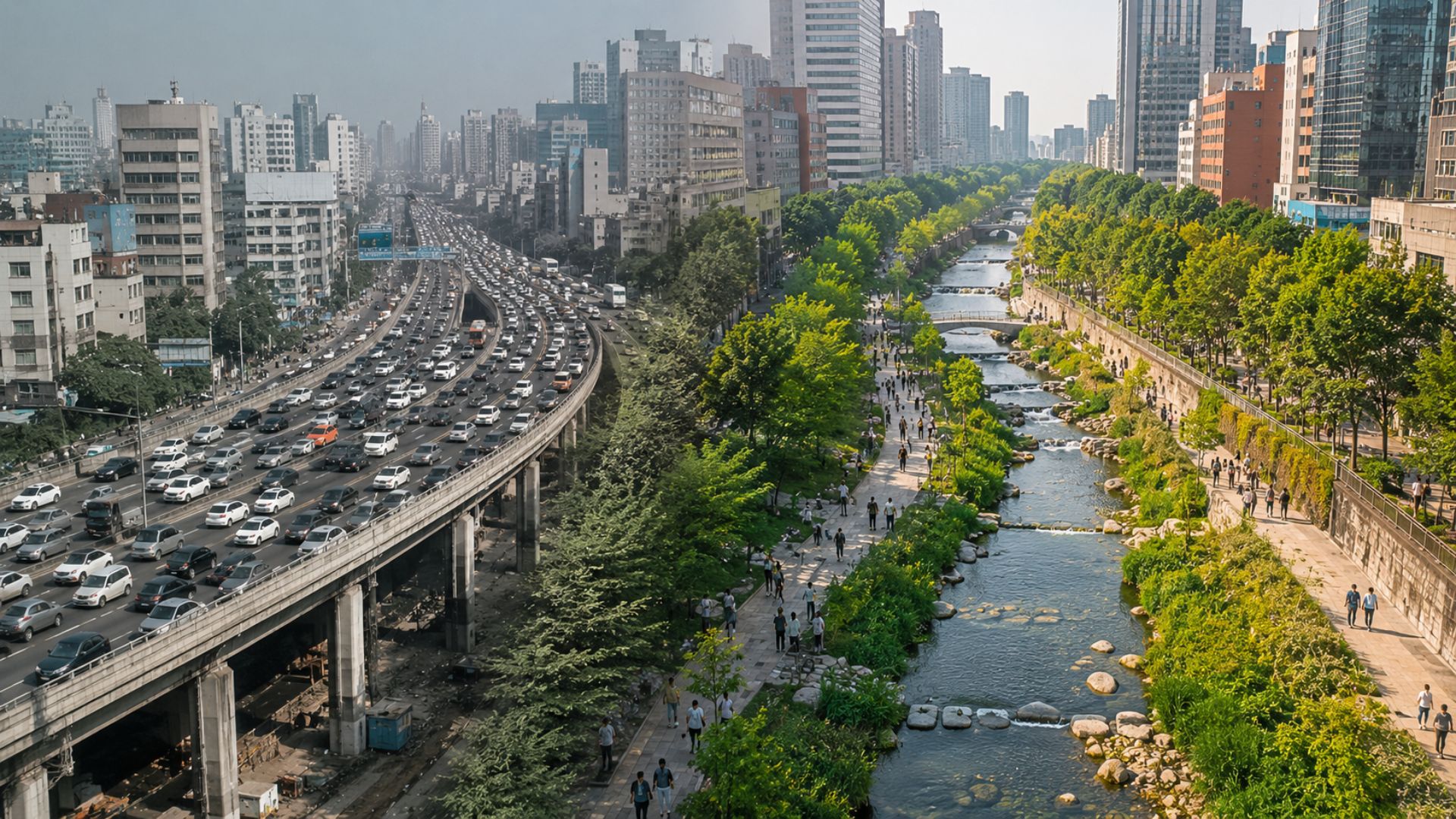

Demolishing a highway that carried almost 170,000 cars a day to put a stream in its place seemed crazy, but that’s what Seoul did in the 2000s. The Cheonggyecheon stream became one of the most studied urban renewal cases on the planet, even though it relies on artificial water pumping to survive in the heart of the city.
In the early 2000s, the city of Seoul, the capital of South Korea, made a decision that seemed absurd to most people: demolish an elevated highway that carried about 168,000 cars a day to put a stream in its place. The Cheonggyecheon restoration project, led by then-mayor Lee Myung-bak, began in July 2003 and reopened the watercourse on October 1, 2005, transforming a corridor of concrete and traffic into a linear park that became a global reference in urban renewal.
The Cheonggyecheon stream has an ancient history, dating back to the Joseon dynasty era, over 600 years ago, when residents washed clothes and went about their daily lives along its stone bridges. But after the Korean War, the watercourse was covered with concrete between 1958 and 1978, and an elevated highway was built over it. Decades later, the deterioration of this structure and the suffocation of the city center led Seoul to bet on a radical idea: bringing the stream back to the surface.
From a symbol of progress to an urban burden

Devastated and swollen by millions of refugees, the city jumped from about 1.5 million inhabitants in 1950 to over 10 million by the end of the 20th century. Slums spread around the old stream, and sewage and garbage were dumped directly into it, to the point where the place was nicknamed the city’s cancer. Covering everything with concrete and building an expressway over it seemed, at the time, the natural path of modernization.
-
Orphaned Youth Turns Dismissed Idea into Global Prestige with Innovative Wristwatch

-
English Skills Boost Career Opportunities in the Oil and Gas Industry

-
Brazil Secures Second Place at WorldSkills 2024 in Lyon, with 64 Young Professionals and 8 Medals, Including Gold from a Rio de Janeiro Hairdresser

-
3,000 Military Personnel from 10 Countries, Including US and Chinese Marines, Train Together in Brazil’s Savanna: Operation Formosa Becomes Largest Naval Ground Exercise Before First Cancellation Since 1988



For decades, the elevated highway was seen as a symbol of progress, synonymous with more cars, agile commerce, and a strong economy. But by the late 1990s, the structure that carried more than 168,000 vehicles per day was seriously deteriorated, with extremely high repair costs. Worse: downtown Seoul had become a concrete block that retained heat, with polluted air and constant traffic jams. What was once a source of pride turned into a burden, and the buried stream began to be seen as a possible solution.
The bold decision of a former Hyundai executive

He had spent almost 30 years at Hyundai, becoming CEO of the group’s construction company while still young, precisely at a time when the company was a symbol of South Korean industrialization, linked to major road, bridge, and concrete projects. The irony is that this builder profile decided to dismantle one of the city’s infrastructure symbols to return the space to the stream.
When he took office, Lee pushed the project with a speed that surprised Seoul, and later urban planners would classify it as one of the most daring urban decisions in Asia at the beginning of the 21st century. It is worth noting that he knew how to sell the idea: he framed the project also as a flood relief channel and as a showcase of sustainable development to improve Korea’s image in the world. Years later, Lee Myung-bak would become president of South Korea.
The complex work of uncovering the stream


The demolition, officially started in 2003, transformed downtown Seoul into a gigantic construction site. The city had to deal with layers and layers of infrastructure piled up over decades: the elevated highway, concrete pavement, sewage networks, electrical wires, telecommunications cables, water pipes, and even old bridges, all in the busiest area of the capital. It was like performing heart surgery while the body needed to keep functioning, according to urban planners.
The scale is impressive: more than 680 thousand tons of concrete and steel were removed, equivalent, according to the American Society of Landscape Architects, to dismantling dozens of skyscrapers in the middle of a financial district. In 27 months of construction, at a cost of about 281 million dollars, a 5.8-kilometer-long water and public space corridor emerged, crossing the center of Seoul, with 22 bridges and pedestrian walkways on both banks of the stream.
A stream that needs pumping to exist
Here is the point that is often forgotten in the more romantic versions of the story. The Cheonggyecheon is not a natural river that started flowing on its own. As its original watershed was completely urbanized over the decades, the restored stream relies on artificial water pumping to exist. According to project studies, about 120 thousand tons of water per day are pumped from the Han River, tributaries, and the subway’s underground water drainage to maintain a constant flow, with a depth of about 40 centimeters.
This detail is crucial for the accuracy of the story. The city spends millions of dollars a year just to keep the stream running, which makes it a water corridor designed and maintained by modern engineering, more like a large urban garden that needs daily irrigation than a self-sustaining ecosystem. Several academic studies criticize precisely the myth of returning to nature, reminding that the Cheonggyecheon is a work of urban design, and not an ecological restoration in the strict sense.
The explosion of life and freshness in the heart of Seoul
Even though it is artificial, the environmental results were extraordinary. According to research by the Seoul Institute, biodiversity around the stream increased by 639% between 2003 and 2008. The number of plant species jumped from 62 to 308, insects from 15 to 192, and fish from 4 to 25. Herons, wild ducks, dragonflies, and butterflies reappeared in the city center, something extremely rare before the project, and subsequent surveys recorded hundreds of living species in the area.
The physical effects were also felt. The area around the stream became about 3.5 degrees Celsius cooler than the neighboring concrete streets, an important relief in a city marked by the urban heat island effect. The removal of the elevated highway improved air circulation between buildings, and nitrogen dioxide levels dropped by about 35%, according to city environmental reports, showing that bringing water and vegetation back generated concrete benefits for quality of life.
The mystery of the traffic that disappeared
The biggest concern before the project was traffic chaos. After all, how could a megacity simply eliminate a road that carried almost 168 thousand vehicles a day? Merchants feared losing customers and engineers predicted paralysis. But what happened was more complex and surprising. In parallel with the demolition, Seoul expanded exclusive bus lanes, renovated the subway, and reduced dependence on private cars.
The result is a phenomenon that urban planners call traffic evaporation, the inverse logic of induced demand: sometimes, removing a road causes some drivers to simply change the way they commute. Between 2003 and 2008, the number of bus passengers grew by 15.1% and subway users increased by 3.3%. The stream stopped being a mechanical flow of hurried cars and became a place where people stop: about 64,000 visitors per day frequent Cheonggyecheon to walk, have lunch, or rest.
A global movement to uncover rivers
The impact of Cheonggyecheon quickly spread throughout the world of urban planning, becoming one of the most famous examples of the river revitalization movement, known as daylighting, which consists of bringing back to light watercourses previously buried under concrete. The project earned Seoul the Veronica Rudge Green Prize in Urban Design, awarded by Harvard University, and real estate values around the stream rose well above the city average.
Cities around the world began to look at similar cases. In Madrid, the Madrid Río project buried part of a highway to create parks along the banks of the Manzanares River. In Boston, the Big Dig buried an expressway and returned public space to the surface. In San Francisco, after the 1989 earthquake, the city chose not to rebuild an elevated road and transformed the waterfront into a boulevard. All these projects reflect a change in mindset: nature is no longer seen as an obstacle to development but as part of the solution for more livable cities.
The story of Cheonggyecheon shows that what was once celebrated as progress, the highway over the stream, can become exactly what suffocates a city. Seoul buried a watercourse to build an expressway and, decades later, demolished that same road to bring the water back. The case is fascinating precisely because of its complexity: a success in urban renewal and quality of life that, at the same time, depends on constant pumping and maintenance to exist, reminding us that recreating nature in the city comes at a price.
Do you think modern cities should continue prioritizing concrete and cars, or create more space for nature and people, as Seoul did with the Cheonggyecheon stream? Do you know of any buried river or stream in your city that could be brought back to light? Leave your comment, tell us where you are reading from, and share the article with those interested in urbanism, the environment, and the future of cities.