Portuguese
  Spanish


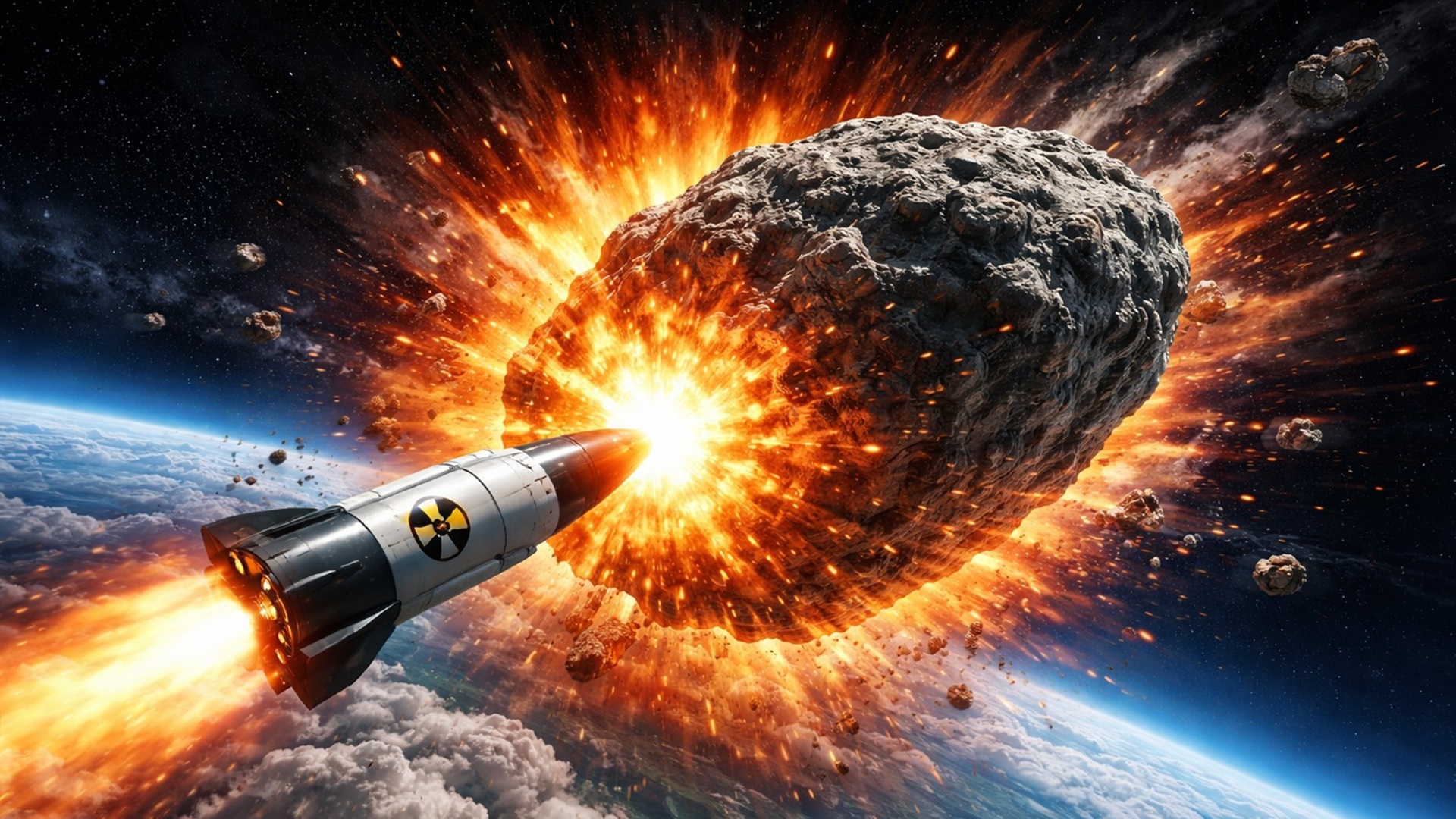

Results of the 2022 DART Mission and CERN Experiments with 440 GeV Proton Beams Indicate That Metallic Asteroids May Withstand Nuclear Explosions, Maintaining the Possibility of Controlled Deflection in Extreme Planetary Defense Scenarios with Little Response Time
The first planetary defense test in space, conducted in 2022, showed that the deliberate collision of a spacecraft can alter an asteroid’s trajectory, while new CERN experiments indicate that, in extreme scenarios, nuclear deflection may be more effective than previously thought.
The DART Mission and the Direct Orbital Deflection Test
The DART mission, conducted by NASA, marked the first practical planetary defense test by sending a spacecraft to collide with an asteroid in 2022. The goal was to evaluate whether a kinetic impact could alter its trajectory.
The test was considered a success because it demonstrated that, in a hypothetical scenario of imminent collision with Earth, a direct intervention could modify the path of a large celestial body.
-
She spent 73 years breathing inside an iron lung, survived the aftereffects of polio, and became the last woman in the United States dependent on the equipment before dying at 78 years old.

-
Brazilian students created a $1 filter using pine bark, cotton, and 3D-printed parts to clean cassava wastewater, reduce the toxicity of a hazardous waste, and transform contaminated water into biofertilizer.

-
Astronaut from Artemis II steps down after mission to the Moon and decision surprises after a record of 406,771 km, a historic 10-day journey, and an unprecedented achievement for Canada.

-
A fossil kept for years in a small museum in Montreal concealed 450-million-year-old soft tissue, a discovery that has only happened once before in history.


Scientists view this approach as more favorable than the immediate use of nuclear weapons, as the explosion could fragment the asteroid into several smaller pieces that would continue on a dangerous course.
Nuclear Deflection as a Last Scientific Resort
Despite the advantages of kinetic impact, nuclear deflection remains an emergency alternative for extreme situations. In this context, a team linked to the Proton Synchrotron at CERN conducted new research on the resistance of asteroid materials.
The study indicates that some types of space rocks, particularly those rich in metals, may be more resistant to nuclear explosions than previously imagined. This reduces the risk of uncontrolled fragmentation.
According to the researchers, understanding the composition of the asteroid is one of the most critical variables in any planetary defense mission, whether based on direct impact or controlled nuclear explosion.
Advanced Modeling and Scientific Publication
The results were detailed in a paper published in the journal Nature Communications, in which the team describes the use of advanced models to evaluate the effectiveness of nuclear deflection.
Karl-Georg Schlesinger, co-founder of OuSoCo, explained in an interview with CERN Courier that planetary defense represents a unique scientific challenge, as it is not possible to conduct real tests in advance.
According to him, the world needs to have the capability to execute a nuclear deflection mission with a high degree of confidence, even without the possibility of experimentation under real conditions, which imposes extraordinary demands on materials and physics data.
Experiments with 440 GeV Proton Beam
To address these uncertainties, the team conducted experiments at CERN’s HiRadMat facilities, in collaboration with Fireball and the University of Oxford. They fired 27 short and intense pulses of a 440 GeV proton beam.
The pulses hit a sample of the Campo del Cielo meteorite, simulating in the lab some effects of a nuclear detonation, without the need to explode a real weapon of mass destruction.
Melanie Bochmann, co-founder and co-leader of the team, stated that the material became more resistant after the impacts, with increased yield strength and self-stabilizing damping behavior.
Implications for Emergency Scenarios
The experiments indicate that, at least for metallic materials of asteroids, a nuclear device larger than previously considered could be used without causing catastrophic damage to the celestial body’s structure.
For the researchers, this is a positive finding, as it suggests that a powerful nuclear weapon could deflect an asteroid without fragmenting it into multiple smaller and equally dangerous pieces.
Bochmann explained that this possibility keeps an emergency option open for situations involving very large objects or extremely short warning times, when non-nuclear methods would be insufficient.
In such cases, current models, which assume fragmentation as a limiting factor, may need to be revised in light of the new experimental data obtained in the laboratory.