






 Portuguese
  Spanish
  5 min of reading
  0 comments


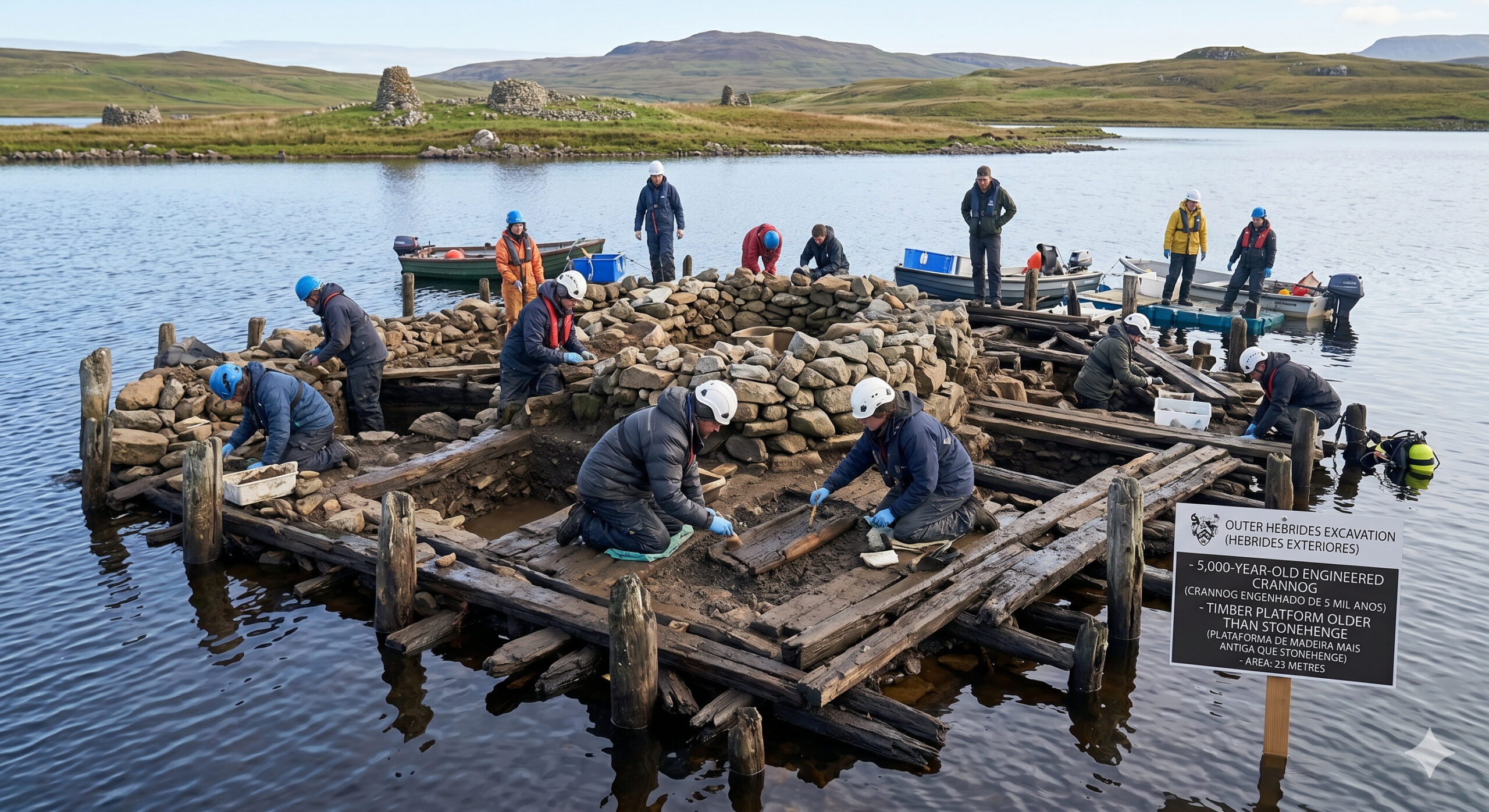
Archaeologists discover 5,000-year-old wooden platform hidden beneath artificial island in remote Scottish loch.
On May 05, 2026, archaeologists from the University of Southampton released details of a discovery that is drawing attention in the world of prehistoric archaeology: an artificial wooden platform built about 5,000 years ago and hidden beneath a small stone island in a remote Scottish loch. The site is located in Loch Bhorgastail, on the Isle of Lewis, part of the Outer Hebrides archipelago, in the far northwest of Scotland.
The study showed that what appeared to be just a small rocky island was, in fact, a carefully constructed human structure. Beneath tons of stone and sediment, researchers identified an ancient circular wooden platform approximately 23 meters in diameter, created thousands of years before the formation of many well-known monumental structures of prehistoric Europe, including early parts of Stonehenge.
Submerged structure began as a wooden platform before becoming an artificial stone island
Research revealed that the structure went through different phases over the millennia. Initially, the site would have been a circular platform built primarily with wood, branches, and other organic materials.
-
While the world looks at forests, the UN warns that the Earth is also threatened by the silent degradation of natural grasslands and savannas, ecosystems that cover half of the planet, support billions of people, and can exacerbate water, food, and climate crises.

-
Small pygmy hippopotamus is born in Germany, surprises veterinarians with healthy growth and steals the show at the Berlin Zoo

-
Brazilian mechanic invented a lamp made from a PET bottle during the 2001 blackout, the idea turned into an NGO present in 30 countries and has already illuminated 40,000 people in 200 communities without electricity in Brazil.
-
Centuries-old mystery gains new chapters in Greece after excavations reveal a possible lost temple of Poseidon, hidden among ancient lagoons, monumental remains, ritual objects, and an architectural plan that surprised even the experts.




Over time, this base was covered with stones and reinforced until it transformed into a small artificial island known as a crannog, a type of construction common in parts of ancient Scotland and Ireland.

The distinguishing feature of Loch Bhorgastail lies precisely in the antiquity of the structure. Radiocarbon dating indicated that part of the wood used in the platform dates back to around 3,000 BC, placing the site among the oldest examples of this type of engineering ever identified.
This means that the structure began to exist before several famous European Neolithic monuments reached their final form, extending the archaeological importance of the site.
Artificial island was hidden underwater and appeared to be just a natural formation
Another aspect that impressed researchers was the degree of concealment of the structure. For a long time, the island appeared to be just a common rocky formation in the loch.
It was only after underwater investigations and detailed analyses that archaeologists realized the presence of the human-built platform.
The work involved diving, sediment analysis, and detailed mapping of the loch bed. Beneath the stones, scientists found wood preserved by the humid environment and low oxygenation of the water.
This type of preservation is rare and extremely valuable for archaeology, because organic materials typically disappear after thousands of years.
23-meter platform reveals engineering capability long before advanced metallurgy
The structure measures approximately 23 meters in diameter, a significant dimension for a construction made in a period before advanced metallurgy and without modern machinery.
The builders had to transport wood, organize stable foundations, and stack large volumes of stone onto the original platform.
This required collective planning, structural knowledge, and mastery of the lacustrine environment. The discovery reinforces that Neolithic populations possessed much more sophisticated technical capabilities than often imagined, especially in regions considered peripheral to prehistoric Europe.

Crannogs challenge archaeologists because many are still hidden beneath Scottish lochs
Crannogs are artificial structures built in lochs or flooded areas, typically associated with habitation, defense, or ceremonial functions.
For a long time, archaeologists believed that most of these constructions had been created in the Iron Age, thousands of years later.
However, recent discoveries in different regions of Scotland have begun to show that some crannogs are much older, dating back to the Neolithic period. This is completely changing the chronology of these structures, indicating that Neolithic populations were already modifying lakes in a planned way about 5,000 years ago.
Remote site in the Hebrides preserved organic materials for millennia
Loch Bhorgastail is located in an isolated area of the Isle of Lewis, a region known for its humid climate, low population density, and preserved landscapes.
These conditions helped keep some of the submerged wood protected for thousands of years. Furthermore, the aquatic environment reduced oxygen exposure, slowing down natural decomposition processes.
Without these special conditions, the original platform would likely have disappeared completely, leaving only the currently visible layer of stones.
Structure may have had social, ritual, or residential function
Archaeologists still cannot state with certainty what the original function of the platform was. One hypothesis is that the site served as an isolated dwelling, protected from wildlife and potential conflicts. Another possibility involves ceremonial or symbolic use.
In other Neolithic crannogs found in Scotland, archaeologists have already identified unusual deposits of pottery and objects suggesting ritual activities.
The fact that ancient populations invested enormous effort to build artificial islands raises questions about the symbolic importance of these spaces, especially in early agricultural societies.
Discovery broadens view on Neolithic societies in Northern Europe
For a long time, part of European archaeology focused attention on large stone monuments, such as Stonehenge and megalithic circles. The discovery in Loch Bhorgastail broadens this view by showing that sophisticated engineering also occurred in aquatic environments and peripheral regions.
This reinforces that Neolithic communities in Scotland were capable of altering entire landscapes using wood, stone, and collective organization, even without advanced metal tools.
The study also shows that there are still many hidden sites in Scottish lochs awaiting investigation.
Underwater excavations are revealing a “lost world” beneath Scotland’s lochs
In recent years, archaeologists have been intensifying underwater research in Scottish lochs, and the results have revealed extremely ancient structures preserved beneath the water.
These environments function almost like archaeological time capsules, protecting wood, plant fibers, and other materials rarely preserved in terrestrial sites.
Each new excavation expands the understanding that an important part of European prehistory is still hidden beneath lakes and flooded areas, invisible from the surface.
Given discoveries like this, do you believe there are still giant prehistoric structures hidden beneath lakes and oceans waiting to be found, or would most of these remains have already disappeared over the millennia?







Be the first to react!