






 Portuguese
  Spanish


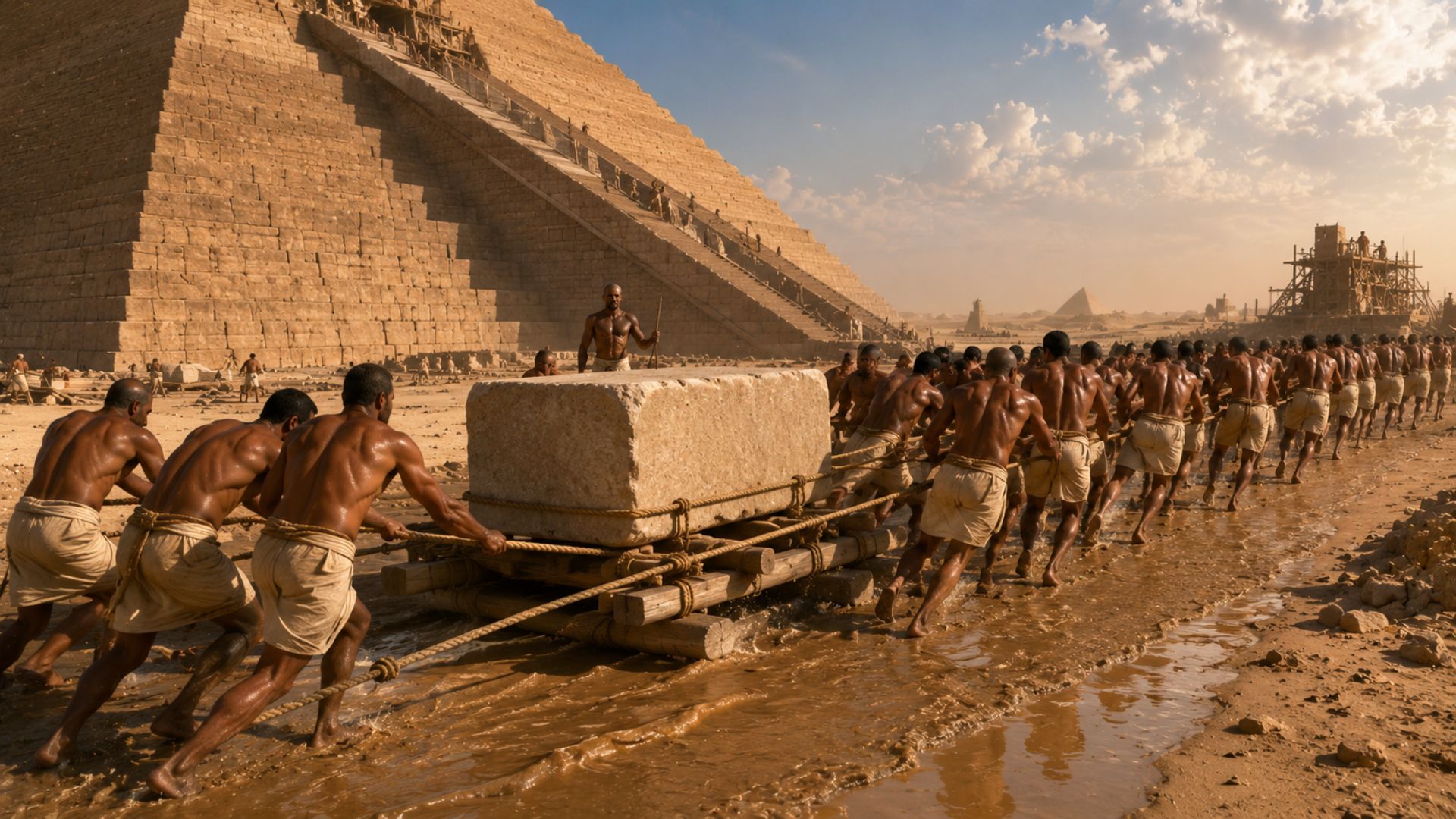


Without wheel, without iron, and without machine, teams of up to 32 men would have dragged 2.3-ton blocks over wet sand on a ramp embedded in the Great Pyramid of Giza itself. A new computer model estimates the construction in 20 to 27 years and reignites a millennial debate on how the Great Pyramid was built.
In March 2026, the independent Spanish researcher Vicente Luis Rosell Roig published in the scientific journal npj Heritage Science, from the Nature group, a study proposing a new explanation for one of history’s greatest enigmas: how the Egyptians built the Great Pyramid of Giza. Using a computer model that simulates the construction step by step, he suggests that teams of up to 32 workers dragged blocks averaging 2.3 tons over wet sand, without wheel, without iron, and without any modern machine, on a ramp embedded in the structure itself.
The model estimates that the pyramid was erected in a period of 20 to 27 years, a timeframe that coincides with the reign of Pharaoh Khufu, for whom the monument served as a tomb around 2560 BC. The proposal reignites a debate that has lasted centuries among archaeologists and engineers, with the major difference being that it is, for the first time, testable through an integrated simulation of geometry, logistics, and structural analysis, with open code and data for other scientists to verify.
The theory of the integrated ramp in the construction of the pyramid

Called IER, an acronym in English for Integrated Edge-Ramp, the system would be a spiral ramp embedded in the very edges of the pyramid, which rose along with the structure as the construction progressed, instead of a gigantic external ramp.
-
Antarctic Volcano Emits Microscopic Gold Particles That Travel Up to 1,000 Kilometers Across the Continent

-
Little-known Japanese factory is the world’s largest zipper manufacturer, producing 7 billion pieces annually and closing half the world’s pants.

-
Brazilian Factory Recycles One-Third of the Country’s Styrofoam Waste, Matching European Levels with 51,000 Tons Reused Since 2007
-
Brazilian Navy Conducts Major Military Exercise with 2,000 Troops, Amphibious Vehicles, and Drones on Lake Furnas in Minas Gerais


In practice, according to the study, the workers deliberately stopped placing the blocks at the edges of each level, creating a corridor about 3.8 meters wide through which the stones were pulled on sleds. As construction progressed, these gaps were filled, and the ramp simply disappeared, leaving no external traces. This mechanism would explain why no clear archaeological traces have ever been found of the gigantic external ramps that other theories about the pyramid assume.
How the stone blocks were transported without wheels or iron

According to the study, the limestone blocks, which weighed an average of 2.3 tons, were dragged on sleds over previously wetted sand. The water reduced friction between the sled and the ground, facilitating sliding, and teams of up to 32 workers pushed each piece up an incline of about 7 degrees, considered feasible for human effort.
The arsenal of the ancient builders was completed with ropes, levers, and wooden poles, with no wheels, no iron metal, or machinery. The 3.8-meter-wide corridor allowed traffic in both directions, with loaded sleds going up and empty sleds going down for the next load. Therefore, the entire engineering of the pyramid depended on organization, coordinated human strength, and refined technical knowledge, not on advanced technologies or, as suggested by theories without scientific basis, supernatural means.
The pace of one block every few minutes
To meet the deadline of Khufu’s reign, the system needed to operate in a parallel and intense manner. The model predicts up to 16 ramps functioning simultaneously in the initial phases of the work, when the base is wider, a number that decreased to 8, then 4, 2, and finally a single ramp at the top, as the pyramid narrowed towards the apex.
In the simulated pace, a block was positioned every 4 to 6 minutes. This intense flow, maintained over years, would result in a median duration of work on site between 13.8 and 20.6 years, according to the study’s calculations. Adding the stages of stone extraction in the quarries, transport via the Nile River, and seasonal work breaks, the total timeframe reaches 20 to 27 years, a period that fits precisely within the reign of the pharaoh for whom the pyramid was built.
The clues hidden inside the pyramid
One of the most intriguing points of the study connects the theory to a recent discovery. In recent years, muography techniques, which use cosmic particles to see through stone like a kind of natural x-ray, have detected empty spaces inside the Great Pyramid that intrigue researchers. According to Rosell Roig, these voids could be exactly the remains of the integrated ramps that were never completely filled during construction.
This is a verifiable hypothesis, and therein lies the great merit of the work. For the first time, a theory about the construction of the pyramid has gone through an integrated computational model, combining parametric geometry, logistics, and finite element analysis in a single platform. If the edges of the structure show the wear patterns predicted by the model, or if the internal voids have the projected shape, archaeology will have concrete data to confirm or discard the hypothesis, something rare in a field marked by speculation.
Why the debate about the pyramid is not over yet
Despite the consistency, the author himself acknowledges that the study does not end the discussion. Rival theories continue to compete. The most classic one proposes straight external ramps but encounters a serious geometric problem: to reach the top with a viable incline, the ramp would need to be twice the length of the pyramid, requiring a volume of material almost as large as the monument itself, without leaving traces.
Other researchers bet on different hypotheses, such as the use of hydraulic force to lift the blocks or mixed systems with zigzag ramps. Rosell Roig’s model enters this arena not as a definitive truth but as a rigorous and open tool to test the viability of each scenario. It is this data-driven approach that differentiates the work from the speculations that have surrounded the pyramid for millennia.
The consensus that remains about the Great Pyramid
Regardless of which theory prevails, there is a scientific consensus that remains intact and worth reinforcing against popular myths. The Great Pyramid was built around 2560 BC, during the reign of Khufu, by organized teams of specialized workers, not by slaves, as common sense still insists on repeating. Archaeological records, including workers’ villages and evidence of food and medical care, support this view.
The structure, with an original height of about 146.6 meters, a base of approximately 230 meters per side, and about 2.3 million blocks, is the oldest of the Seven Wonders of the Ancient World and the only one still standing. Each new study, like that of Rosell Roig, not only brings science closer to understanding how it was erected but also reinforces respect for the ingenuity of the ancient Egyptians, capable of solving a complex logistical problem with the resources of their time.
The question of how the Egyptians built the pyramid has persisted for more than four thousand years, and it may never have a single, definitive answer. But the integrated ramp model, by combining computer simulation, open data, and testable predictions, represents a leap in the way of investigating the mystery. Instead of speculation, verifiable science. The pyramids of Giza continue to guard their secrets, but with each study like this, humanity gets closer to understanding one of the greatest works ever erected on Earth.
Do you believe that the integrated ramp theory finally explains how the Great Pyramid was built, or do you think the mystery will continue? What impresses you most about this work of the ancient Egyptians? Leave your comment, tell us which theory about the pyramid’s construction you find most convincing, and share the article with those who love history, archaeology, and the great enigmas of humanity.





The equipment used to move large slabs, on the flat or up a slope, is illustrated in an ancient Egyptian drawing but ignored by everyone. Kurt Vonnegurt (apologies for spelling) included it in one of his books. Corners would still require some manhandling but the turning could be achieved fairly easily. I once saw a video clip taken in Israel. In the background there was a guy moving a large rock, maybe 50 kg, with little effort, using a small version of the same equipment. Farmers use the same principle with hay bales, no lifting, no dragging, no sledge
Its clear now that the pyramids and the huge structure underneath were built long before the Egyptians were around. No need to speculate any longer how people with copper tools and ropes managed to build them…