






 Portuguese
  Spanish


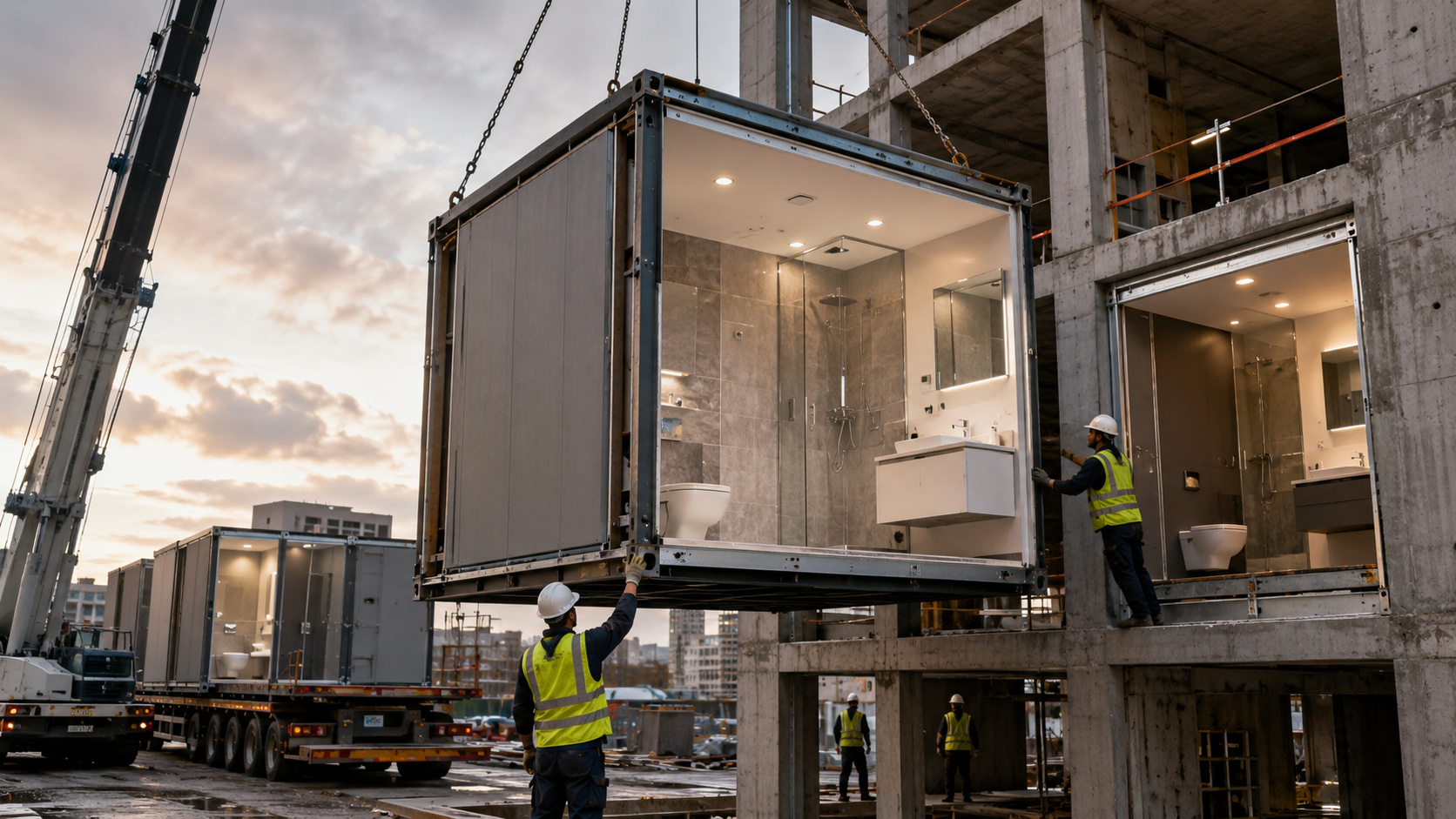


Modular bathrooms arrive ready from the factory with plumbing, electrical, toilet, sink, and finish to speed up construction and reduce labor.
The bathroom, one of the most time-consuming, expensive, and interference-prone parts of a construction, has started to move from the site to the factory. Instead of assembling plumbing, electrical, flooring, tiling, fixtures, fittings, and finishes piece by piece on-site, modular construction uses bathroom pods, bathroom modules manufactured off-site and then transported, hoisted, fitted, and connected to the building.
The logic is straightforward: transform an environment that depends on various professionals into an industrial unit ready for connection. The National Institute of Building Sciences states that factory-made bathrooms tend to have fewer defects, reduce construction time, improve quality, and decrease the complexity of coordinating plumbers, electricians, tilers, carpenters, and other specialists on-site.
Factory-ready modular bathroom replaces multiple teams with an industrialized unit
The traditional bathroom concentrates many steps in a few square meters. It is necessary to install pipes, electrical, waterproofing, subfloor, tiling, fixtures, fittings, ventilation, sealing and finishing, almost always with different teams working in sequence.
-
U.S. City Builds Tiny Home Village on Water Company Land to House 136 Homeless People: Inside the Social Housing Units

-
Woman Turns Shipping Container into Home, Embraces Rural Life to Cut Monthly Expenses to Just Over $330
-
France Revamps 530 Social Housing Units with Large Balconies and Glass Facades Without Demolishing Existing Buildings

-
Facing high rent, couple transforms parents’ garage into a fully functional apartment, creating a complete home at a fraction of the market cost.




In ready-made modules, much of this process happens in a controlled environment. The bathroom is produced as a volumetric component, with its own structure, embedded installations, internal finish, and points prepared for final connection to the building’s plumbing, electrical, and mechanical systems.
This model does not eliminate all labor, but changes where it works. Instead of concentrating professionals on-site, repetitive execution moves to the factory, while the construction site is responsible for logistics, hoisting, fitting, connection, and inspection.
Plumbing, electrical, sink, and finish arrive in the module before construction is completed
The strongest point of bathroom pods is that they can be produced while the construction is still progressing in other areas. The NIBS report explains that the manufacturer can produce and finish the bathroom while the land is still being moved or while the main structure of the building is underway.

This changes the logic of the schedule. Instead of waiting for the structure, masonry, shafts, and environment clearance to start the bathroom, the unit can arrive at the site ready to be positioned when the building is prepared.
The bathroom does not become operational before being connected. What arrives is a module with finished interior and systems, which needs to receive final connections for water, sewage, ventilation, electrical, and other building systems on site.
Technology reduces the conflict between plumber, electrician, tiler, and finishing within the construction
The practical advantage lies in the reduction of interferences. The NIBS highlights that, in traditional construction, many trades need to be organized to deliver a single bathroom, including plumbing, electrical, tiling, flooring, sealants, painting, carpentry, and other finishes.
This overlap creates delays, rework, and competition for space. An error in waterproofing can halt tiling; a misplaced pipe can delay fixtures and countertops; an electrical fault may require breaking after finishing.

With the modular bathroom, most of this coordination moves out of the unstable environment of the site and into a production line.
The gain is not just in “building faster,” but in reducing the sequence of human dependencies within the construction.
Modular construction can reduce labor and accelerate schedules
McKinsey states that modular construction can address challenges such as low productivity, global labor shortages, housing deficit, and carbon emissions.

The consultancy also points out that modular can reduce labor requirements by up to 40% and accelerate deadlines by up to 50%, but this data refers to modular construction in general, not exclusively to ready-made bathrooms.
Where the technology makes the most sense is in projects with many similar bathrooms, such as hotels, hospitals, student housing, multifamily buildings, and serial residential developments. NIBS itself cites hospitals, hotels, and housing as ideal markets for repetitive prefabricated components.
Shortage of bricklayers accelerates the search for ready-made bathrooms and off-site construction
The shortage of skilled labor is one of the pressures explaining the advancement of modular construction. The NIBS report points out that bathroom pods have a greater impact in areas with high labor costs and a lack of skilled workers, especially in remote locations and urban centers.
McKinsey also describes modular construction as a movement that shifts parts of construction activity from traditional sites to factories, with industrial-style production. The idea is to tackle a sector historically marked by low productivity and strong dependence on on-site manual labor.
In this scenario, the ready-made bathroom becomes an aggressive technology. It doesn’t just replace a task but compresses several construction stages into a single product manufactured off-site.
Factory-ready bathroom is not a luxury, it’s a sign of less artisanal work
The image seems futuristic, but the logic is industrial: manufacture repetitive environments in series, control quality in the factory, reduce rework, and install on-site only when the structure is ready.
NIBS states that bathroom pods reduce the coordination of multiple trades in the same area and can be quickly connected when utilities are correctly routed and grouped.
For civil construction, this is a profound change. The bathroom ceases to be a critical point built from scratch by various teams and becomes a technical, finished, and traceable module, almost like an assembly component.

The construction site of the future might not be a place full of professionals redoing the same stage in each apartment.
It could be a building receiving ready-made bathrooms, hoisted by cranes, fitted into place and connected like parts of a habitable machine.









