





 Portuguese
  English
  Spanish
  6 min of reading
  0 comments


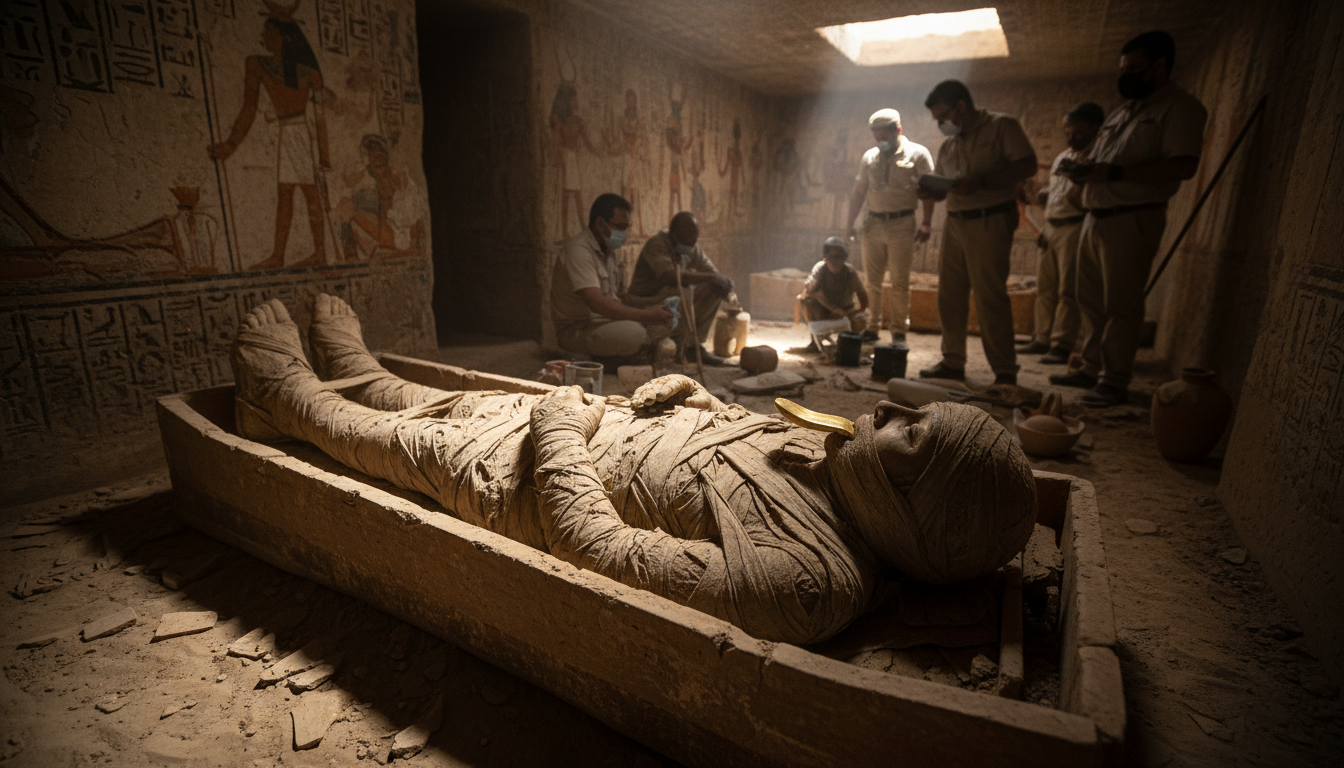
Egypt-Spain Mission finds in Oxyrhynchus a papyrus with the Catalogue of Ships from Book II of Homer’s Iliad sewn inside a 1,600-year-old mummy
Archaeologists opened a Roman tomb with 16 golden-tongued mummies in Al-Bahnasa Iliad Homer. Inside one of them, they found the first Greek literary text ever discovered in a funerary practice in history.
The text was a passage from Homer’s Iliad. Specifically, the Catalogue of Ships from Book II of the epic poem.
The discovery was announced on April 18, 2026. According to Archaeology Magazine, the mummy is about 1,600 years old.
-
Instagram finally delivers the feature that many people wanted and now allows users to reorganize posts, change the profile appearance, and highlight posts without having to delete anything from the grid.

-
Father cannot withstand the crisis and sells 5-year-old daughter for R$ 17,000 to pay for urgent surgery; agreement stipulates that the child will leave the family to get married in a country where aid has dropped by 70%.

-
What seemed like just an urban excavation to contain rainwater turned into a rare find in Germany: oak trunks, organized stones, and an ancient construction hidden beneath the city for more than two millennia.

-
Brazilian justice discovers hidden commands in processes and raises a red flag about the use of artificial intelligence in the analysis of legal actions


As reported by the Jerusalem Post, the find comes from an excavation campaign by the University of Barcelona and the Institute of the Ancient Near East.
Therefore, the mission is a binational Egypt-Spain effort. The site is called Al-Bahnasa, the ancient city of Oxyrhynchus in the Minya province.
Indeed, Oxyrhynchus is the cradle of world papyrology. It has provided more than 500,000 papyrus fragments since 1898. None had this type of use.

What is the Al-Bahnasa Iliad Homer papyrus and why it is unique
The text found in Al-Bahnasa Iliad Homer is a fragment of the Iliad. More specifically from Book II, the part known as the Catalogue of Ships.
The Catalogue of Ships lists the Greek contingents that set out for the Trojan War. It is one of the most famous passages in Western literature.
As reported by Heritage Daily, the papyrus was found sewn to the abdomen of the mummy. It was neither rolled nor free.
Therefore, the novelty is total. Previously, papyri found in mummies were only magical texts, ritual hymns, or protection formulas.
In parallel, the Iliad is a secular literary text. According to the analysis by the University of Barcelona, the presence of the epic poem in a funerary context is “unprecedented in the history of archaeology”.
Thus, the discovery rewrites the understanding of Greco-Roman funerary practices in Egypt.
Indeed, the text was identified by papyrologist Leah Mascia. As reported by ScienceAlert, the textual confirmation came from classical philologist Ignasi-Xavier Adiego.

Why the Iliad was inside a Roman mummy
The main question about Al-Bahnasa Iliad Homer still has no definitive answer. Researchers discuss possible meanings of the find.
One hypothesis is protection. According to the analysis by EurekAlert, Ignasi-Xavier Adiego suggests it may be “an identification mark of the embalming specialist”.
Therefore, the papyrus might have been the embalmer’s “signature”. He would have left a well-known scholarly text as proof of quality.
In parallel, another hypothesis is a ritual function. The Iliad may have been seen as a protective text even though it is secular.
According to the analysis by Finestre sull’Arte, there is a tradition of transforming literature into ritual in Mediterranean cultures.
Indeed, the mummy dates from the late Roman period. It was when Christianity began to spread through Egypt.
Thus, it is possible that the papyrus reflects cultural resistance. Keeping Homer in funerary practice would be a way to assert pagan identity.
Historical context: Oxyrhynchus, the capital of world papyrology
The site of Al-Bahnasa Iliad Homer is known to archaeologists as Oxyrhynchus. The city was an important Greco-Roman center in Egypt.
According to details from Wikipedia, the region is located in Middle Egypt, on the bank of the Bahr Yussef.
In 1898, British archaeologists Bernard Grenfell and Arthur Hunt began systematic excavations. They found piles of discarded papyri around the city.
Therefore, Oxyrhynchus became one of the largest deposits of ancient papyri in the world. Hundreds of thousands of fragments have been cataloged since then.
In parallel, other monumental finds have come from the site. According to the Wikipedia Oxyrhynchus Papyri, fragments of the Old Testament, Greek comedies, and poems by Sappho have been identified.
Indeed, Oxyrhynchus is the site that has returned the most classical Greek literary texts to the modern world. Each new campaign reveals something unprecedented.
- Location: Al-Bahnasa, Minya Governorate, Egypt
- Age of the mummy: ~1,600 years (Late Roman Empire)
- Total mummies: 16 with golden tongues
- Identified text: Iliad Book II, Catalogue of Ships
- Announcement: April 18, 2026
- Mission: University of Barcelona + Institute of the Ancient Near East
- Papyrologist: Leah Mascia (initial reading)
- Philologist: Ignasi-Xavier Adiego (confirmation)
Who were the dead in the Al-Bahnasa tomb
The tomb of Al-Bahnasa Iliad Homer housed 16 mummies. Each had a golden tongue sealed in their mouth.
According to the analysis by the Biblical Archaeology Society, golden tongues are a mark of social elite in Greco-Roman Egypt.
Therefore, these dead were important people. Probably priests, wealthy merchants, or Roman administrators.
In parallel, the function of the golden tongue was to speak with Osiris in the afterlife. The deity required the dead to “speak” their innocence during the final judgment.
According to Ancient Origins, there are hundreds of mummies with golden tongues already cataloged in Egypt.
Indeed, what makes this tomb special is not the golden tongue. It is the insertion of the Iliad in the abdomen of one of the mummies.

What comes next after the Al-Bahnasa discovery
The Al-Bahnasa Iliad Homer mission continues. According to the University of Barcelona’s schedule, there are a series of public lectures until May 11, 2026.
Therefore, more technical details of the find will be revealed in the coming weeks. The UB Faculty of Philology hosts the events.
In parallel, the excavation campaign continues. Another 24 tombs in the same necropolis have yet to be opened.
According to SciTech Daily, there is an expectation of more literary papyri in the next mummies. This could confirm or disprove current hypotheses.
Indeed, if more literary texts are found in mummies from the same period, the professional identification theory gains strength. If they are only ritual texts, the function of the Homeric papyrus was unique.
For another recent archaeological coverage from Click Petróleo e Gás, check out the coverage on the secret chamber of the Pyramid of Cheops.
For another similar case of ancient papyri discovery, check out the coverage on Brazilian paleontological finds from Click Petróleo e Gás.

The cultural impact of the discovery in the coming decades
The discovery of Al-Bahnasa Iliad Homer will impact the global academia. According to the analysis by New Criterion, Homer continues to influence cultures 2,700 years later.
Therefore, the find has a symbolic dimension. It shows how literary texts transcend religion and borders.
In parallel, the European classical community may revise manuals. According to the Wikipedia Catalogue of Ships, Book II of the Iliad is one of the most studied passages.
Indeed, any textual variation in the Al-Bahnasa fragment can change accepted versions. The manuscripts of the Iliad have small differences among them.
Thus, ancient papyri like this are a window to the “original”. Each new fragment contributes to the critical reconstruction of the text.
It is worth noting that there is still complete cataloging work ahead. The additional 24 tombs may alter the current interpretation.
Despite this, the historical novelty is guaranteed. Egypt has returned to the world the first known evidence of the Iliad used in a Greco-Roman funerary ritual.


-

-

2 people reacted to this.