






 Portuguese
  Spanish


Inspired by the Asian tuk-tuk, the GoSun Gopher electric tricycle combines solar panels, pedal assist, and 2,400 watts of power to replace conventional trucks in urban deliveries and rural work, with a load capacity of 272 kilograms and a utility vehicle classification that waives license and insurance.
Imagine a delivery truck that never stops at a gas station, recharges itself while parked in the sun, and even allows the driver to pedal whenever they want. This description, which sounds improbable, accurately summarizes the GoSun Gopher, a solar-powered electric cargo tricycle that has entered the market promising to replace conventional vehicles in delivery operations, street vending, and rural logistics. With capacity to transport 272 kilograms and up to three people, the utility vehicle challenges the idea that brute force requires internal combustion engines.
What makes the Gopher even more surprising is what it dispenses with. By falling under electric bicycle regulations in several countries, the tricycle does not require a driving license, vehicle registration, or mandatory insurance. In practice, anyone can operate it legally without facing bureaucracy, which opens up a huge range of applications for small entrepreneurs, farmers, and last-mile delivery operations that currently rely on a conventional truck with all its associated costs.
From Asian tuk-tuk to solar utility vehicle

The Gopher’s story begins in the congested urban centers of South Asia, where the motorized tuk-tuk has circulated for decades as an affordable solution for transporting people and goods. GoSun engineers started with this proven platform and reinvented it with contemporary technology. They removed the internal combustion engine, added electric pedal assist, and covered the roof with a set of 650-watt solar panels that transform light into miles traveled.
-
A fossil kept for years in a small museum in Montreal concealed 450-million-year-old soft tissue, a discovery that has only happened once before in history.

-
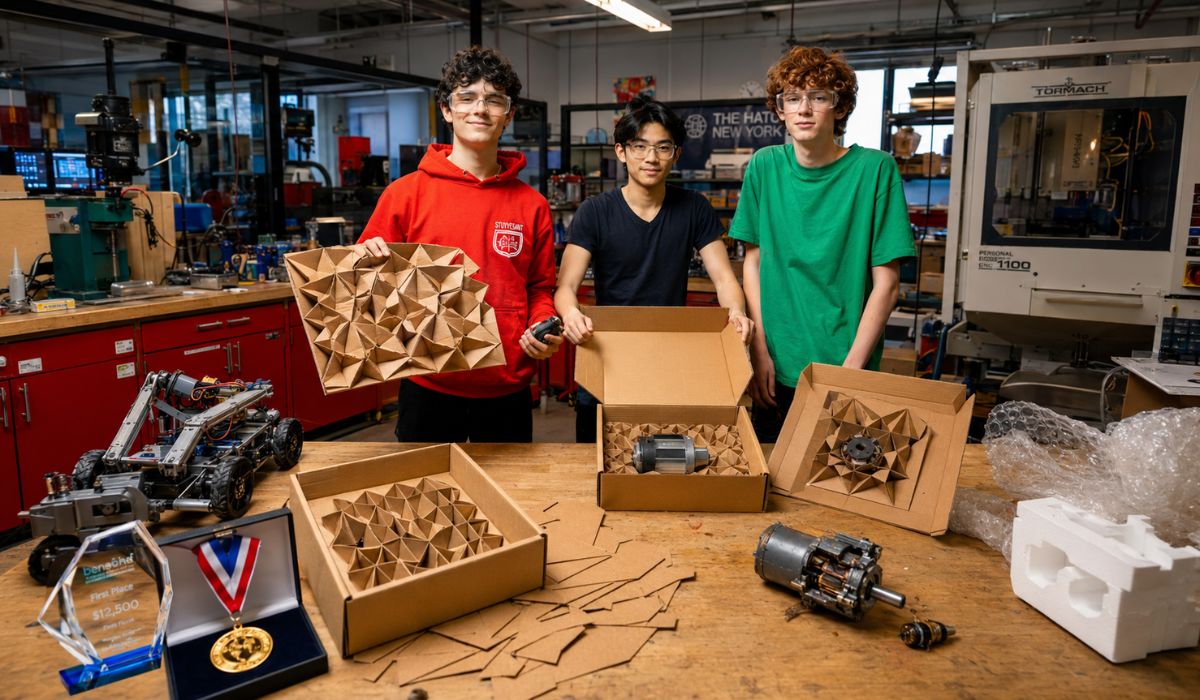
Three teenagers transform cut cardboard into Japanese origami-style packaging that promises to retire styrofoam and bubble wrap, win a $12,500 prize, and target giants like Amazon, FedEx, and Home Depot after a robot motor arrived broken.

-
The large jar blender has a rival: Oster Ultra Power bets on 1,000 W, six stainless steel blades, and two portable cups with leak-proof lids.

-
Tesla injected an additional $250 million into the German factory, doubled the battery cell target, and opened its own production line for startups.



The result is a utility vehicle that preserves the mechanical simplicity of the original tuk-tuk but delivers radically superior energy efficiency performance. The combination of electric propulsion with solar recharging means that the electric tricycle can operate for days on end in regions with good light incidence without relying on any refueling infrastructure. For rural areas or isolated communities, where fuel costs and the distance to the nearest gas station are real barriers, this autonomy represents a paradigm shift.
Heavy load in compact structure

The 272 kilograms of load capacity place the Gopher in a performance range comparable to that of a light truck in short-distance operations. The rear compartment offers 1.36 cubic meters of space for luggage and goods, protected by a weatherproof box with an integrated lock. Rain, dust, and theft attempts stay outside while the cargo remains safe and dry, something few delivery vehicles in this price range can guarantee.
The sides of the cargo compartment are designed to fold down and transform into flat work surfaces. This functionality converts the electric tricycle into a field workbench for farmers, a service counter for street vendors, or a preparation table for coffee-on-wheels operations. The utility vehicle ceases to be just transportation and becomes productive infrastructure, adapting to the operator’s activity with a versatility that a traditional truck simply does not offer.
Solar energy, battery, and the freedom of never refueling

The Gopher’s energetic heart is an integrated system that combines solar power panels with a high-performance battery. A full battery charge delivers up to 56 kilometers of range, and the 650-watt solar panels add approximately 36 additional kilometers per day of passive recharging. In practice, parking the tricycle in the sun is already fueling it, eliminating dependence on electrical outlets and making the operational cost close to zero.
In addition to powering the vehicle, the battery feeds a 2,400-watt AC output, enough power to operate power tools, kitchen equipment, lighting systems, or any common household appliance. This transforms the Gopher into a mobile solar power station. Farmers can power portable irrigation pumps, street vendors can keep refrigerators running, and field teams can charge electronic devices, all directly from the vehicle, without a diesel generator and without an extension cord.
No license, no registration, no insurance

The Gopher’s legal classification is perhaps its most disruptive differentiator. As it is classified as an electric cargo bicycle in various legislations, the electric tricycle does not require a driver’s license, registration with traffic authorities, or mandatory insurance. This regulatory condition simultaneously eliminates three of the biggest barriers to entry for those who need a utility work vehicle but cannot afford the bureaucracy and costs of a registered truck.
For micro-entrepreneurs, the math is transformative. The investment that would be allocated to licensing, IPVA (vehicle property tax), insurance, and internal combustion engine maintenance simply disappears from the spreadsheet. The total cost of ownership of the electric solar tricycle tends to be a fraction of that required by a conventional truck of similar capacity, especially considering that fuel is free and simplified mechanics drastically reduce workshop visits. Furthermore, the recent possibility of also using the Gopher as a scooter or cargo trailer further expands the versatility of the investment.
Truck, coffee, farm: the multiple lives of the Gopher
The versatility of the Gopher is already being tested in real-world applications around the globe. Last-mile delivery companies see the tricycle as an alternative to urban trucks that face circulation restrictions in historic centers and low-emission zones. Street vendors use the foldable sides as a coffee counter on wheels, with the solar power output feeding espresso machines and grinders without relying on an external generator.
In the field, the utility vehicle takes on the role of a farm helper. It transports tools, supplies, and even small harvests between sheds and cultivation areas with the cargo protected against the elements. Driving with electric assistance allows the operator to tackle inclined terrains and dirt roads without excessive effort, something the creators describe as an experience capable of bringing back the playful feeling of cycling. For rural properties that need mobility without the costs of maintaining a truck, the Gopher emerges as a work tool that pays for itself through the savings it generates.
What this tricycle says about the future of cargo mobility
The GoSun Gopher is not just a curious product. It crystallizes a broader trend in which solar energy, electrification, and regulatory simplification converge to create vehicles that meet real demands with radically lower costs. If a solar-powered electric tricycle can replace a light truck in dozens of practical operations, the question that arises is how many commercial fleets will continue to justify internal combustion engines in the next decade.
The combination of robust cargo capacity, solar range, and bureaucratic independence forms a package that no conventional utility vehicle delivers at the same level of accessibility. More than 50 patents protect the solar energy harvesting and onboard storage technologies in the electric tricycle, signaling that the manufacturer is betting on the continuous evolution of the platform. The Gopher could be just the beginning of an entire category of solar cargo vehicles that are redesigning short-distance logistics on a global scale.
And you, would you use a vehicle like this in your daily life? Can you imagine a solar-powered electric tricycle replacing the delivery truck or pickup truck in your area? Leave your comment and tell us how a solar cargo utility vehicle would change your routine.


Not sure I like all the patenting, there are plenty of electric tuk tuks in the world already, why not try to help them.
This is an amaIng invention. Hopefully this invenrion can be used for other vehicles. We don’t have to dependent on oil. No pollution.