Portuguese
  Spanish




Discovered in the final days of the Diavik mine in Canada, a 158-carat yellow diamond draws attention for its rarity, two-billion-year origin, and symbolism in the operation’s closure
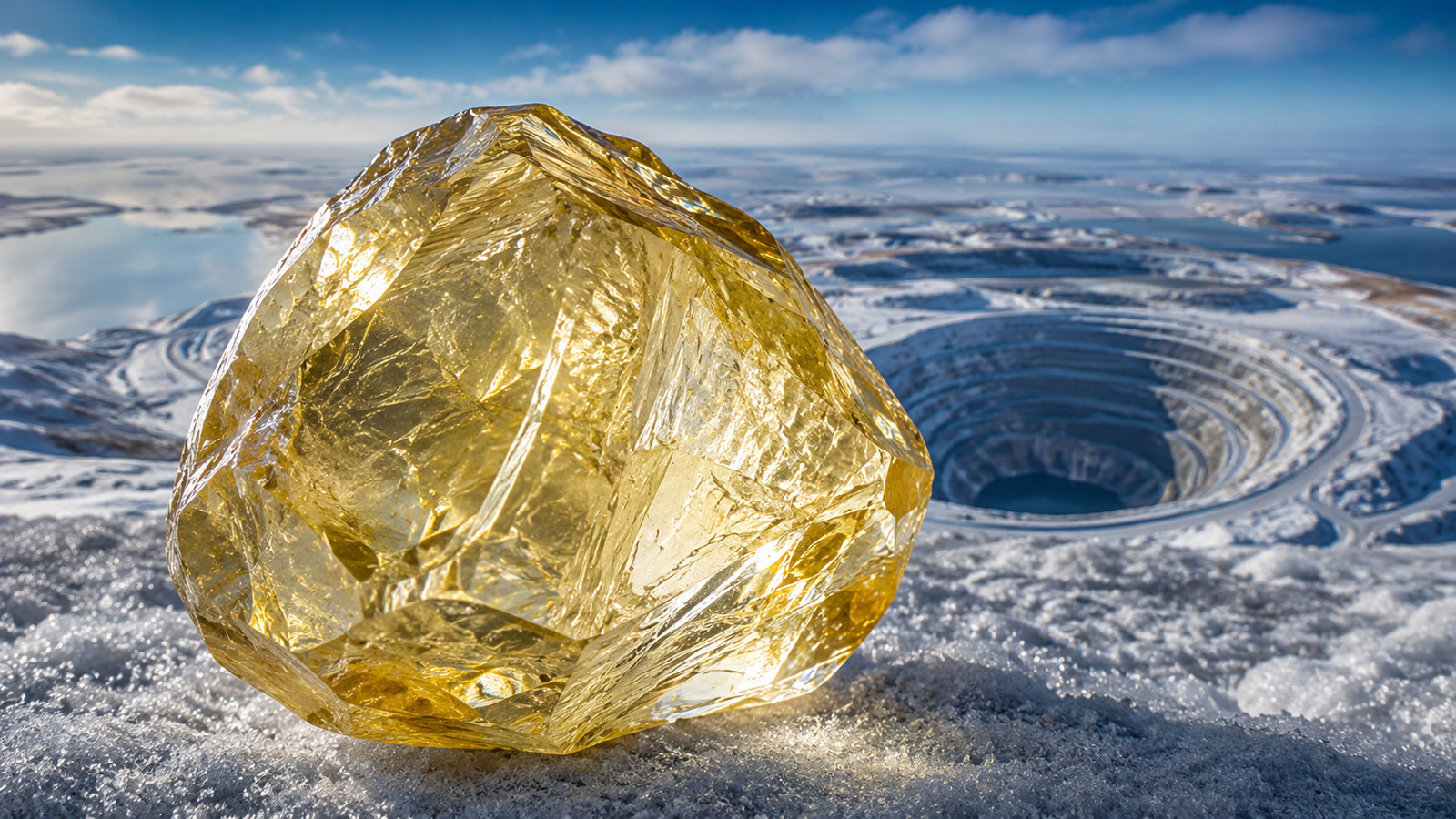
A yellow diamond weighing over 158 carats was found in early April at the Diavik mine in Canada, just before the operation’s closure, becoming one of the country’s rarest discoveries.


Unexpected find at the end of activity
The discovery occurred in a remote area of the planet, just a few kilometers from the Arctic Circle. The mine was in its final days when it revealed a stone capable of changing the significance of its closure.
The episode gained momentum by combining unusual size, rare color, and a symbolic moment. Where extraction seemed to belong to the past, the ground still held a piece formed in an almost impossible time.
-
Study Reveals 97% of Pregnant Munduruku Women in the Brazilian Amazon Have Mercury Levels Above Safe Limits, 90% of Newborns Contaminated by Gold Mining

-
China could reduce iron ore imports from 80% to 50% of consumption by 2030, while its share in global steel production falls from 52% to 46%, in a shift that could reshape the global market, says CMRG.
-
Brazil is sitting on one of the largest lithium reserves in the world, in the Jequitinhonha Valley, but national mining has almost become an appendage of China: 97% of the metal’s export goes to a single country, which also dominates refining.
-
Iron ore falls to 762 yuan in China as real estate sales decline and steel production hits lowest level since 2018


The yellow diamond was presented as more than a geological occurrence. Due to its size and context, it came to represent one of the last milestones of an operation that began more than two decades earlier.
Yellow diamond is among the largest in Canada
Weighing over 158 carats, the stone is among the largest yellow diamonds ever discovered in Canada. This type of gem is exceptional in the country and has appeared only a few times in comparable size in the mine’s history.
In more than twenty years of activity, only a few similar stones had been found. Therefore, the discovery entered an almost unprecedented category within Diavik’s production.
The rarity increases because yellow diamonds represent less than one percent of what was extracted from the mine. The find drew attention for its weight and the low frequency of this type of gem.
Origin dates back to two billion years
The stone’s value is also linked to its origin. Researchers explained that the yellow diamond formed approximately two billion years ago, deep within the Earth, through slow geological processes.
This formation remained untouched until it was extracted at the end of the mine’s productive life. The almost unimaginable age reinforces the unusual nature of the discovery, linked to geological time and the operation’s closure.
The yellow color comes from the presence of nitrogen in its crystalline structure. This detail adds uniqueness to the piece, which was already notable for its size, rarity, and the moment it appeared.

Diavik Mine closed after more than 150 million carats
The Diavik mine had been operating since 2003 and was closed after more than twenty years of activity. During this period, it produced over 150 million carats, consolidating its presence in northern Canada.
The emergence of the yellow diamond just before the end turned the discovery into a symbolic closure. The stone appeared as the mine was nearing the end of its productive journey.
This context gave the find a significance that goes beyond mining. The piece ended up being associated with the last moment of an area that concentrated technology, labor, and extraction in an extreme environment.
Operation required engineering in a subarctic environment
The importance of the discovery also lies in the conditions of the mine. Diavik operated in a subarctic climate, with extreme temperatures and geographical isolation, making each stage of extraction a technical and human challenge.
The operation required advanced solutions, including dams in icy waters and hybrid energy systems with renewable sources. This scenario shows that mining depended on a complex structure, not just the extraction of stones.
Throughout its existence, the mine also boosted the regional economy. It generated thousands of jobs, stimulated significant industrial activity, and maintained partnerships with local indigenous communities for land management and future restoration.
With the closure completed, environmental recovery begins. At this moment, the yellow diamond emerges as the last great sign left by Diavik, bringing together nature, technology, time, and mining in a symbolic conclusion.
With information from Xataka.