






 Portuguese
  Spanish


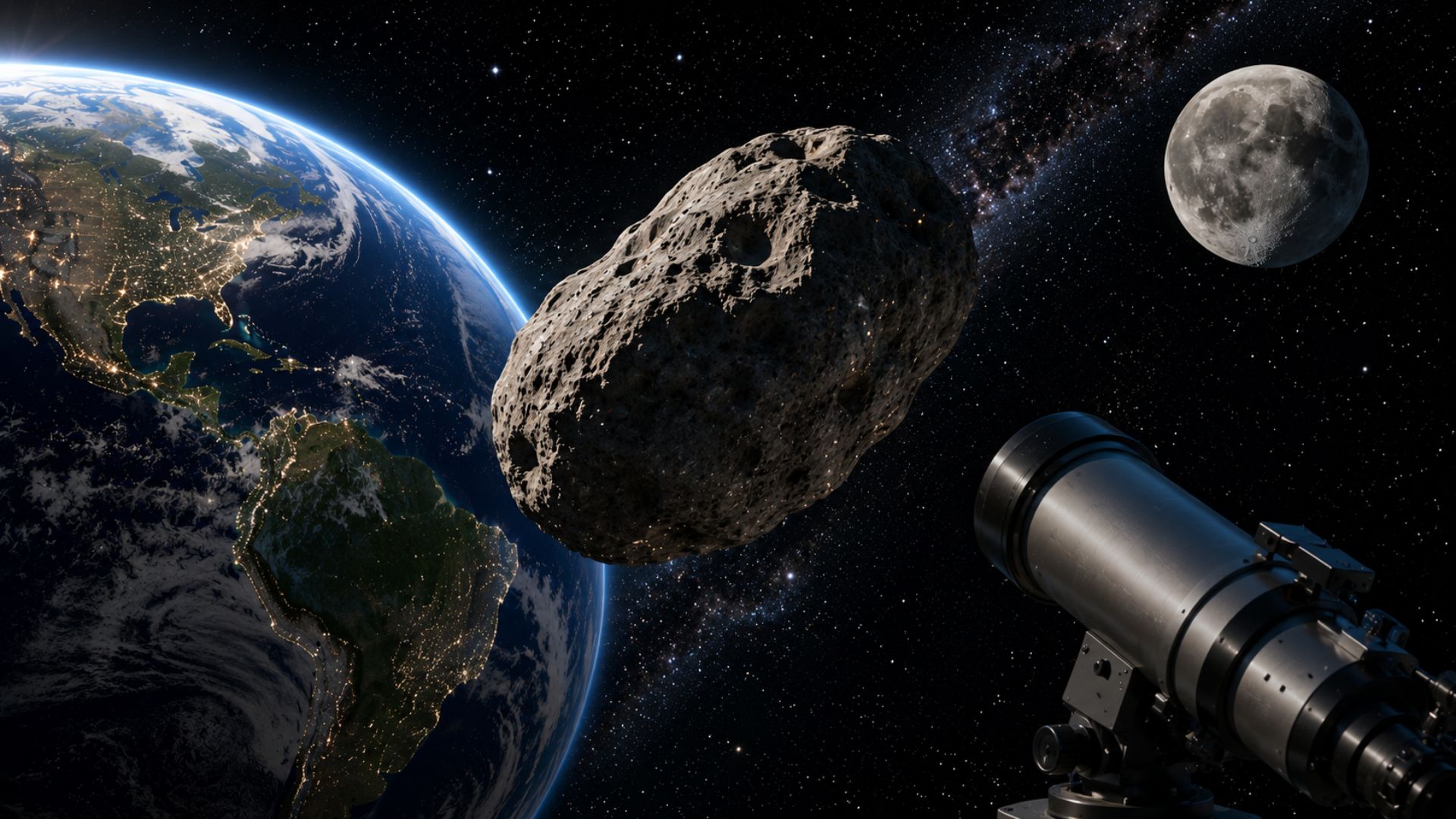

The asteroid 2026 JH2 will pass about 90,000 kilometers from Earth, a distance equivalent to approximately a quarter of the space between the planet and the Moon. According to NASA calculations, there is no risk of impact, and the approach can be followed live via the Virtual Telescope Project.
An asteroid discovered a few days ago by astronomers will pass by Earth next Monday (18) at a much closer distance than that which separates the planet from the Moon. Designated as 2026 JH2, the object will approach about 90,000 kilometers, according to calculations released by NASA, the United States space agency.
The good news is that there is no cause for concern. NASA’s current calculations do not indicate any evidence that the object will hit Earth during this approach, classified as safe by scientists studying the asteroid’s trajectory. For those interested in following the phenomenon, the Virtual Telescope Project plans to broadcast the encounter live starting at 6:45 PM Brasília time on Monday.
Who discovered the asteroid 2026 JH2 and when

The asteroid was identified just a few days ago by astronomers working at five different observatories around the world. Among them are the Farpoint Observatory in Wabaunsee County, Kansas, and the Mount Lemmon Observatory located in the Santa Catalina Mountains, Arizona, both in the United States.
-
China Develops Custom 140-Ton Electric Mining Truck with 770 kWh Swappable Battery, Deploys 290 Units in Xinjiang’s Largest Zinc Mine

-
Meta to Launch Arena, a New Prediction App Targeting 3.56 Billion Users, Competing with Polymarket and Kalshi

-
Scientist Challenges Famous Human Evolution Theory, Argues Homo Sapiens Evolved Gradually Over Thousands of Years
-
15-Year-Old American Builds Ocean Generator with PVC Pipe and 3D-Printed Propeller for $12, Wins National Prize, Presents at White House, and Makes Forbes 30 Under 30 List




The work of identifying objects like 2026 JH2 routinely takes place at these observation centers. Telescopes systematically scan the night sky for moving points of light, which may indicate the presence of new asteroids in Earth’s nearby orbit.
After the initial recording, the technical confirmation of the asteroid goes through the Minor Planet Center, an institution responsible for cataloging and naming these objects. This process resulted in the official designation 2026 JH2 and the international coordination to refine calculations on the celestial body’s trajectory.
Distance: less than the separation between Earth and Moon

The passage of the asteroid draws attention for a specific detail: the distance from Earth will be less than that which separates the planet from the Moon. For comparison, the average distance between Earth and the Moon is approximately 384,000 kilometers.
The 2026 JH2 will pass about 90,000 kilometers away, that is, about a quarter of the average distance to the Moon. In cosmic scale, this value is considered extremely close, but for the orbital safety standards monitored by NASA, it remains within a safe perimeter, with no risk of collision with Earth.
Approaches of this type are not rare in the monitoring done by NASA. Small asteroids frequently pass by Earth’s vicinity, but most are not visible to the naked eye and require specialized equipment to be detected and studied.
How big is the asteroid and what is the material
Estimates from NASA’s Jet Propulsion Laboratory, known by the acronym JPL, indicate that the asteroid 2026 JH2 is between 15 and 30 meters in diameter. The measurement is based on the apparent brightness of the object and the amount of light scientists believe its surface reflects towards Earth.
The size range is considered small in the universe of asteroids monitored by NASA. Celestial bodies up to a few dozen meters are sufficient to cause visible atmospheric phenomena if they enter Earth’s atmosphere, but they are far from the catastrophic impact scenarios involving objects hundreds of meters or kilometers across.
The exact composition of 2026 JH2 has not yet been precisely determined. Astronomers continue to collect data to better understand the physical structure of the asteroid, but so far the object has been tracked only 24 times over several days, a number considered limited for deeper analyses of its orbit and composition.
Apollo Class: what does this mean
The asteroid 2026 JH2 has been classified by NASA as a near-Earth object of the Apollo class. This group includes celestial bodies with specific orbital characteristics that deserve continuous attention from space monitoring programs.
According to the definition by the American agency, these asteroids have an orbit larger than Earth’s orbit around the Sun, but their trajectory crosses the planet’s orbit. Precisely because of this intersection between orbits, bodies classified as Apollo are closely monitored by NASA and other space agencies around the world.
Permanent monitoring serves to identify any changes in the orbital behavior of these asteroids in advance. Most of them pass by Earth’s vicinity without any danger, but the monitoring history is what allows NASA to anticipate decades of movement to confirm safety.
How to watch the passage live
For those who want to follow the event without needing their own equipment, the Virtual Telescope Project has organized a live broadcast of the encounter. The initiative is coordinated by Italian astrophysicist Gianluca Masi and usually broadcasts asteroid approaches in real-time to the general public.
The broadcast starts at 5:45 PM Eastern Time, which corresponds to 6:45 PM Brasília time next Monday. The Virtual Telescope Project maintains its own channel on the internet, where the observation can be watched for free by anyone anywhere in the world, including Brazil.
This type of broadcast has become popular in recent years as a way to bring the public closer to astronomical observations. For most people, the live broadcast option is the only viable way to follow the asteroid’s passage, as objects of this size require powerful telescopes to be visible from the Earth’s surface.
The trajectory is still being refined
Although preliminary calculations have already been released, astronomers continue to work to better understand the asteroid’s orbit and physical characteristics. The number of observations recorded so far is considered small for a complete picture of the object.
The 2026 JH2 was tracked only 24 times over several days by teams taking turns at the five observatories involved in the discovery. Each new measurement helps refine the exact trajectory prediction, but current calculations are already sufficient for NASA to rule out any risk of impact with Earth during the approach scheduled for Monday.
The process of orbital refinement is routine in this type of discovery. After the passage, the data collected during the encounter will be used to project future approaches of the asteroid, which are expected to repeat over long periods due to its orbit classified as Apollo by NASA.
Why approaches like this interest science
Even without the risk of impact, the passage of 2026 JH2 brings important opportunities for science. The approach allows telescopes on Earth’s surface to collect detailed data about an object that would normally be difficult to study at such distances.
This type of observation helps astronomers better understand the composition of asteroids that cross Earth’s orbit. The accumulated knowledge is a fundamental part of global efforts to prepare against potential future threats, even though 2026 JH2 poses no real risk to the planet.
NASA maintains specific planetary defense programs, which include missions to test ways to divert asteroids from Earth’s path should it become necessary in the future. Monitoring objects like 2026 JH2 feeds these programs with data that can be used in decades of research.
The approach of the asteroid 2026 JH2 next Monday is a reminder that the space around Earth is in constant motion, even when we don’t notice it. Small celestial bodies frequently cross the planet’s path, and the continuous work of NASA and other observatories ensures the peace of mind that none of them pose a real threat.
And you, do you plan to watch the live broadcast of this passage? Do you believe that NASA’s investment in planetary defense programs is sufficient in the face of potential cosmic risks? Did you know that asteroids of this size pass so close to Earth frequently? Leave your comment, share your opinion, and tag someone who loves astronomy.






