






 Portuguese
  Spanish


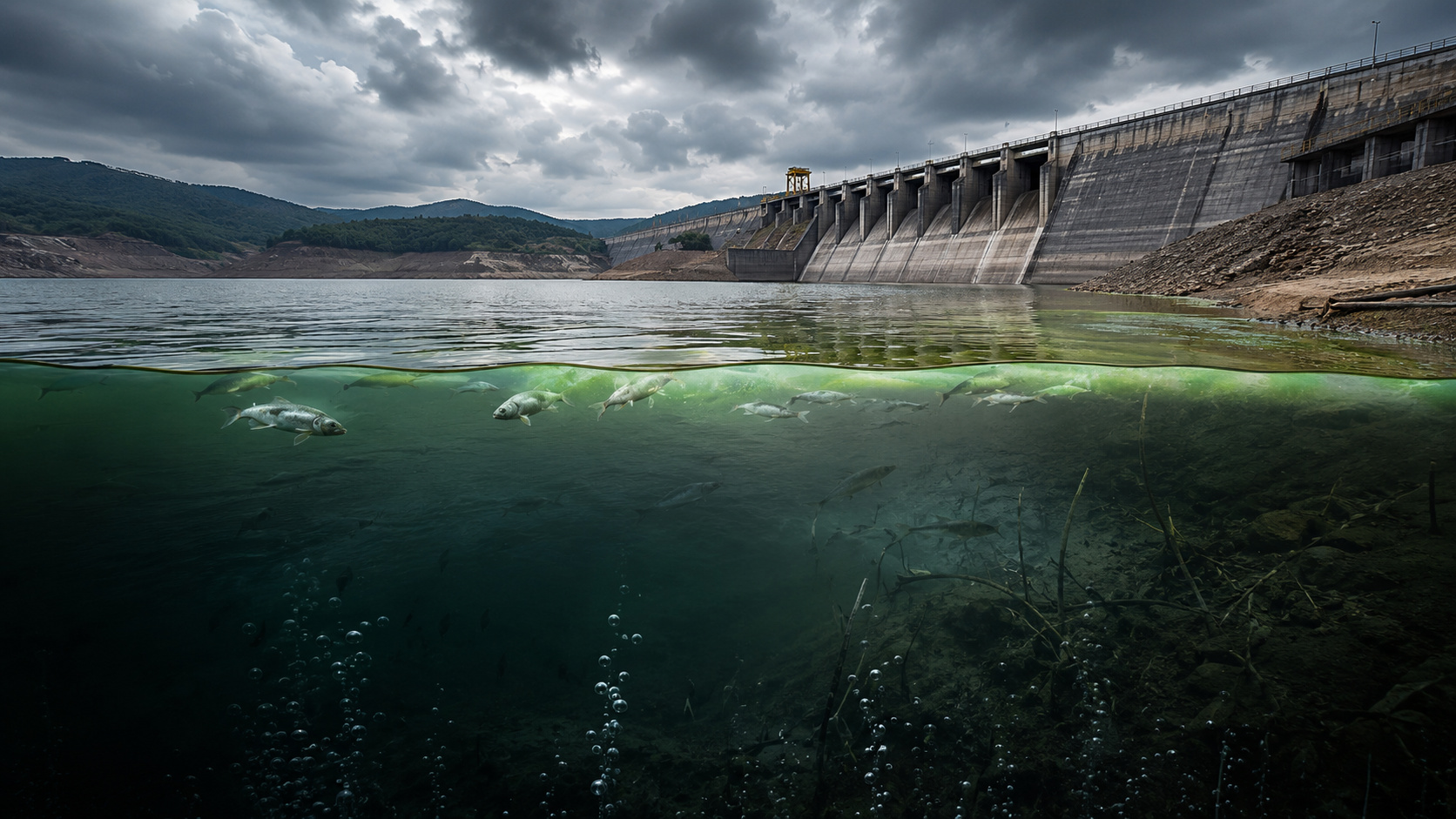


Study reveals oxygen drop in 74% of large global reservoirs, posing risks to biodiversity, water, and emissions.
A study published in Scientific Reports in December 2025 analyzed 357 large artificial reservoirs worldwide and identified a widespread decline in dissolved oxygen between 1984 and 2023. According to researchers Liangwei Liao and Xinge Cai, 264 reservoirs, equivalent to 74% of the sample, showed deoxygenation during the period. The most concerning data is that the average rate of decline was 0.13 mg/L per decade, a rate described in the study as faster than observed in natural lakes, oceans, and rivers in comparable periods. In reservoirs, this loss can affect fish, water quality, nutrients, sediments, and even greenhouse gas emissions.
Dissolved oxygen is one of the vital signs of reservoirs, dams, and large artificial lakes
Dissolved oxygen, known by the acronym DO in scientific studies, indicates how much oxygen is available in the water to sustain fish, invertebrates, microorganisms, and essential chemical processes. When this level drops too low, the environment can enter hypoxia or anoxia.
Hypoxia occurs when there is insufficient oxygen for many forms of aquatic life, while anoxia represents an almost total absence of oxygen in certain layers. The study cites reference limits of DO below 2 mg/L for hypoxia and below 0.5 mg/L for anoxia.
-
China Develops Custom 140-Ton Electric Mining Truck with 770 kWh Swappable Battery, Deploys 290 Units in Xinjiang’s Largest Zinc Mine

-
Meta to Launch Arena, a New Prediction App Targeting 3.56 Billion Users, Competing with Polymarket and Kalshi

-
Scientist Challenges Famous Human Evolution Theory, Argues Homo Sapiens Evolved Gradually Over Thousands of Years
-
15-Year-Old American Builds Ocean Generator with PVC Pipe and 3D-Printed Propeller for $12, Wins National Prize, Presents at White House, and Makes Forbes 30 Under 30 List




In artificial reservoirs, this problem gains special weight because they are not just ecosystems. They also store water for supply, irrigation, energy, navigation, flood control, and economic activities.
Study used satellites and machine learning to reconstruct four decades of oxygen in water
The research developed a model based on remote sensing and machine learning to estimate dissolved oxygen in reservoirs with an area greater than 100 km². The model was calibrated with about 32,065 in situ samples of dissolved oxygen.
Among three methods tested, Random Forest showed the best performance, with R² of 0.73 and an average error of 1.23 mg/L in the test set. This allowed the reconstruction of oxygen dynamics in large reservoirs over nearly 40 years.
This point is important because direct measurements in global reservoirs are limited and irregular. The use of satellites has allowed for an expansion of the analysis scale, covering regions where continuous field collection is difficult.
74% of the analyzed reservoirs lost oxygen between 1984 and 2023
The central result is straightforward: 74% of the global reservoirs studied lost surface dissolved oxygen between 1984 and 2023. This represents 264 of the 357 reservoirs analyzed.
The average global trend was a decrease of 0.13 mg/L per decade, while the reservoirs that lost oxygen showed an average decrease of 0.07 mg/L per decade. The study also identified that 26% of the sample showed an increase, indicating that the phenomenon is not uniform.


Even so, the loss appears on all evaluated continents. The average rates were -0.07 mg/L in Africa, -0.06 mg/L in Asia, -0.12 mg/L in Europe, -0.10 mg/L in North America, -0.05 mg/L in Oceania, and -0.05 mg/L in South America.
Reservoirs may lose oxygen faster than lakes, oceans, and rivers
The study states that the rate of decline in reservoirs was faster than that observed in other aquatic environments over similar periods. The comparison cited by the authors points to about -0.08 mg/L per decade in lakes, -0.02 mg/L in oceans, and -0.04 mg/L in rivers.
This difference may occur because reservoirs combine natural and artificial characteristics. They are influenced by climate, warming, nutrients, land use, dam operations, and changes in water flow.
When the water becomes stratified, deep layers can become isolated from the oxygenated surface. With less vertical mixing, the oxygen at the bottom is consumed by biological processes and is not replenished at the same rate.
Warming, land use, and nutrients appear as main drivers of the decline
The study’s attribution analysis indicated three major groups of factors behind the oxygen decline. Climate changes accounted for about 46%, human disturbances for 31%, and biogeochemical processes for 23%.
The increase in temperature reduces the solubility of oxygen in water. In simple terms, warmer water can retain less oxygen, while simultaneously accelerating microbial metabolism and oxygen consumption.
Agriculture and other land use changes also weigh in. The influx of nutrients can stimulate algae blooms; when this organic material decomposes, microorganisms consume oxygen and can push the reservoir to critical levels.
The loss of oxygen can affect fish, supply, and water quality
When dissolved oxygen drops, fish and other organisms may lose habitat, migrate to smaller areas, or die in extreme events. The loss also alters food chains and reduces the ecological stability of the reservoir.

The study highlights that deoxygenation can favor harmful algae blooms, biodiversity loss, and deterioration of drinking water. These effects make the problem relevant not only for ecologists but also for cities, hydroelectric plants, and supply systems.
Reservoirs with low oxygenation at the bottom can also release phosphorus, nitrogen, and reduced metals from sediments. This feeds back into eutrophication and worsens water quality in cycles that are difficult to control.
Low oxygen can also increase methane and nitrous oxide emissions
Deoxygenation has a climate impact because it changes microbial processes within the water and sediments. In oxygen-poor environments, microorganisms can produce more methane and nitrous oxide, potent greenhouse gases.
GEOMAR and other researchers argue that the loss of aquatic oxygen should be treated as a possible planetary boundary, because it responds to global warming and can also interfere with climate cycles, biodiversity, and economic activities.

This is the point that strengthens the agenda. Dams and reservoirs are usually seen as water and energy infrastructure, but they can also transform into active biogeochemical systems, capable of altering nutrients, carbon, and invisible gases.
The study does not claim that all reservoirs are on the brink of collapse. The conclusion is more precise: the loss of oxygen is widespread, measurable, and faster in these environments than in other comparable aquatic systems.
This requires more continuous monitoring because reservoirs are central pieces of supply, energy, irrigation, and water security. When oxygen levels drop, the problem is not limited to fish; it can affect water quality, treatment costs, and ecological stability.
The question that remains is how many dams are still treated only as engineering works when data shows they also function as artificial ecosystems sensitive to warming, land use, and increasing human pressure.







