Portuguese
  Spanish


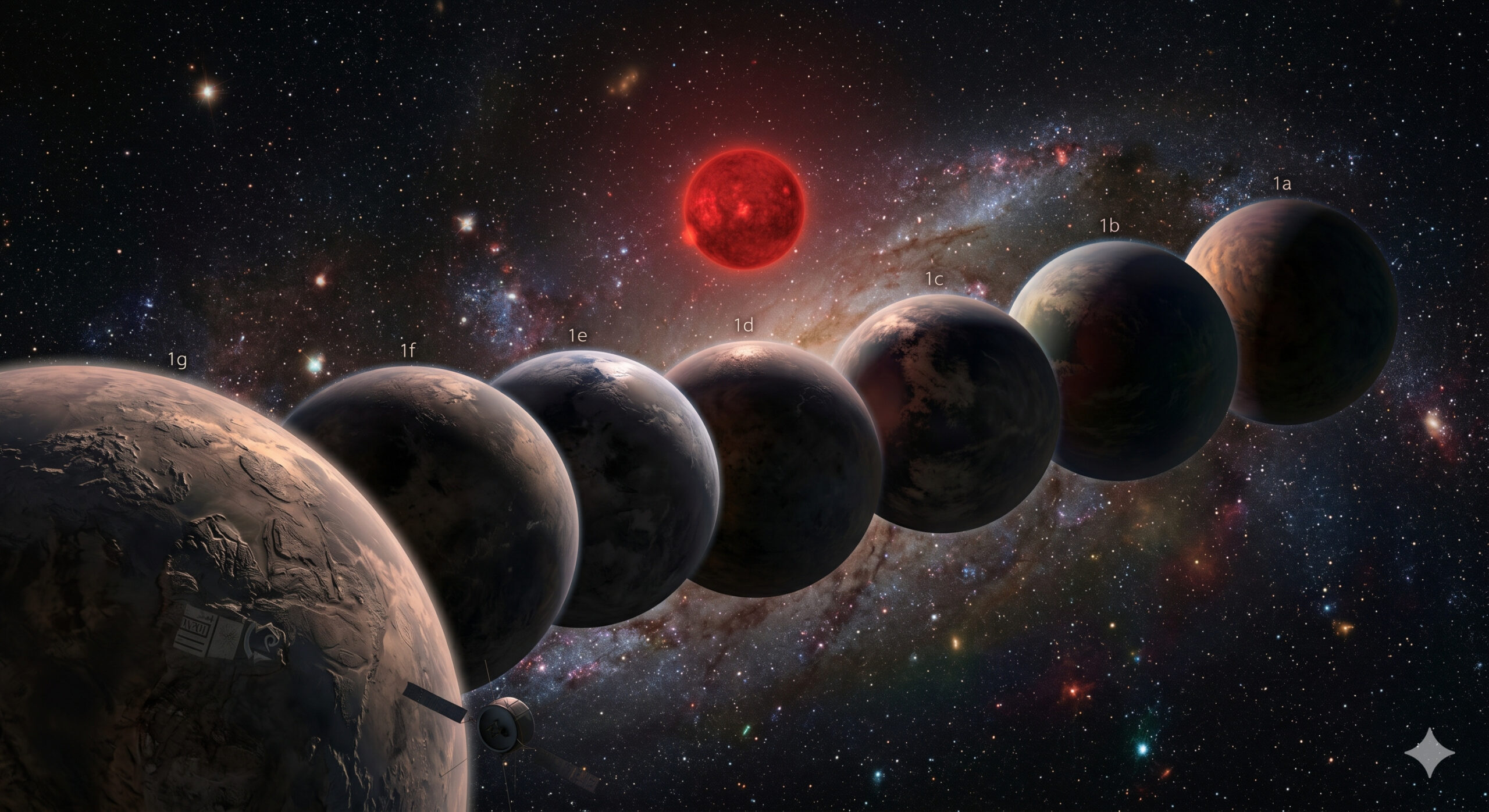


TRAPPIST-1 system challenges James Webb by not revealing if planet in habitable zone has atmosphere, creating impasse in search for life.
In December 2025, researchers led by Ana Glidden from the Massachusetts Institute of Technology published new results in the Astrophysical Journal Letters about the TRAPPIST-1 system, located about 41 light-years from Earth, which hosts seven rocky planets similar in size to Earth. The study utilized data from the James Webb Space Telescope, considered the most advanced instrument ever placed in orbit for the analysis of exoplanetary atmospheres. The main focus was the planet TRAPPIST-1 e, considered the best positioned within the so-called habitable zone of the system.
The result, however, surprised the scientific community: even after years of observation and multiple attempts, the telescope could not confirm or rule out the presence of an atmosphere on the planet.
This type of result, although seemingly frustrating, represents one of the most complex scenarios ever faced in the search for life beyond Earth.
-
In Andradina, in the interior of SP, a tannery transformed tilapia skin that slaughterhouses used to throw away into exotic leather for bags, shoes, and even wedding dresses, producing about 2,000 pieces per month and exporting to seven countries, proving that fish waste has become high-value fashion.

-
The industrial waste that even recyclers didn’t want has gained value in the interior of Bahia: two entrepreneurs invested R$ 2.8 million to transform 350 tons per year of foam, rubber, and plastic into boards that can replace wood and MDF.

-
What is a red flashlight used for, after all? See why it is so commonly used at night.

-
He has never read a line of code, but he already knows how to work: the French company UMA presented in Paris the Northstar, its first AI-powered humanoid robot designed for factories and warehouses, capable of copying tasks just by observing an employee in action.



The system with seven Earth-like planets that became a priority in the search for life
The TRAPPIST-1 system is one of the most studied in modern astronomy precisely because of its unusual configuration.
It orbits an ultra-cool dwarf star and contains seven rocky planets with sizes close to that of Earth, three of which — including TRAPPIST-1 e — are located in the habitable zone, a region where the temperature could allow for the existence of liquid water.


This rare alignment has made the system one of the main candidates for investigating the existence of atmospheres and, potentially, conditions favorable to life.
Since its discovery, the system has been the target of intensive observations by ground-based and space telescopes, culminating in the use of James Webb for more detailed analyses.
What James Webb tried to measure and why the atmosphere is the key piece
The main objective of the observations with James Webb was to detect chemical signals in the planet’s atmosphere.
When a planet passes in front of its star, part of the starlight passes through its atmosphere, allowing instruments to identify present gases based on spectral signatures.
The detection of an atmosphere is considered an essential step in assessing habitability, as it can regulate temperature, protect against radiation, and allow for the existence of liquid water. In the case of TRAPPIST-1, scientists sought to identify gases such as:
- Carbon dioxide
- Methane
- Water vapor
- Nitrogen
Results exclude some scenarios but keep others open
Although it did not confirm the presence of an atmosphere, the study was able to rule out some possibilities.
The data indicate that the planet likely does not have a thick hydrogen-rich atmosphere, like that of gas giants.

Scenarios similar to the following were also ruled out:
- Dense atmosphere like that of Venus
- Extremely thin atmosphere like that of Mars
However, the possibility of a more subtle atmosphere, dominated by nitrogen with traces of carbon dioxide or methane, remains open. This type of atmosphere is more difficult to detect, especially in systems like TRAPPIST-1.
Spots on the star create noise and make data reading difficult
One of the main obstacles faced by scientists is not the planet itself, but the star. The star TRAPPIST-1 has stellar spots — regions with different temperatures that alter the emitted light.

These variations create interferences in the data captured by the telescope, making it difficult to separate signals from the star and possible signals from the planet’s atmosphere.
This phenomenon acts like “noise” that can mask or mimic chemical signatures, making interpretation much more complex.
One of the greatest impasses faced in the search for life beyond Earth
The inconclusive result is not seen as a failure, but as a step forward in understanding the limits of observation. For the first time, a telescope with unprecedented capability encounters real difficulty in determining the presence of an atmosphere on a potentially habitable planet.
This raises important questions:
- How many planets may be in this zone of uncertainty?
- To what extent can we detect thin atmospheres?
- What are we missing to see even with advanced technology?
The role of TRAPPIST-1 as a natural laboratory for understanding rocky planets
The TRAPPIST-1 system remains one of the best natural laboratories for studying rocky planets outside the Solar System.

By containing multiple planets with similar characteristics, it allows for direct comparisons within the same stellar environment.
This helps scientists understand how factors such as radiation, proximity to the star, and composition influence the presence or absence of atmospheres. Even with inconclusive results, each new observation contributes to refining models and techniques.
The James Webb has not finished the work, and new observations are underway
Researchers emphasize that the study does not represent a final point. The James Webb will continue observing the TRAPPIST-1 system in search of clearer signals.
With more data, it will be possible to reduce uncertainties, improve models, and perhaps finally confirm the presence or absence of an atmosphere.
The continuation of observations is essential to overcome current limitations, especially those caused by stellar activity.
What is at stake in the search for atmospheres on Earth-like planets
The detection of an atmosphere on a rocky planet outside the Solar System is considered one of the most important steps in astrobiology.
It may indicate conditions for the existence of liquid water and, potentially, life. However, the case of TRAPPIST-1 shows that even with advanced technology, this task is still far from simple.
The difficulty in obtaining clear answers reveals how much the universe may be more complex than current models predict.
Do you believe we are close to finding life beyond Earth or just beginning to understand the limits of observation
The TRAPPIST-1 system presents science with a curious scenario: the more advanced the technology, the more complex the questions become.
The fact that we cannot confirm an atmosphere on one of the most promising known planets shows that the search for life still faces fundamental challenges.
The central question is not just to find a habitable planet, but to understand if we have enough tools to recognize signs of life when they are truly present.
In light of this impasse, an inevitable reflection arises: are we close to a great discovery or just beginning to realize how much we still cannot see in the universe.