






 Portuguese
  Spanish
  3 min of reading
  0 comments


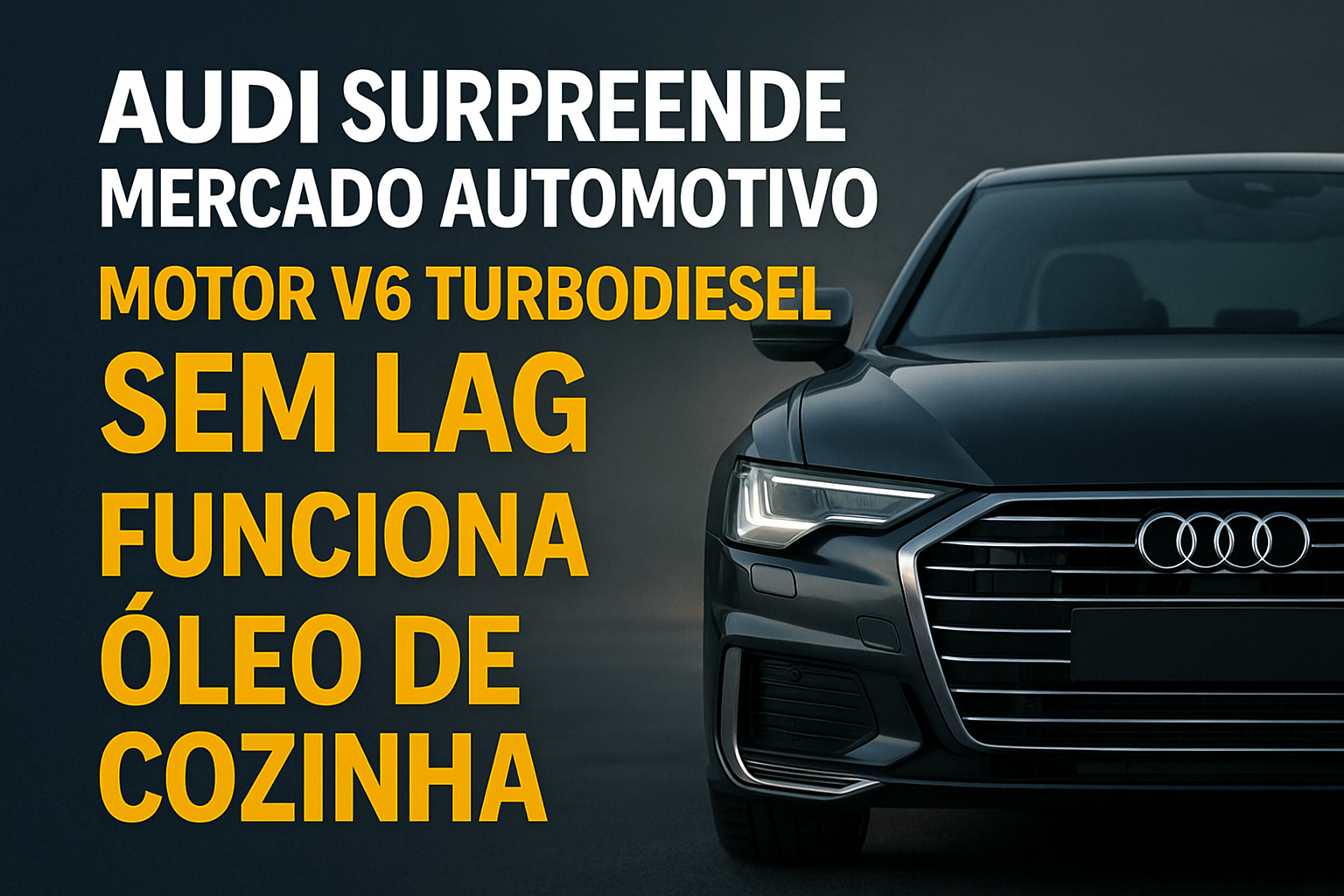
Audi V6 Turbo Diesel Engine Surprises With Instant Response And Uses Cooking Oil As Fuel.
Audi Invests in Innovation to Save Diesel in the Automotive Market
The European automotive market is undergoing rapid transformations, and Audi decided to react before the diesel engine disappears completely.
The automaker launched, in 2025, a new V6 turbo diesel engine, featured in the A6 and Q5 models, with a bold proposal: immediate response, high efficiency, and compatibility with cooking oil converted into renewable fuel.
The technology enters the market just as diesel is losing ground, as the European Union continues to push for lower emissions. Thus, Audi tries to demonstrate why it still bets on TDI — and why it believes there is room for innovation in the segment.
-
Uber Faces Shareholder Scrutiny as Board Accused of Ignoring Safety, Compliance, and Harassment Warnings Amid Over 3,500 U.S. Lawsuits

-
Ferrari’s First Electric Car Divides Fans, Priced at $630,000, Amid Concerns Over Limited Editions; Brand Clarifies It’s Not Just for Future Perks
-
BYD Dolphin Mini: The Electric Car That Defies Depreciation, Losing Only 3.58% in a Year and Becoming the Best-Selling Retail Model Under $22,000

-
Electric Car JAC E-JS4 Loses $19,000 in Value in One Year, Leading Record Depreciation of Used Cars in Brazil Due to Expensive Battery and New Models


Today, diesel represents only 8% of the European automotive market, far from the more than 50% it dominated in the early 2000s. Moreover, hybrids, gasoline, and even plug-in hybrids have already surpassed consumer preferences.
Therefore, the brand decided to act quickly and present a solution that aims to combine the best of both worlds: strong performance and reduced emissions.
Audi V6 Turbo Diesel Engine Delivers Instant Response With Electric Compressor
Audi implemented the most advanced mild hybrid system ever used by the brand in the new V6 turbo diesel engine. It works in conjunction with an electric compressor, a device that acts before the traditional turbocharger and eliminates the notorious “turbo lag”.
When the driver accelerates and the turbo has not yet built enough energy, air first passes through the electric compressor, which compresses the intake and sends more pressure to the combustion chamber.
This way, torque appears immediately — something rare in diesel engines. The brand claims that the response resembles that of an electric car with equivalent power.
Thus, the 3.0 V6 EA897evo4 delivers 300 hp at 3,620 rpm and 59.1 kgfm at 1,500 rpm. Another novelty is the speed: the maximum turbo pressure reaches almost one second earlier compared to the previous model. The turbine also spins 40% faster, reaching 90,000 rpm in just 250 milliseconds.
Strong Acceleration and Support From The Mild Hybrid System
During take-offs, the mild hybrid system adds 25 extra hp and an additional 23.4 kgfm, improving initial performance. Thus, the Audi A6 Sedan goes from 0 to 100 km/h in 5.2 seconds, while the Avant version takes just 0.1 seconds longer.
Interestingly, the Q5, although taller and weighing the same as the A6 Sedan, is even faster. Both the standard version and the Sportback reach 100 km/h in 5.0 seconds and attain the same 250 km/h electronically limited top speed.
Innovation and Efficiency: Turbo Diesel Engine Runs Even On Cooking Oil
Even as an evolution of an existing engine from the Volkswagen Group — the EA897 launched in 2010 — Audi claims this is the cleanest and most efficient version ever produced.
The innovation stands out: the engine accepts HVO (hydrotreated vegetable oil), fuel produced from used cooking oil and agricultural waste. HVO reduces CO₂ emissions by up to 95% compared to regular diesel. Additionally, Audi already utilizes this biofuel in vehicles manufactured in Neckarsulm and Ingolstadt, Germany.
The brand emphasizes that the new V6 has improved durability, surpassing the limitations of previous versions — including those marked by the Dieselgate scandal, in which the EA897 was involved.
Why Does Audi Insist on Diesel?
The automaker recalls that its history with TDI engines is long. Since 1989, Audi has been manufacturing diesel cars and has won Le Mans eight times with a model equipped with this technology. Even a supercar R8 received a V12 TDI — although it was never sold.
Now, with the new V6 turbo diesel, the brand attempts to prove that there is still room for efficiency, performance, and more sustainable solutions in a declining segment.





Be the first to react!