






 Portuguese
  Spanish


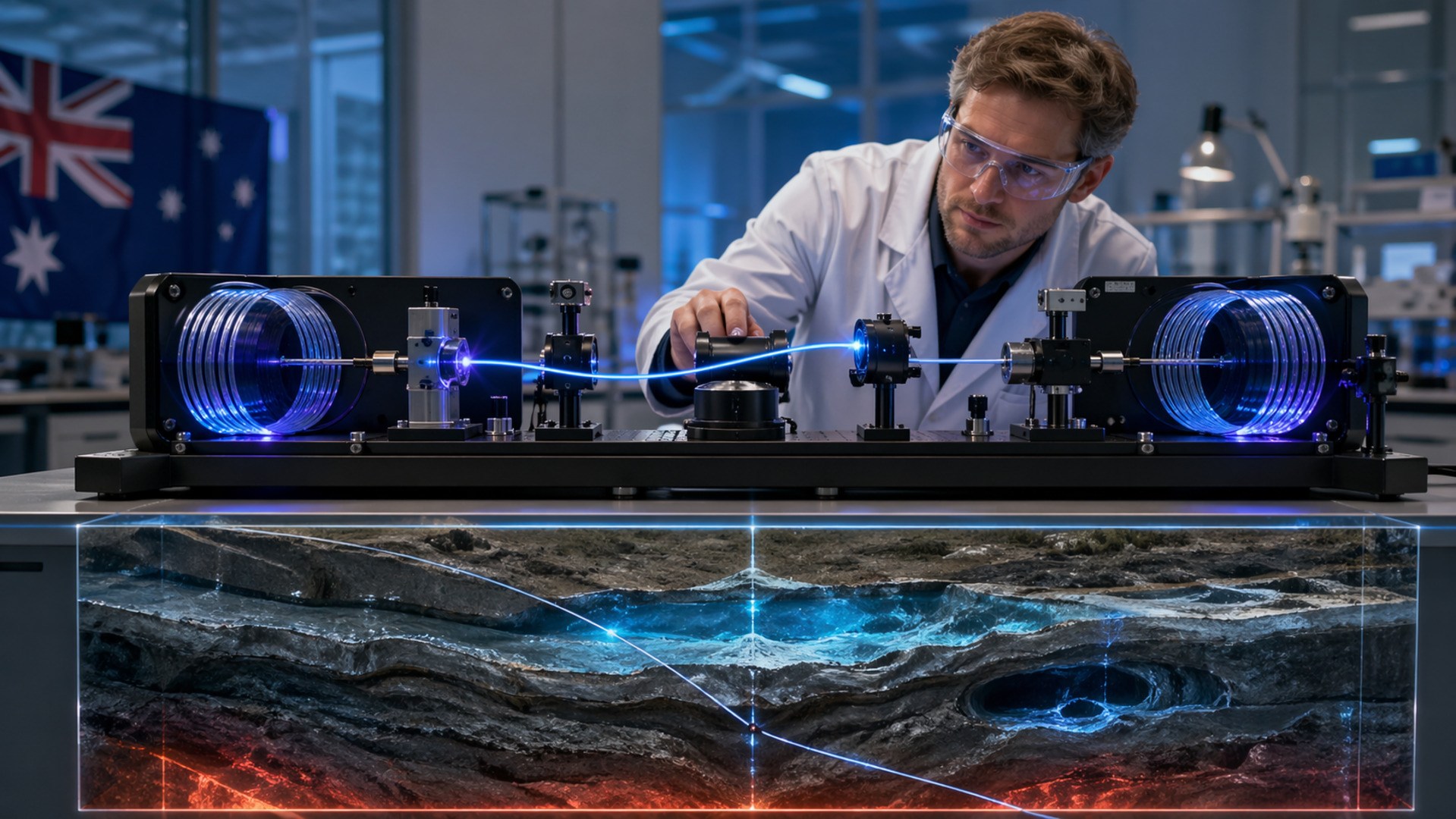


Enbang Li’s research from the University of Wollongong shows how a compact device with fiber optic coils can bend light, measure minimal delays in laser beams, and open new possibilities for monitoring groundwater, magma, tunnels, and hidden environmental changes
Australian physicist Enbang Li, a senior lecturer at the University of Wollongong’s School of Physics, has developed a simple and effective technique to bend light using gravity. The experiment involves a device just 1 meter long and could pave the way for new applications in mapping, monitoring, and navigation.
The research also brings into question an assumption formulated by Albert Einstein in 1905, that the speed of light is constant in a vacuum and independent of the observer’s motion. Experimental results indicate that photons can interact with Earth’s gravitational field in ways that can influence light propagation.
Compact Device Can Bend Light
The equipment created by Enbang Li has reduced dimensions and does not exceed 1 meter in height. Despite its compact size, it brings together two coils of fiber optic cable that, if unrolled, would extend over 10 kilometers.
-
$7,999 Isaac 1 Robot Aims to Tackle Household Chaos: Folds Clothes, Makes Beds, and Organizes, but Raises Privacy and Cost Concerns with Camera Reliance and Remote Human Assistance

-
Mobile Electron Accelerator Units Enable Safe Testing of Water, Materials, and Industrial Waste Treatment in Countries Without Permanent Labs

-
Brazil Invests $12 Million in Biodiversity to Develop Drug Molecules, but When Will It Reduce Dependence on Imported Pharmaceutical Ingredients?
-
3D Printing: From 1945 Sci-Fi Concept to Modern-Day Prosthetics, Homes, and Industrial Parts


The system works by comparing the temporal delay between two light beams that travel through the fiber optic cable in the spiral coils and then return. These delays are extremely small, usually only a few picoseconds, but the data obtained can be amplified and used to record disturbances in laser light caused by gravity.
The proposal allows light to be bent under controlled laboratory conditions, something that has long been difficult to achieve on Earth. The experiment relates to the phenomenon known as gravitational lensing, used by astrophysicists to explain the bending of light from distant stars by the gravity of dense celestial bodies.
Gravity Can Reveal Hidden Changes
The ability to measure small gravitational variations is one of the main avenues opened by the device. Subtle changes in gravity can indicate alterations below the surface or in the surroundings, including groundwater levels and magma accumulation under volcanoes.
Li stated that these variations can reveal critical changes around or below the surface, including signals associated with future eruptions. The research suggests that light-based sensing technologies could, in the future, detect and monitor these transformations with very high precision.
Gravity detection is already used in areas such as mining, defense, and geosciences. These applications help to “see” below the surface by identifying differences in the density of rocks, minerals, water, and underground tunnels.
Light-Based Sensors Can Overcome Limitations
Most current sensors rely on mechanical systems capable of detecting vibrations and movements. This characteristic limits their use on mobile platforms, such as submarines and airplanes, where stability and sensitivity are essential factors.
Light-based detectors can overcome some of these limitations. In addition to offering greater sensitivity and stability, these systems can occupy a reduced space, which expands the possibilities for use in compact equipment and moving platforms.
Li’s device still operates under controlled laboratory conditions, which aided the calibration process. The work remains in its initial phase but already provides a basis for better exploring the interactions between light and gravitational fields.
Research Challenges Einstein’s Old Assumption
By demonstrating a way to bend light with a benchtop device, the research also rekindles discussions about the fundamentals of physics. In 1905, Einstein postulated that the speed of light is constant in a vacuum and independent of the observer’s motion.
Li stated that experimental results suggest that photons can interact with Earth’s gravitational field in ways that influence how light propagates. This observation offers a new perspective on an old assumption in modern physics.
The researcher acknowledges that further progress will be needed to identify the sources of fluctuations in the time delay signals detected by the equipment. While this step continues, the device keeps open new possibilities for sensing technologies and for the study of the relationship between light and gravity.
Applications may extend to mapping and navigation
Possible applications of the device include mapping, monitoring, and navigation systems. The ability to bend light and measure minimal changes can contribute to instruments capable of detecting changes that are not directly visible.
In areas such as mining and geosciences, reading density differences can aid in identifying rocks, minerals, water, and underground structures. In defense and navigation, more stable and compact sensors can be useful in mobile and difficult-to-operate environments.
Even in its initial phase, Enbang Li‘s work presents a light-based alternative for gravitational measurements. The advance shows how a small device, supported by more than 10 kilometers of optical fiber, can bend light and extend the reach of sensors aimed at hidden changes below or around the surface.
Click here to access the study.


