Portuguese
  Spanish


Sealed sarcophagus discovered in Alexandria in 2018 surprised archaeologists by revealing deteriorated human remains and traces of infiltration.
An archaeological discovery made in Alexandria, Egypt, has once again drawn attention for involving one of the most intriguing sarcophagi ever found in the region.
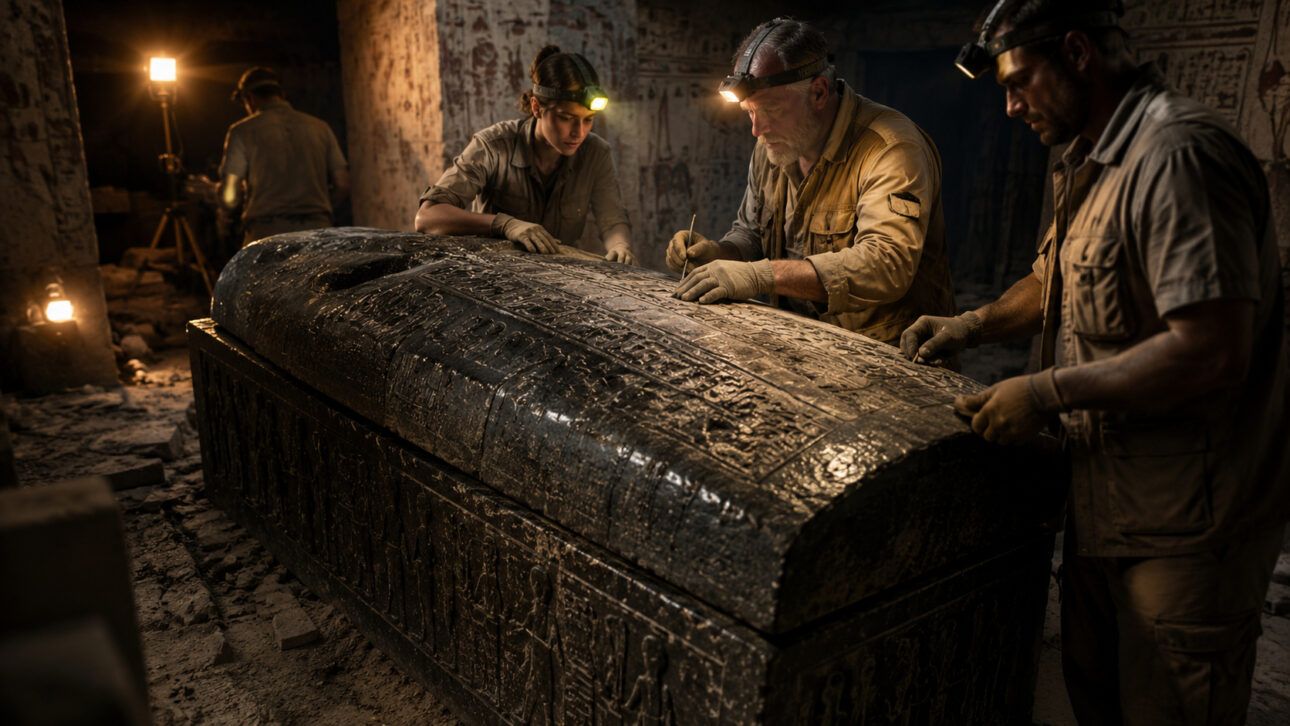
The black granite sarcophagus was located in July 2018, during excavations in the Sidi Gaber district, according to the Egyptian Ministry of Antiquities.
The artifact impressed due to its size, weight, and the fact that it was sealed, a detail that increased curiosity about what might exist inside.
-
Childhood Psychology: Experts Highlight How Playing Outdoors Until Dusk Boosted Autonomy, Decision-Making, and Resilience in Previous Generations, Influencing Adult Behavior Today

-
Former Truck Driver from Brazil Builds Logistics Company Aiming for $70 Million Revenue with 11 Branches, 700 Monthly Clients, and $10 Million Fleet Investment

-
World’s First Plasma Dress Turns Fashion Show into Scientific Spectacle with Controlled Electric Discharges and Ionized Gases in Iris Van Herpen’s Groundbreaking Tech-Fashion Creation

-
Phone Falls from Plane at 300 Meters in Rio de Janeiro, Continues Recording for 15 Seconds, Found by Environmentalist Next Day in Unbelievable Twist




The discovery gained international attention at the time, mainly because ancient tombs often raise questions about funerary rituals, preserved skeletons, and ceremonial objects.
Black granite sarcophagus impresses archaeologists
The stone coffin found in Alexandria was described as one of the largest ever identified in the city.
Its sealed state increased the caution of specialists, as any opening could damage important historical evidence.
Archaeologists also considered possible risks involving gases, accumulated liquids, and fragile materials preserved over the centuries.
The process required technical attention and monitoring by professionals linked to the Supreme Council of Antiquities of Egypt.
What was inside the sarcophagus?
The opening of the sarcophagus revealed three human skeletons in an advanced state of deterioration.
The interior also contained a reddish liquid, later associated with the infiltration of groundwater and sewage.
The discovery dispelled exaggerated theories that circulated on the internet, such as stories about curses, ancient monsters, or secret treasures.
The find, nonetheless, maintained great scientific value, as it revealed information about ancient burials and preservation conditions in Alexandria.

Modern technology helps preserve ancient finds
Modern archaeology uses methods capable of investigating tombs and artifacts without destroying their content.
Among the main techniques used in similar studies are:
- High-resolution tomography, for 3D reconstructions;
- Muography, with cosmic rays, to analyze internal densities;
- Thermal scanning, to identify material differences;
- Digital modeling, without direct contact with the artifact.
These resources allow for the evaluation of internal structures before any physical intervention.
The technologies also help protect bones, tissues, seals, liquids, and possible ceremonial objects.
Why does the discovery matter for Ancient Egypt?
Each intact sarcophagus functions as a kind of time capsule.
Researchers can better understand beliefs, funerary rituals, social hierarchies, and burial practices of Ancient Egypt.
The case of Alexandria also reinforced the importance of archaeological conservation.
Even without gold or great treasures, the sarcophagus provided answers about death, preservation, and the historical occupation of the city.
Mysteries still surround sealed tombs
Many ancient sarcophagi remain closed or partially studied, despite technological advances.
Each new investigation can reveal unprecedented details about ancient civilizations.
Experts emphasize that the priority should be the preservation of historical heritage.
In this way, science can balance discovery, safety, and respect for the memory of ancient civilizations.
What do you think might still be hidden in sealed sarcophagi from Ancient Egypt? Share your opinion!