Portuguese
  Spanish



Discover how Iris Van Herpen’s plasma dress combines haute couture, plasma technology, and scientific innovation in a landmark of technological fashion.
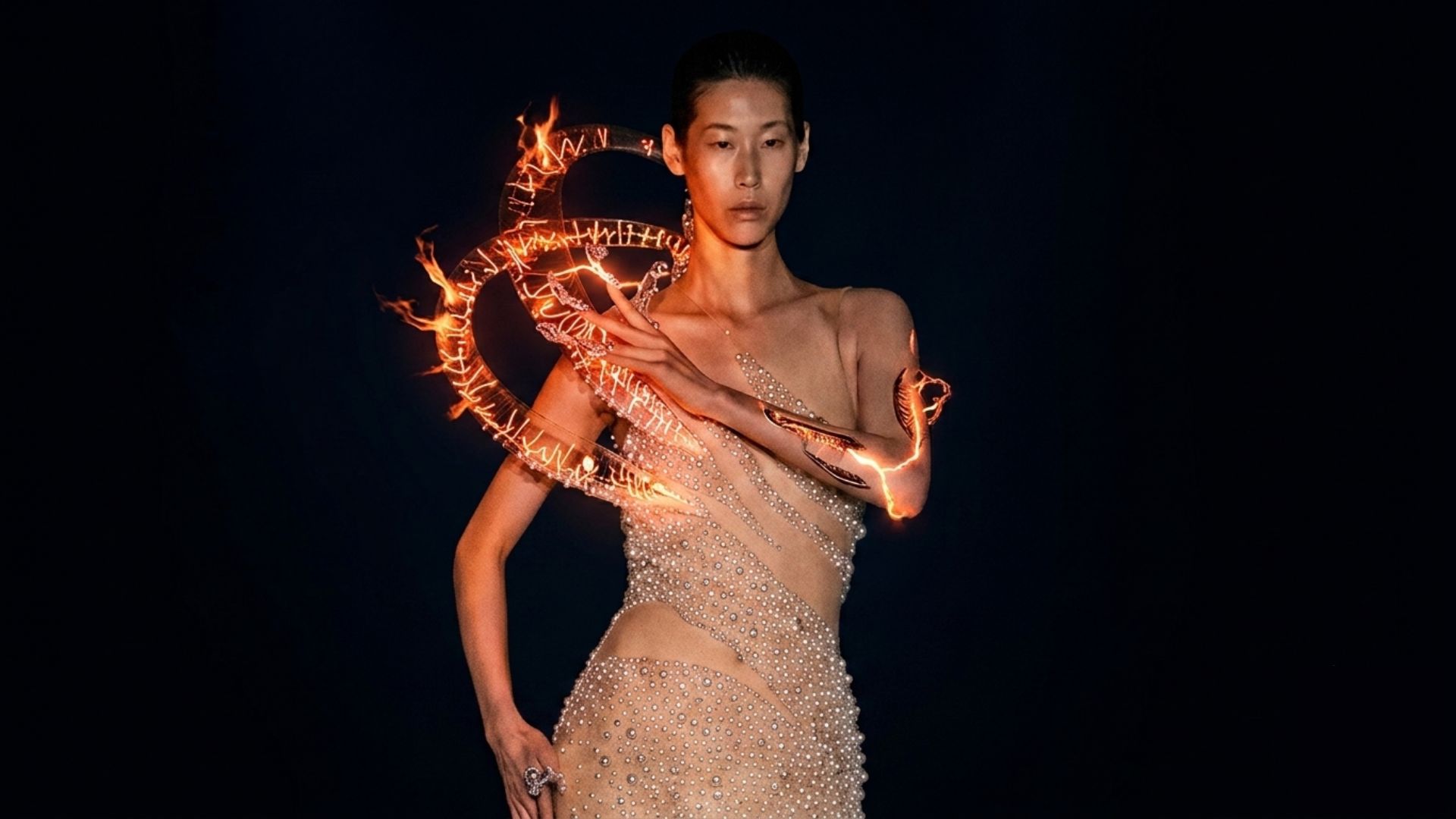
The debut of the plasma dress during the Paris Haute Couture Week, which began this Monday (6), marked one of the most innovative moments in contemporary fashion. The Dutch designer Iris Van Herpen, internationally recognized for combining science, art, and design, presented the piece named Helix Nebula, considered the first plasma dress in history.
The project goes beyond the aesthetic aspect. The creation uses ionized gas encapsulated in hand-blown glass structures, allowing the plasma to react to human touch through a carefully controlled electric field. The result is an unprecedented visual experience that brings technological fashion closer to scientific advances typically seen in research laboratories.
According to an article published by CNN Brazil on July 6, 2026, in addition to the Helix Nebula, the “Sonic Starquakes” collection presented other pieces inspired by astronomical phenomena, reinforcing the designer’s identity in transforming complex scientific concepts into works of haute couture.
-
Former Truck Driver from Brazil Builds Logistics Company Aiming for $70 Million Revenue with 11 Branches, 700 Monthly Clients, and $10 Million Fleet Investment

-
Phone Falls from Plane at 300 Meters in Rio de Janeiro, Continues Recording for 15 Seconds, Found by Environmentalist Next Day in Unbelievable Twist
-
8-Year-Old Finds 900-Year-Old Viking Bronze Buckle on Swedish Beach While Fossil Hunting
-
8-Year-Old Who Ran Barefoot Wins Race in Brazil with Shoes Gifted by Famous Athlete, Becomes Symbol of Hope but Family Seeks Support to Sustain Athletic Dream



Plasma dress inaugurates a new phase for technological fashion
The plasma dress represents one of the greatest advances ever seen in the relationship between fashion and science. Unlike clothes illuminated by LEDs or optical fibers, the piece effectively uses an ionized gas, known as plasma, considered by physics as the fourth state of matter.
According to NASA, approximately 99.9% of the visible matter in the universe is in the plasma state, present in the Sun, stars, and various space phenomena. On Earth, however, this physical state is relatively rare, being found mainly in lightning, fluorescent lamps, experimental reactors, and industrial equipment.
By transporting this concept into an artistic creation, Iris Van Herpen further expands the boundaries of technological fashion, showing that clothes can incorporate real principles of physics without losing their artistic character.
Iris Van Herpen transforms science into haute couture with plasma technology
Since the creation of her maison in 2007, Iris Van Herpen has become a world reference for integrating scientific innovation into the universe of haute couture.
Throughout her career, her collections have already utilized 3D printing, biomimetics, computational architecture, artificial intelligence, experimental materials, and materials engineering.
With the plasma dress, however, the designer reaches a new level. The piece was constructed on an extremely lightweight tulle base, while two suspended blown glass structures received the ionized gas responsible for the luminous effect.
The functioning depends on the interaction between the human body and the electric field existing within the glass structures.
According to the designer’s explanation on her social media:
“When the dress is worn, the body becomes a conductor of the plasma’s electric field, altering it and interacting with it. As a result, the dress temporarily incorporates the body into its electromagnetic system.”
This interaction causes the lighting to vary according to the model’s contact, creating a dynamic experience practically impossible to reproduce by conventional methods.
How the plasma technology used in the dress works
The plasma technology employed in the Helix Nebula is based on a known principle of physics.
Plasma arises when a gas receives enough energy for its electrons to be separated from the atoms, forming electrically charged particles.
This process creates a highly energetic material capable of responding to electric and magnetic fields.
In the creation presented by Iris Van Herpen, the plasma remains encapsulated within sealed glass structures, ensuring safety during the show.
Among the main characteristics of this plasma technology, the following stand out:
- use of ionized gas in a controlled environment;
- reaction to the electric field created by the human body;
- light emission without the need for conventional LEDs;
- real-time visual interaction;
- integration between engineering, physics, and artistic design.
This combination demonstrates how scientific knowledge can find new applications outside the laboratories.
Plasma dress was inspired by phenomena observed by NASA
The creative concept of the collection did not arise solely from artistic imagination.
To develop the plasma dress, Iris Van Herpen sought inspiration in NASA’s research related to stars.
The collection was named Sonic Starquakes, a reference to the so-called “starquakes,” phenomena similar to earthquakes that occur on the surface of some stars.
These vibrations cause changes in their energy fields and help researchers understand their internal structure.
By transforming this astronomical concept into visual language, the designer directly connects space science and technological fashion, bringing together two traditionally separate universes.
Fractal Universe expands the scientific proposal of haute couture
Another piece that caught attention during the show was Fractal Universe.
In this project, the team used a particle accelerator operating under extreme conditions, reaching temperatures close to -100°C.
During this process, electrically charged particles produced patterns similar to electrical discharges on the fabric.
According to the description presented by the designer herself, the dress became a reservoir of metastable energy containing billions of electrons trapped in its structure.
The visual effect reinforces the collection’s proposal to explore the limits between matter, energy, the human body, and nature.
Just like the plasma dress, this creation demonstrates how plasma technology, experimental engineering, and scientific research are expanding the possibilities of haute couture.
Technological fashion brings art, engineering, and scientific research closer
In recent years, technological fashion has evolved rapidly.
Today, researchers and designers work together in areas such as:
- smart fabrics;
- biodegradable materials;
- conductive fibers;
- 3D printing;
- nanotechnology;
- biomaterials;
- wearable sensors.
Although many of these resources are already used in sports and medical applications, few brands manage to bring them to the world of haute couture with the artistic level achieved by Iris Van Herpen.
Her work demonstrates that technological innovation can also serve as a creative language, sparking interest from both scientists and design professionals.
Haute couture gains new meaning with the plasma dress
Historically, haute couture has always been associated with craftsmanship, noble materials, and exclusivity.
The plasma dress expands this concept by incorporating knowledge of physics, electrical engineering, and scientific research.
The piece ceases to be just clothing to become an interactive art installation.
This approach reinforces a growing trend in the creative industry: multidisciplinary projects developed by teams composed of designers, engineers, researchers, and material specialists.
In this context, Iris Van Herpen consolidates her position as one of the main figures responsible for transforming technological fashion into a field recognized internationally.
The impact of the plasma dress on the future of fashion
Although the Helix Nebula is a creation aimed at conceptual fashion shows, its impact goes beyond the runways.
By presenting a functional plasma dress, the designer demonstrates that technologies previously restricted to scientific research can inspire new paths for clothing design.
Experts point out that the integration between material science, electronics, engineering, and design is likely to grow in the coming years, driving solutions for smart clothing, wearable interfaces, and new responsive materials.
In this scenario, plasma technology can continue to be explored in experimental projects, expanding the possibilities of innovation applied to fashion.
A historic creation that redefines the boundaries between science and art
The launch of the first plasma dress in history represents a milestone for technological fashion and for the evolution of haute couture itself. By transforming one of the fundamental states of matter into a central element of an artistic creation, Iris Van Herpen demonstrates how science, engineering, and design can coexist harmoniously.
Inspired by NASA research on stars and developed with glass structures filled with plasma, the Helix Nebula piece highlights that the future of fashion lies in interdisciplinarity. More than just a fashion show, the presentation showed that scientific innovation can also move, surprise, and redefine the limits of human creativity.