






 Portuguese
  Spanish


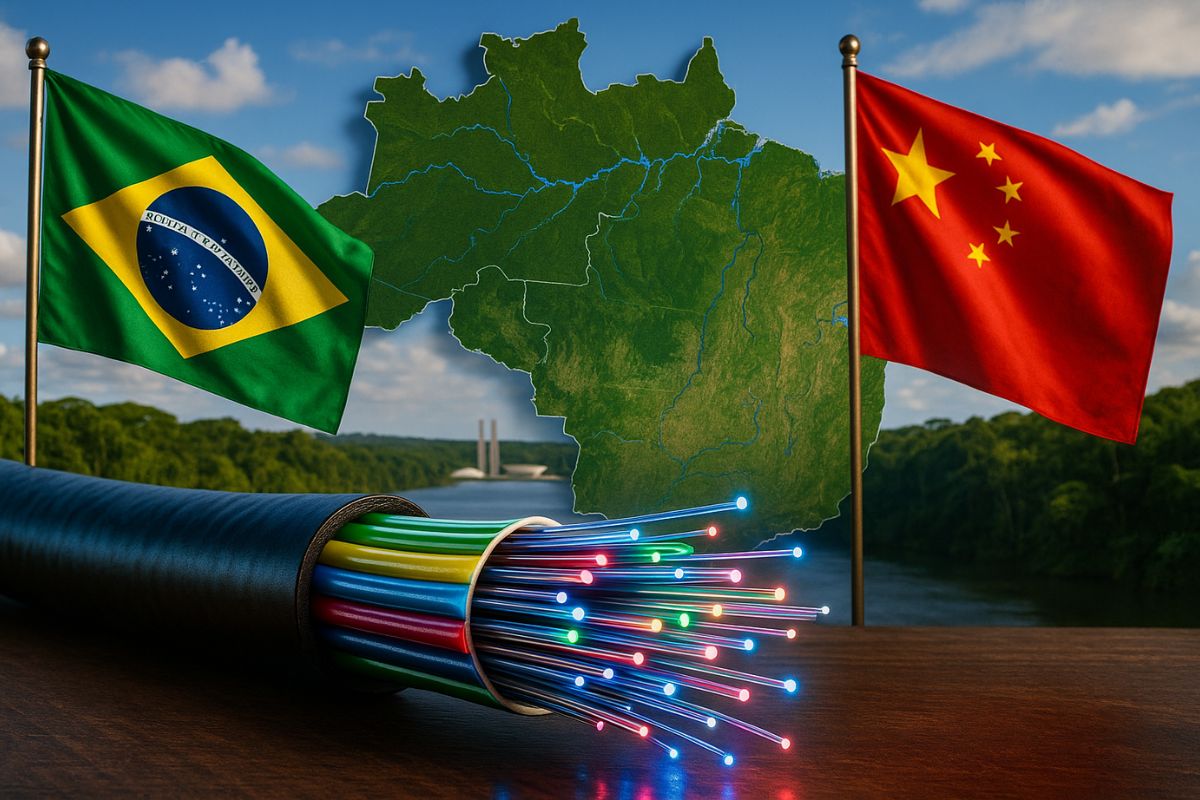


Government Initiative Predicts Subsea Fiber Optic Cables in the Amazon, Connecting Isolated Communities and Creating a Technological Basis for Bioeconomy 4.0.
Brazil presented, in China, the Northern Connected program, which will implement 12,000 kilometers of fiber optics in the Amazon. The announcement took place at the Global Industrial Internet Development Exchange Conference in Shenyang, highlighting the impact on digital inclusion and sustainable development.
According to the government, the project connects previously isolated riverside communities, allowing access to high-speed internet and strengthening public policies in the region.
The Amazon Becomes an International Showcase of Connectivity and Bioeconomy, transforming its biodiversity into high-value economic opportunities.
-
China Develops Custom 140-Ton Electric Mining Truck with 770 kWh Swappable Battery, Deploys 290 Units in Xinjiang’s Largest Zinc Mine

-
Meta to Launch Arena, a New Prediction App Targeting 3.56 Billion Users, Competing with Polymarket and Kalshi

-
Scientist Challenges Famous Human Evolution Theory, Argues Homo Sapiens Evolved Gradually Over Thousands of Years
-
15-Year-Old American Builds Ocean Generator with PVC Pipe and 3D-Printed Propeller for $12, Wins National Prize, Presents at White House, and Makes Forbes 30 Under 30 List




What Is Northern Connected
The program is coordinated by the Ministry of Communications and is already recognized as a reference in reducing digital inequalities.
The goal is to integrate cities in the Amazon through subsea cables that follow the riverbeds and provide more stable infrastructure than satellite transmission.
The Secretary of Telecommunications, Hermano Tercius, emphasized that the initiative will allow the region to leap from an extractive economy to bioeconomy 4.0, based on science, technology, and innovation.
For him, “digital transformation should serve a greater purpose: human development.”
Economic and Social Impact
Northern Connected paves the way to expand the offer of digital public services, distance learning, telemedicine, and professional training in the region.
Furthermore, it creates conditions for companies to sustainably explore the forest’s biodiversity, with innovation in pharmaceuticals, biotechnology, and renewable energies.
Brazil’s presence at the event in China also reinforced the country’s role in international forums.
As president of the G20 and a member of Brics, Brazil advocated for inclusive and multilateral connectivity, capable of reducing global inequalities and supporting fair trade.
International Recognition
The invitation to Brazil came from the China Economic Information Service, Xinhuanet, and Shenyang Bureau of Industry and Information Technology, in recognition of Brazilian public policies on connectivity.
The government’s speech reinforced the idea that, instead of “building digital walls,” the priority is to build technological bridges that connect countries and regions.
With Northern Connected, the Amazon gains global prominence not only as a biome to be preserved but also as a strategic space for digital and sustainable innovation.
And you, do you believe that the Northern Connected project can transform the Amazon into a global technological reference?
Leave your opinion in the comments.






