






 Portuguese
  Spanish
  3 min of reading
  0 comments


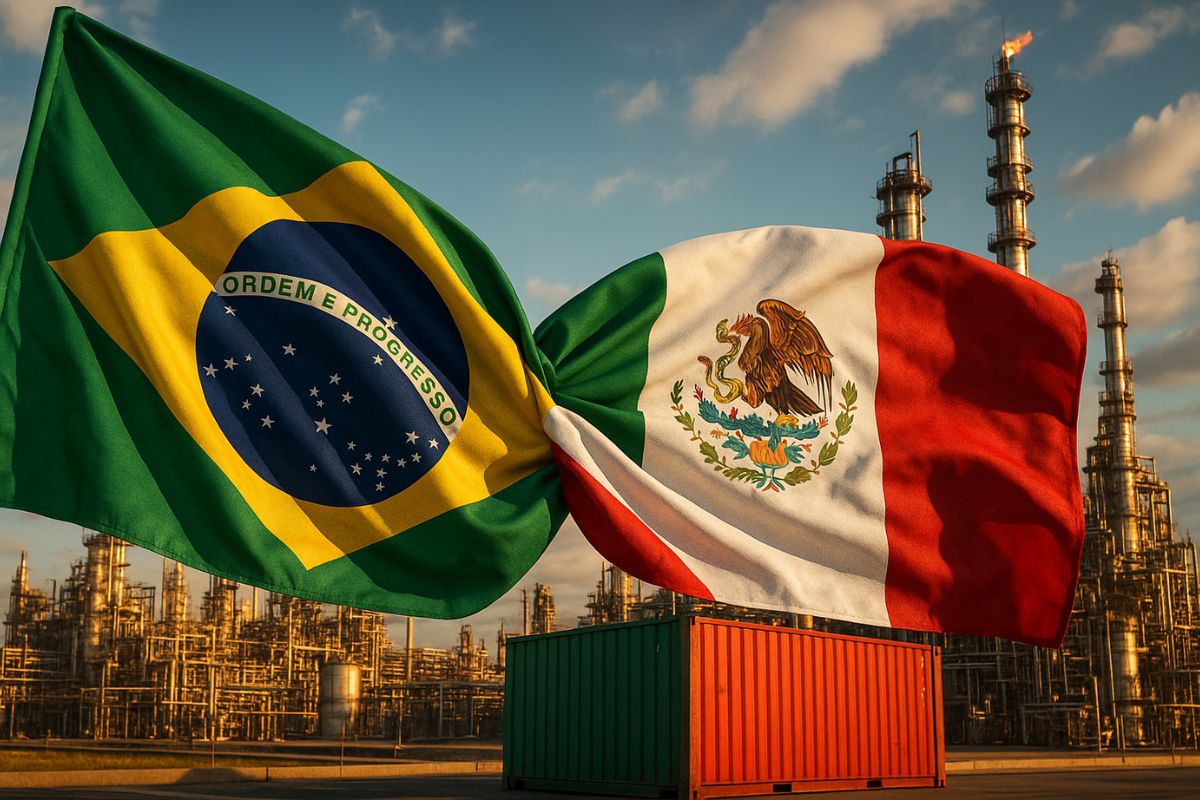
Brazil and Mexico Sign Biofuels and Competitiveness Agreements. Partnership Seeks to Expand Trade, Strengthen Companies and Reduce Impacts of US Economic Pressure
The announcement that Brazil and Mexico sign biofuels and competitiveness agreements marks an important step in the rapprochement between the two largest economies in Latin America. The documents were signed during the visit of Brazilian Vice President, Geraldo Alckmin, to Mexico, at a time when both countries are experiencing the effects of US trade policy.
According to a statement from the Mexican government, the central objective is to leverage Brazil’s experience in sustainable biofuel production and create cooperation mechanisms involving regulation, certification, and use of this type of energy. Furthermore, the pact aims to strengthen business competitiveness through a memorandum signed between Apex (Brazilian Agency for the Promotion of Exports and Investments) and the Secretary of Economy of Mexico.
What Is Expected in the Agreements
According to Mexican authorities, the two countries will work together to develop common regulatory standards and enhance the exchange of technologies focused on biofuel production. Brazil is already internationally recognized for its ethanol model, while Mexico seeks alternatives to diversify its energy matrix.
-
Central Bank changes rule that lasted decades and allows dollar and euro accounts in Brazil for exporters and companies with foreign capital, eliminating the need for currency exchange in some transfers starting in October 2026.

-
The Central Bank ends the R$ 500 limit on Pix by approximation, and account holders will be able to use the general Pix limit to pay any amount by tapping their phone on the terminal starting in October 2026.
-
A collective political will that allows for the creation of a cross-party and state agenda, focusing on concrete actions such as reducing the Custo Brasil; commitment to fiscal balance; feasible goals that enhance professional qualification and the adoption of a myriad of incentives aimed at innovation.

-
PIX from BRICS becomes reality: BRICS Pay advances to enable international payments without the dollar; system inspired by Pix and based on blockchain could move up to 20% of global trade by 2030, while bloc countries already account for 40% of the world economy.




In the economic field, the cooperation signed between Apex and the Secretary of Economy aims to increase the international positioning of Brazilian and Mexican companies, promoting partnerships in sectors such as pharmaceuticals, agriculture, and aerospace.
US Pressure Accelerates Rapprochement
The decision to sign the agreements does not happen by chance. This month, the United States raised tariffs on Brazilian products, imposing an additional challenge to international trade. In this context, Brazil and Mexico sign agreements as a strategic response to reduce dependencies and seek new channels for growth.
President Luiz Inácio Lula da Silva has advocated for the expansion of the current trade agreement with Mexico, seeing the country as a key partner to balance tensions in the global scenario. Mexican President Claudia Sheinbaum also highlighted the possibility of economic complementarity, especially in the automotive industry, in addition to other strategic sectors.
Expected Impacts in the Medium Term
Experts assess that the agreements may generate new export opportunities for both Mexican and Brazilian companies. Cooperation in biofuels also paves the way to attract international investments, as the sector is seen as fundamental to the global energy transition.
Moreover, institutional reinforcement between trade promotion agencies is expected to help small and medium-sized enterprises gain a foothold in previously restricted markets. For both countries, this rapprochement may represent a counterbalance to US economic pressure.
The fact that Brazil and Mexico sign biofuels and competitiveness agreements shows that Latin American integration gains momentum in a time of international instability. More than symbolic, the movement seeks to create solid foundations to strengthen companies, reduce external vulnerabilities, and explore new production chains.
And you, do you believe that these agreements can really change the weight of Brazil and Mexico in international trade? Or do you think that US pressure will still be a dominant obstacle? Leave your opinion in the comments — we want to hear from those who live this reality in practice.




-

1 person reacted to this.