






 Portuguese
  Spanish


The DHE headless engine, developed by Aramco for hybrid vehicles, integrates block and head in a monoblock structure, reduces components, and aims for thermal efficiency of 41% to 42%. The technology promises to reduce consumption by up to 25%, but still needs to prove cost, durability, and industrial-scale production in the coming years.
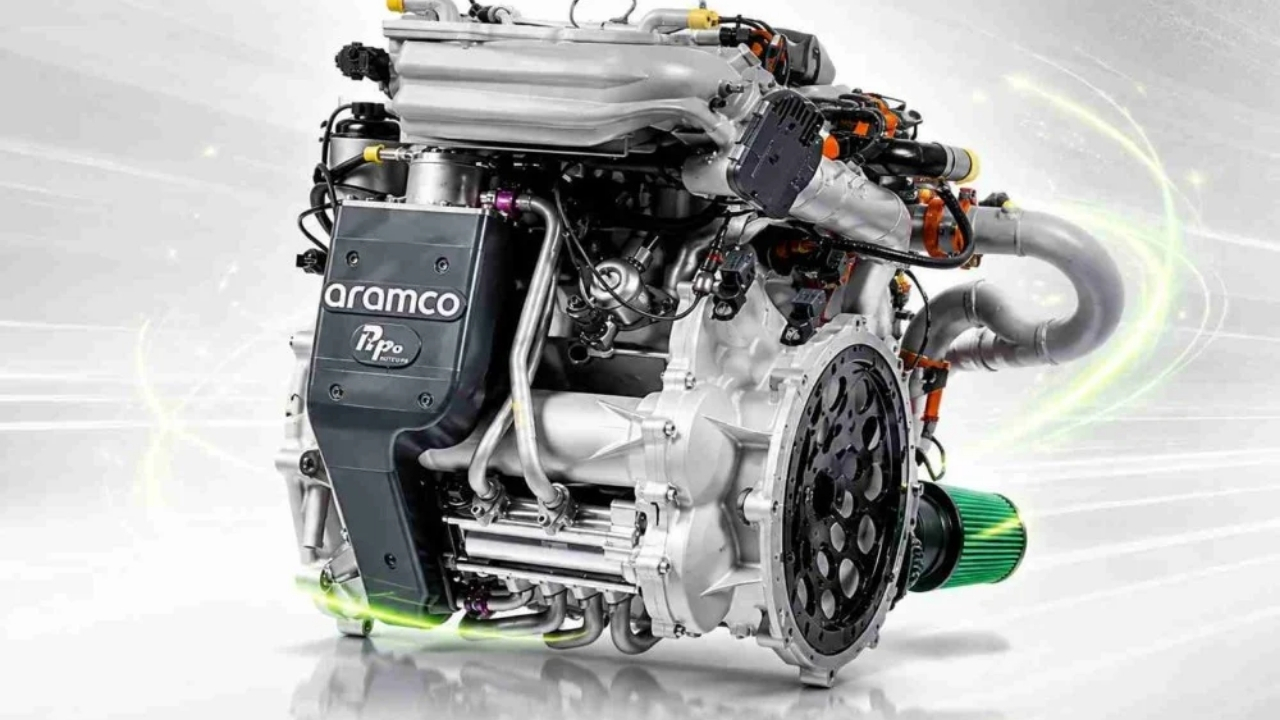
The headless engine developed by Aramco has reignited the debate about the future of hybrids by proposing an uncommon direction in automotive engineering: instead of adding more parts and complex systems, the DHE project bets on mechanical simplification, focus on efficiency, and structural integration.
The technology was highlighted in a report published by Folha BV on June 12, 2026. Called DHE, an acronym for Dedicated Hybrid Engine, the engine was designed from the start to work within hybrid vehicles, rather than as an adaptation of a conventional engine to an electrified system.
DHE is born for a specific function within hybrids
The logic of the DHE starts from an important change: in a hybrid vehicle, the combustion engine does not need to perform all tasks alone. The electric motor can take over accelerations, recoveries, and load transitions, allowing the thermal engine to work in more controlled ranges.
-
Ancient Ritual Circle, Hidden for 5,000 Years, Discovered in Scotland’s Machrie Moor Using Sensors, Revealing a “Phantom Stonehenge”

-
Engineers Develop Fridge-Sized Machine to Produce 95-Octane Synthetic Fuel from Air and Water, Aiming to Sustain Combustion Engines Without Oil
-
Two-Armed Robot Uses AI to Reassemble Destroyed Pompeii Frescoes, Solving an “Impossible” Puzzle
-
New Law in Brazil Requires Breaks for Type 1 Diabetes Management at Work, School, and Public Exams


This specialization allows the engine to be redesigned with another objective. Instead of seeking broad performance in any situation, the DHE tries to operate where it can deliver more efficiency, lower consumption, and less energy waste.
Headless engine replaces traditional part with monoblock structure
In traditional engines, the cylinder head is a separate piece installed on top of the block. It houses valves, intake ducts, exhaust ducts, spark plugs, cooling galleries, and part of the combustion chamber.
In Aramco’s headless engine, the block and cylinder head are integrated into a single structure, called monoblock construction. This design eliminates the traditional cylinder head gasket, reduces mechanical interfaces, and decreases potential leak points.
Fewer parts can mean less friction and simpler assembly
The elimination of the separate cylinder head can also simplify industrial assembly. In a conventional engine, the union between block and cylinder head requires a gasket, high-strength bolts, precisely machined surfaces, and strict sealing control.
By reducing this complexity, the DHE aims to tackle costs, internal friction, and mechanical losses. The proposal is not just to remove a part, but to reorganize the engine to work better within a hybrid architecture.
Prototype seems simple, but the logic is modern
One of the most curious points of the DHE is that its technical specifications do not seem futuristic at first glance. According to Folha BV, the disclosed prototype has a 1.6 three-cylinder engine, naturally aspirated, with two valves per cylinder and pushrod operation.
In a market accustomed to turbo engines, four valves per cylinder, and variable timing, this configuration may seem outdated. The difference is that Aramco is not trying to create the most sophisticated engine, but a thermal engine more focused on hybrids.
Thermal efficiency is the center of Aramco’s proposal
The main metric of the DHE is not maximum power. The focus is on thermal efficiency, an indicator that shows how much of the energy present in the fuel actually becomes useful work in the engine.
Aramco claims that the DHE can achieve thermal efficiency close to 41% to 42%. The promise of reduced consumption reaches up to 25% compared to current hybrid systems, with even greater gains when compared to conventional gasoline engines.
Electric motor helps compensate for mechanical simplification
The secret of the project is not just in the headless engine, but in the way it works with the electrical part. Since the electric motor can deliver quick torque and handle load variations, the thermal engine can operate under more favorable conditions.
This division of functions allows for the simplification of components that, in conventional engines, need to handle a wide variety of speeds, loads, and driving situations. In the hybrid, combustion can be more specialized because it does not work alone.
Technology can serve hybrids and range extenders
Folha BV reports that the architecture can be applied in conventional hybrids, plug-in hybrids, or vehicles with a range extender. This shows that the DHE does not try to compete directly with pure electric cars.
The proposal is to make hybrid systems more efficient, cheaper, and potentially easier to produce. In this scenario, the combustion engine does not disappear but changes its role within the electrified car.
Why an oil company invests in hybrid engines
Aramco’s participation in this project is directly related to the energy transition. As one of the largest energy companies in the world, the company is interested in technologies that keep liquid fuels relevant in an increasingly electrified market.
Folha BV also mentions Aramco’s participation in Horse Powertrain, a joint venture formed by Renault and Geely to develop combustion engines, transmissions, and hybrid systems. This context indicates an industrial strategy, not just an isolated experiment.
Mass production is still the big test
Despite the promising numbers, the DHE still needs to prove its viability outside the study and prototype environment. Demonstrating efficiency in a laboratory or experimental application is different from manufacturing millions of units with competitive costs and predictable maintenance.
It will also be necessary to observe how the monoblock construction behaves in prolonged thermal cycles, repairs, durability, and different emission standards. Therefore, the headless engine should be treated as promising technology, but still dependent on industrial validation.
Project challenges the idea that evolution always requires more complexity
For decades, the evolution of combustion engines was associated with more components: more valves, more controls, more sensors, more actuators, more turbos, and more auxiliary systems. The DHE moves in the opposite direction.
Aramco bets that efficiency can come from specialization. Instead of creating a universal engine for all situations, the project tries to make a simpler engine work at the right point, with the support of electrification.
Future of hybrids may depend on more focused engines
The DHE shows that the automotive transition is not just about replacing combustion with electricity. In some markets and applications, hybrids may still have space, especially where charging infrastructure, battery costs, and long distances remain challenges.
In this context, the headless engine functions as a symbol of a bigger question: will the future of hybrids be decided by increasingly complex engines or by simpler, integrated, and specialized systems?
If the promise advances to scale production, the DHE could open a new phase for hybrid engines, with fewer parts and more focus on efficiency. Do you believe that combustion can still evolve within hybrids, or should the future be fully electric? Leave your opinion in the comments.






I think that way back Leyland diesels had head and block all in one? Now
I’ll have to ask Google if that’s so
Commer TS3
I’m not 100% sold on the hybrid, nobody has ever really done it well cost/efficiency.
But the idea of a small gas sipping generator powering the electric motors or extending the range of the electrics… That looks like a good start until batteries start exceeding the range of gas engines.
Yes I agree hybrids are definitely the future I’ve recently had a KGG Actyon h
and was one of the best car I’ve ever owned being a large car and returning 48 -50 miles to the gallon