Portuguese
  Spanish


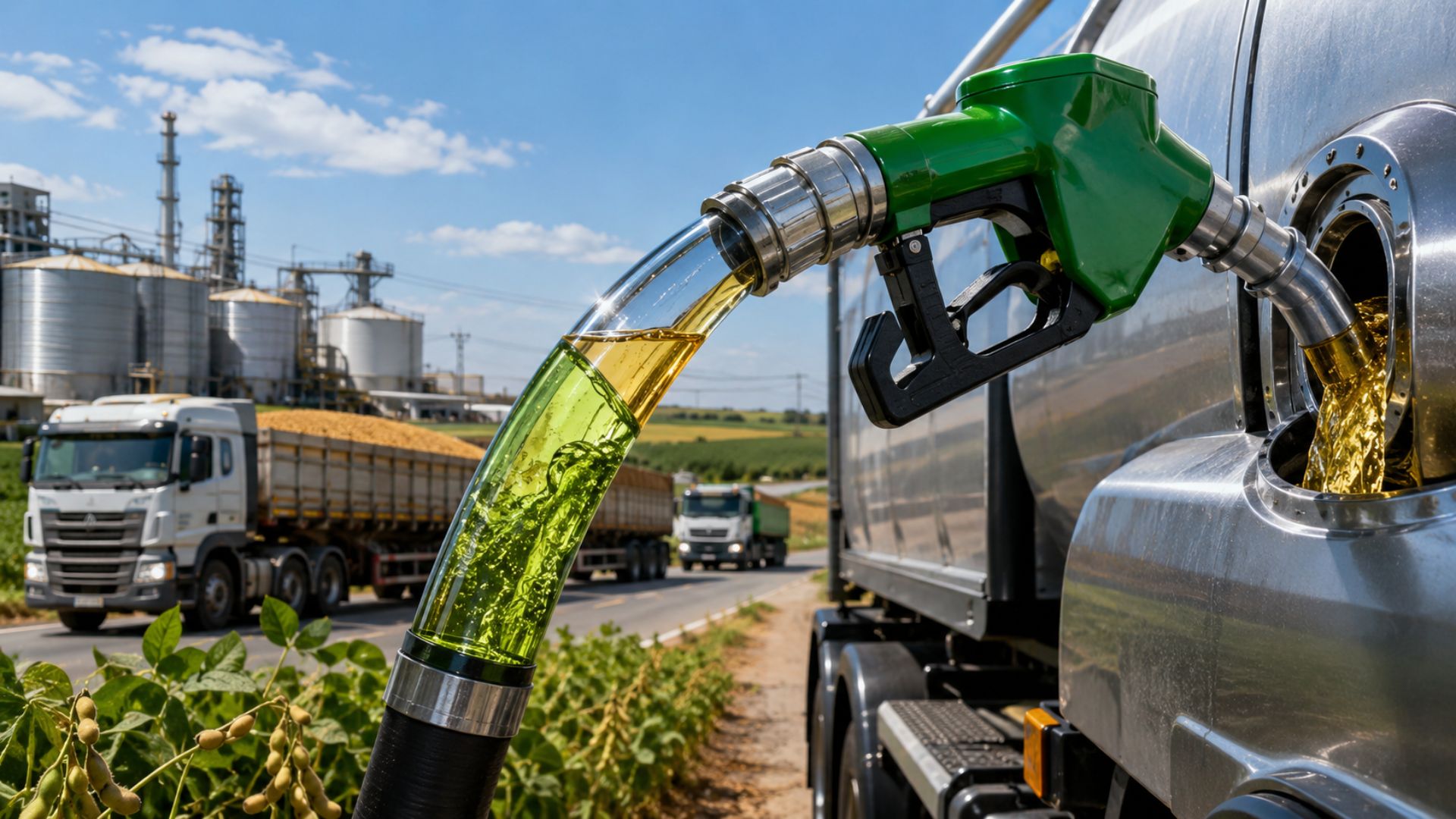

The Future Fuel Law foresees an annual one-percentage-point increase in the blend, and the Executive’s goal is to jump from the current 15% to 16% this year. Technical tests begin in May, with R$ 30 million from FNDCT and private contributions directly involved in the process now.
The decarbonization trajectory of Brazil’s energy matrix gains a new chapter in the coming weeks. The federal government is accelerating efforts to approve, still in 2026, the increase in the mandatory biodiesel blend with diesel oil, moving from the current 15% to 16%, a stage dubbed B16 in the sector.
The information was gathered by g1 and confirms a movement that was already expected by the legal schedule. The first technical trials begin this May and should indicate whether the new proportion can be absorbed without damage by vehicles already circulating on the country’s roads.
What the Future Fuel Law foresees
The policy organizing this advancement has a defined name and deadline. Under the Future Fuel Law, biodiesel’s share in the blend must increase by one percentage point per year, with the possibility of reaching 20% by 2030.
-
At 14 years old, she worked in a factory in Hong Kong, studied economics abroad, and then entered the Chinese real estate market, which helped change the landscape of Beijing.

-
While NATO secured more than $10 billion in missiles and space surveillance at a single forum, Brazil still spends 1.1% of its GDP on defense and is stalling its own anti-aircraft system.

-
Corn ethanol attracts R$ 23 billion in 21 new plants and prepares for a nearly 50% jump in Brazilian production by 2027, even with high interest rates.
-
A newly opened terminal in the middle of the Amazon has begun transporting soy and corn through Amapá, eyeing the queue of ships that is congesting the ports in the South.


In practical terms, this means that each liter of diesel oil sold in the next decade could have one-fifth of its composition coming from renewable sources. The gradual escalation is designed precisely to allow time for adaptation for automakers, gas stations, and fleets.
The rule also places the National Energy Policy Council, CNPE, at the center of decisions. It is this collegiate body that must make the final decision on each new increase, always supported by studies that prove the technical feasibility of the elevation.
Without this approval from CNPE, any jump remains suspended, even if the legal calendar indicates the advance as the next natural step. Therefore, the testing phase gains decisive weight in the current debate.
Tests begin this month with R$ 30 million at stake
The start of the trials is scheduled for May and will consume about R$ 30 million. Part of the resources comes from the National Fund for Scientific and Technological Development, FNDCT, and part is funded by private contributions from companies interested in advancing the agenda.
The objective is to simulate the behavior of diesel oil with 16% biodiesel under different usage conditions. The goal is to rule out any risk of mechanical failure, loss of performance, or problems in vehicle injection systems.
The mobilized structure is robust and gives a dimension of the study’s complexity. There are 11 mechanical laboratories, five physicochemical laboratories, and six test benches dedicated to the analysis of hydraulic and mechanical components.
Technicians close to the discussion state that this infrastructure can be expanded according to the pace of work. If operational capacity grows, the tests could be concluded before the originally projected deadline and pave the way for CNPE’s deliberation still in 2026.
Lula’s endorsement and the green leadership discourse
The political push came directly from the Palácio do Planalto last month. President Luiz Inácio Lula da Silva (PT) publicly defended the continued advancement of the blend and framed the topic as an international showcase for Brazil.
For the PT member, the strategy of increasing by one percentage point at a time serves to show the world that the country has consolidated technology in renewable fuels. The idea is to position Brazil as a destination for technology transfer, and not merely as a consumer.
The presidential speech was interpreted by the productive sector as a green light to accelerate the internal processing of the topic. Still, final approval depends on technical proof and articulation within the CNPE, which brings together different ministries and actors from the energy market.
Some point out that the Future Fuel Law’s schedule was already pressuring the government to meet the foreseen increases. Lula’s public message merely reinforced what was stipulated in the legal text and pushed the matter to the top of the agenda.
And gasoline, how does it fit into this equation?
The biodiesel movement does not happen in isolation. In parallel, the government is also evaluating raising the mandatory blend of anhydrous ethanol in gasoline, moving from the current level to 32%, a format dubbed E32.
In the case of ethanol, the feasibility tests have already been concluded. The measure only depends on a formal decision from the CNPE to come into effect at fuel pumps.
There is still no set date for the collegiate body to specifically address E32. Technicians consulted, however, assess that the macroeconomic scenario favors the increase, with international prices and domestic supply playing in favor of the measure.
The combination of B16 in diesel and E32 in gasoline, if confirmed, could reshape the emissions profile of the Brazilian fleet in the coming years. For the agribusiness sector, especially soy and sugarcane, the impact on domestic demand is direct.
What could delay the approval of B16
Despite political alignment, the path is not free of obstacles. The automotive industry usually calls for caution with each increase, claiming that older systems may suffer with higher proportions of biodiesel without specific adaptations.
Distributors and gas stations are also closely monitoring the movement. Any blend adjustment requires different logistics, new storage parameters, and a review of quality protocols throughout the chain.
On the other hand, biodiesel producers are pushing for the rapid approval of B16 as a way to ensure predictability for investments already made in production capacity. The sector argues that delays in the schedule disrupt the planning of the plants.
This interplay of forces should mark the coming months until the final deliberation of the CNPE. The results of laboratory tests will be the decisive technical argument to unlock or postpone the jump to 16%.
And you, are you in favor of increasing the presence of biodiesel in diesel? Do you think this transition is too fast, too slow, or at the right pace for the Brazilian fleet?
Tell us in the comments if you’ve noticed a difference in your car’s fuel consumption after the last blend increases, if you work with transport and feel the effect on your wallet, and what you expect from the government until 2030. The discussion is just beginning, and your input helps us understand how this progress reaches the end-user.