Portuguese
  Spanish


Submerged work at the Port of Rio Grande involves engineering, sediments, and navigation in an intervention that alters operational conditions below the surface and helps explain how port channels need to be maintained over time.
The Port of Rio Grande, in the south of Rio Grande do Sul, will have approximately 15 million cubic meters of sediments removed from a stretch of about 30 kilometers of the navigation channel.
The dredging was contracted with the company Van Oord, will have an investment of R$ 432.2 million and an estimated duration of 15 months, according to information released by the state government and Portos RS.
The intervention includes the outer channel, the inner channel, and the Porto Novo berths, areas used for access and mooring operations at the Organized Port of Rio Grande.
-
After 40 Years of Research, Powdered Coconut Water to Be Produced in Brazilian Biorefinery, Aiming to Revolutionize Health for Children, Elderly, and Hospital Patients

-
Queen Guitarist Brian May Collaborates with ESA Scientists to Study Asteroids Bennu and Ryugu Using 3D Simulations
-
Largest Known Single-Piece Meteorite, Weighing 60 Tons, Puzzles Scientists with Its Intact Fall and Lack of Visible Crater

-
Oceanographer Turns Abandoned Fishing Nets from Brazilian Waters into Bags, Creating Jobs and Earning Over $7,000 Monthly



The objective stated by those responsible for the work is to maintain adequate depth conditions for the navigation of large vessels.
The work aims to ensure an official draft of 15 meters in the main sections of the access channel.
In the port sector, draft is the distance between the waterline and the lowest part of a vessel’s hull.
This measurement practically defines what depth is necessary for a ship to navigate safely in a given section.
Although it occurs out of sight of most of the population, dredging is a recurring operation in ports subject to the accumulation of sand, mud, and other materials at the bottom of the channels.
These sediments reach navigable areas by the action of currents, winds, tides, and the natural transport of particles in coastal and lagoon environments.
In the case of Rio Grande, the environmental dynamics are directly related to the port’s location, situated at the connection between Lagoa dos Patos and the Atlantic Ocean.
Water circulation in this region favors the displacement of sediments, which requires measurements and interventions to preserve the depth planned in navigation projects.
Dredging at the Port of Rio Grande and channel maintenance
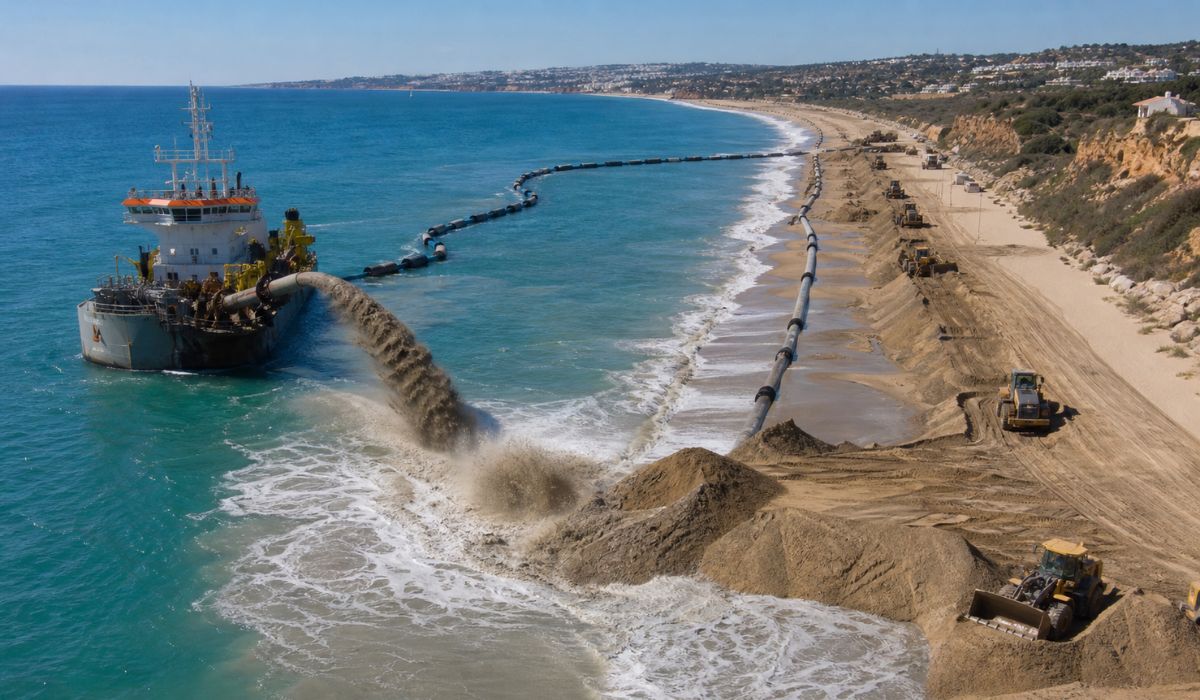
Dredging removes accumulated materials from the channel bed to maintain or restore the depth necessary for vessels to pass.
Without this service, sections previously suitable for navigation may become shallower over time, impacting the operation of larger or more heavily loaded ships.
Before execution, technical teams carry out bathymetric surveys, which measure the submerged relief.
This data indicates where there is greater sediment deposition and guides the dredgers’ operations, preventing removals outside the areas defined in the project.
The volume planned for the Port of Rio Grande helps to dimension the scale of the work.
Considering an Olympic swimming pool with approximately 2,500 cubic meters, the 15 million cubic meters correspond to approximately 6,000 such pools.
The comparison serves only to visualize the physical dimension of the material to be removed, without altering the informed technical data.
The operation will be carried out with the dredge Utrecht, a self-propelled vessel used by Van Oord for this type of service.
According to Portos RS, the contract provides for the removal of sediments throughout the entire length of the navigation channel covered by the work, including the outer channel, inner channel, and the Porto Novo channel and berths.
15-meter draft and impact on navigation
The channel depth directly interferes with the planning of ship entries and exits.
When there is a draft restriction, vessels may have to wait for specific tide conditions, reduce cargo, or adjust their mooring schedule.
These situations affect the predictability of operations and can increase logistical costs.
According to the government of Rio Grande do Sul, the work aims to ensure that cargo movement occurs with greater reliability and without additional waiting for ships due to depth limitations.
This assessment was presented by Governor Eduardo Leite during the signing of the contract and the order to begin, on October 1, 2025, at Estaleiro Rio Grande.
On the occasion, Leite stated that the project represents “the largest investment in dredging ever made in the history of the State.”
He also said that the government considers the maintenance of the port’s navigation conditions a factor associated with attracting investments, generating jobs, and economic development.
The information is an official statement from the state government, not an independent assessment.
In port works, the relationship between depth, operational capacity, and competitiveness is usually treated by authorities and logistics operators as a central point for the circulation of goods.
Port engineering and environmental monitoring
Maintenance dredging combines engineering, hydrodynamics, sedimentology, and environmental monitoring.
The work depends on information about water circulation, the behavior of the channel bed, and the points of greatest material accumulation.
The bed of a navigation channel does not remain static.
In coastal areas, submerged forms change according to water movement and sediment deposition.
Therefore, technical measurements are necessary before, during, and after interventions of this type.
At the Port of Rio Grande, the contract also provides for environmental monitoring throughout the execution.
This monitoring is used to observe possible changes associated with the work, such as temporary changes in water turbidity, and to verify compliance with applicable technical and environmental requirements.
Dredgers remove material from the bottom and transport it according to the conditions foreseen in the project and competent authorizations.
As the service takes place in a navigation area, its execution must be coordinated with port routines and operational safety rules.
Gaucho logistics and cargo outflow
The Port of Rio Grande is one of the main cargo outflow points in Rio Grande do Sul.
The complex serves operations related to agribusiness, industry, and foreign trade, in addition to integrating the State’s logistics network with national and international maritime routes.
In this context, the channel depth is not limited to a technical naval engineering datum.
It influences the capacity to receive vessels, terminal scheduling, cargo movement, and the regularity of operations that depend on defined deadlines.
With adequate draft, larger vessels can operate within the conditions established for the port.
According to the state government, this characteristic is considered necessary to strengthen logistics capacity and provide more efficiency to the outflow of Gaucho production.
The hiring of Van Oord places the work in a specialized segment of maritime infrastructure.
The company operates internationally in dredging and coastal operations, and was responsible for the contract announced for the Port of Rio Grande.
Submerged work and port infrastructure
Unlike works on highways, bridges, or terminals, dredging primarily occurs below the waterline.
For those observing the port from outside, the effects are not immediately visible, but they appear in the navigation parameters and the channel’s operational capacity.
The case of Rio Grande shows how port infrastructure depends on continuous maintenance in natural areas subject to change.
Sediment removal does not eliminate the long-term deposition dynamic, but it reestablishes the conditions foreseen for the use of the channel during the period covered by the intervention.
The work is financed with resources from the Rio Grande Plan Fund, Funrigs, created to support reconstruction, adaptation, and climate resilience actions in the State.
The inclusion of dredging in this set of measures was informed by the state government in the announcement of the contract.
In scientific terms, the intervention also illustrates how natural phenomena, such as currents and sediment transport, interfere with economic and logistical systems.
What accumulates at the bottom of a channel can alter the routine of ships, terminals, and export chains.