






 Portuguese
  Spanish


BYD Qin L Sedan Registered in Brazil with Range Over 2,000 Km, Competitive Price and State-of-the-Art Hybrid Technology, Catching Market Attention.
BYD has requested the registration of the mid-size sedan Qin L in Brazil from the National Institute of Industrial Property (INPI), which arrived in China in May 2024, maintaining the exclusive design of the Dynasty lineup, inspired by the Dragon Face philosophy and filled with modern aesthetic elements.
Equipped with the fifth-generation DM-i 5.0 plug-in hybrid system, the Qin L stands out with a combined range of up to 2,100 km according to the NEDC cycle.
According to information published by the autoesporte website this Saturday (21), in real conditions, tests indicate possible ranges of 2,300 km to 2,500 km.
-
Erected in just 30 minutes over the water that had already engulfed the courtyard, a motorized floating bridge from China evacuated more than 6,000 students trapped inside a school surrounded by the flood in the south of the country, after Typhoon Maysak turned the region into a flooded area.

-
Employee buys a ticket that a customer left behind, discovers a million-dollar prize, tries to claim the fortune, is fired after 20 years, and ends up in a legal dispute with the company.

-
China returned almost 20 Brazilian ships with soybeans and is now back to buying from the USA, but stocks above 9 million tons raise suspicions of a political move, not a commercial necessity.
-
Japan will have a bullet train that levitates at 500 km/h and will cross 90% of the route through tunnels; the project promises trips in just 67 minutes but faces billion-dollar challenges and unprecedented environmental obstacles.




This performance allows for a trip from São Paulo to Buenos Aires without stopping, considering the 65-liter tank and LFP (lithium iron phosphate) battery between 10 kWh and 15.87 kWh.
The 1.5 gasoline engine, combined with the electric motor, results in 163 hp and 21.4 kgfm of torque, achieving a record thermal efficiency of 46.06%.
This contributes to an average consumption of 34.5 km/l according to official data, while independent tests recorded up to 55.5 km/l.
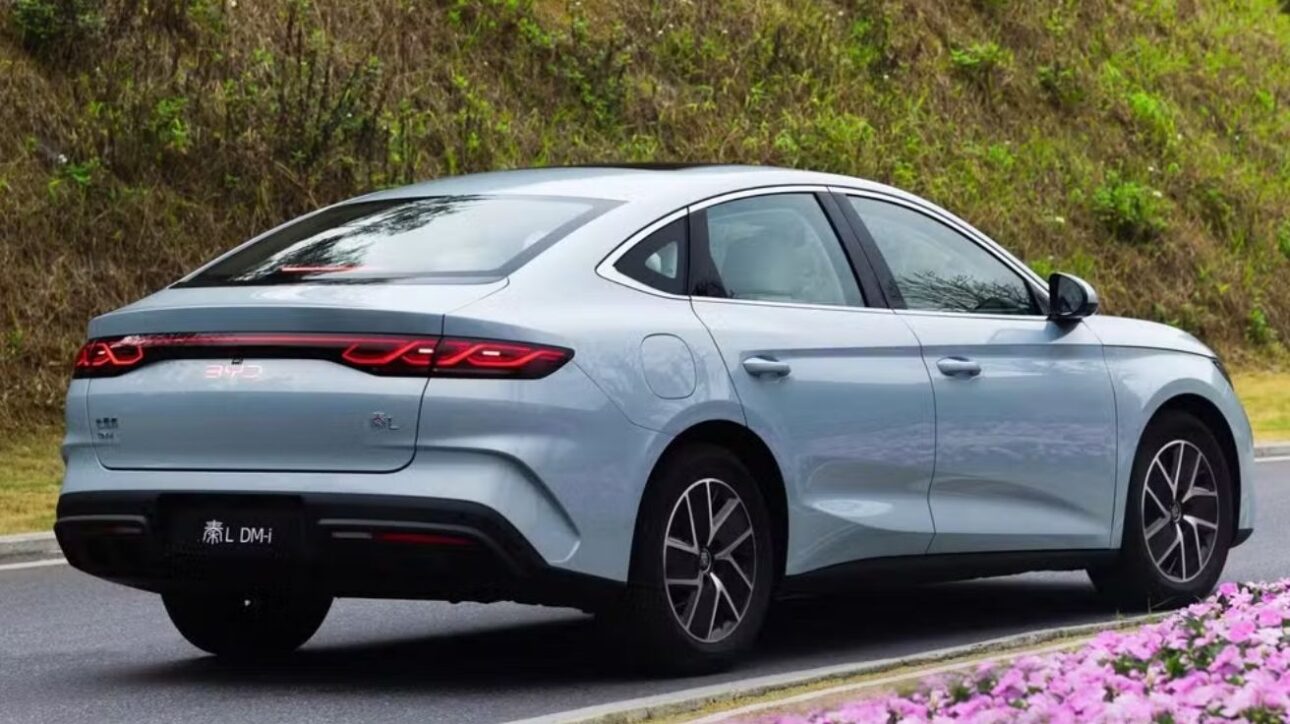
Market Strategy and Positioning in Brazil
Registering the model in Brazil shows BYD’s intention to protect its rights and possibly launch it here in the future.
In the country, the Qin L should be positioned above the King (also known as Quzhujian 05) and below the Seal, offering a more affordable alternative in the electrified sedan segment.
With five variants in China, the model’s prices range from ¥99,800 (R$ 76 thousand) to ¥139,800 (R$ 106 thousand).
In China, the Qin series represents about 17% of BYD’s new energy vehicle sales, totaling 732,252 units in 2024.
The robust acceptance in the Chinese market encourages BYD to expand its offering globally.
External Design and Dimensions of the Medium Hybrid Sedan
The sedan measures 4.83 m in length, 1.90 m in width, and 1.49 m in height, with a wheelbase of 2.79 m, offering a fastback design, conventional door handles, and full-width taillights with an illuminated BYD logo.
The suspension combines MacPherson in the front and an independent E-type four-link system in the rear, ensuring comfort and stability.
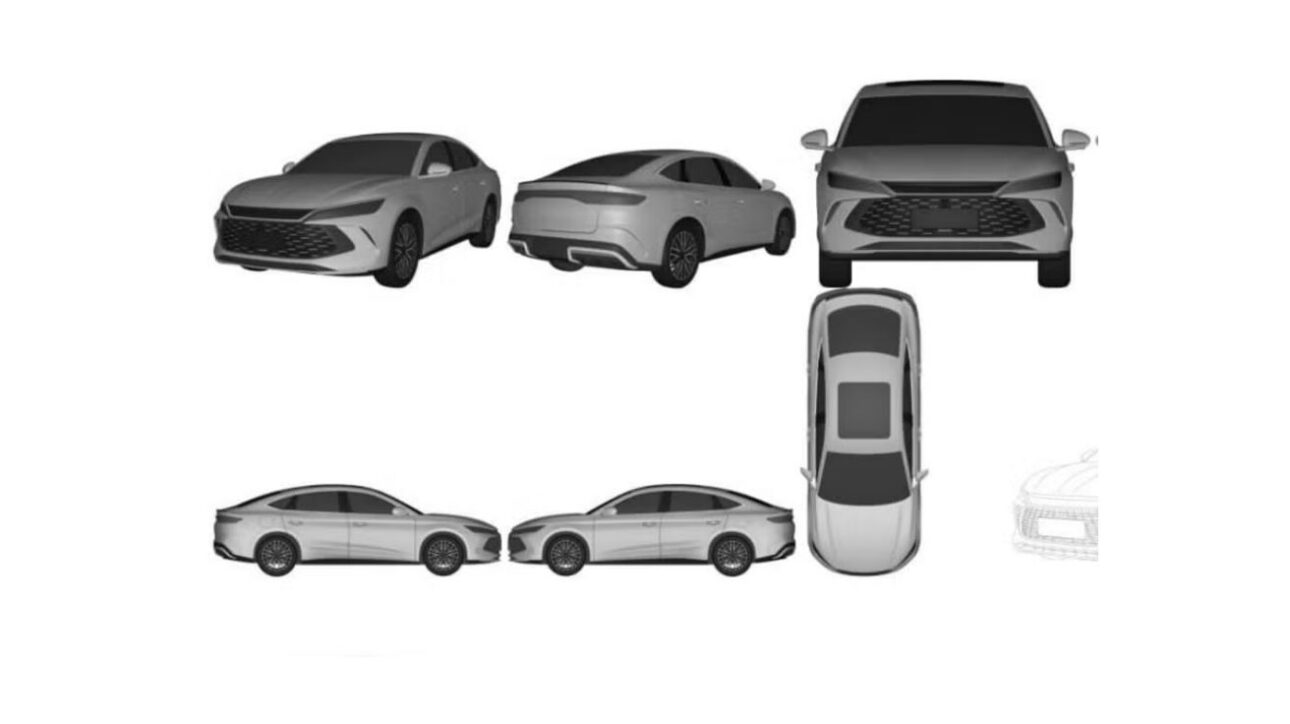
Tech Interior and Standard Equipment
The interior is inspired by Chinese landscape paintings, blending culture and technology.
The dashboard features an 8.8″ instrument display and a 15.6″ rotating central screen with DiLink system.
It also includes intelligent voice control, NFC key via smartphone, and standard airbags.
The package also includes DiPilot L2, semi-autonomous driving assistance, sound system with at least six speakers, automatic air conditioning, and tire pressure monitoring.
Higher-end versions come with a panoramic sunroof, electrically adjustable heated and ventilated seats, automatic transmission, and 18″ wheels.
DM-i 5.0 System: High Efficiency and Low Consumption
The DM-i 5.0 system, launched with the Qin L and Seal 06 in May 2024, combines a 1.5L engine with two electric motors.
Base versions feature a motor of 120 kW and 210 N·m, a 10.08 kWh battery, and an electric range of 80 km.
Top versions use a motor of 160 kW and 260 N·m, with a 15.87 kWh battery and 120 km electric range.
The declared consumption is only 2.9 L/100 km (34 km/l) in hybrid NEDC mode.
In practice, independent tests showed consumption of 4.5 L/100 km, close to 52 mpg, still efficient, although far from the catalog value.
BYD’s energy efficiency reaches a record with a gasoline engine having a thermal efficiency of 46.06%, a level superior to many competitors.
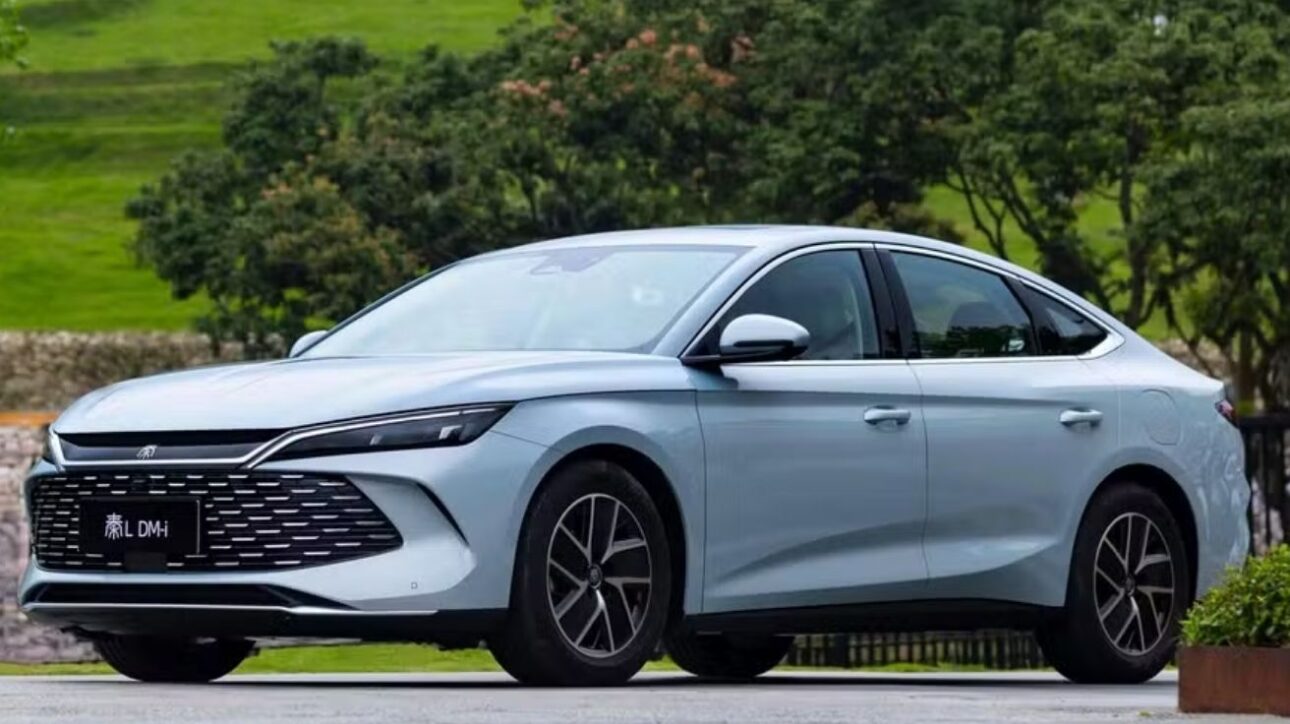
Global Presence and Growth of BYD
Although the registration at INPI does not confirm an immediate launch, the arrival of the Qin L reinforces BYD’s plan to expand its portfolio in Brazil.
The current lineup includes electric models such as Seal, Tang, and the Atto 3 SUV.
With an emphasis on range and consumption, the model could attract fleet operators and consumers conscious of long-term economy.
The registration also signals brand and design protection, preventing similar copies in the country, a strategy employed globally by the Chinese manufacturer.
BYD continues to grow exponentially.
In 2024, it sold 4.27 million new energy vehicles, maintaining leadership in China and strengthening globally.
The company implements cutting-edge technology, such as the “God’s Eye” L2+/L3 autonomous driving system, drones embedded in some models, and ultra-fast chargers of up to 1 MW.
With the Qin L, BYD expands its reach in the medium segment and reinforces advances in efficiency, connectivity, and innovation.
And now you may wonder: could the Qin L be a milestone for hybrids in Brazil or will it remain confined to the Chinese market? Which aspects (economy, design, range) weigh most in your decision?


