






 Portuguese
  Spanish


After Typhoon Maysak flooded Guigang, in southern China, teams set up a motorized floating bridge in about half an hour and evacuated more than 6,000 stranded students. The structure transports up to 500 people per trip and supports more than 60 tons.
On Wednesday, July 8, 2026, a scene that seemed impossible unfolded in southern China: over water that had already swallowed streets and courtyards, a floating bridge was assembled in about 30 minutes to rescue more than 6,000 students stranded inside a school surrounded by the flood, in Guigang, Guangxi Autonomous Region. What separated the students from solid ground ceased to be an insurmountable obstacle and became a metal corridor floating over the current.
The modular vessel has the capacity to transport up to 500 people per trip and supports more than 60 tons, which sped up the evacuation and allowed everyone to be safely removed. Behind the operation was China Anneng, a state emergency response company with roots in a military construction engineering battalion and, as will be seen, the most decisive piece of the rescue may be the fact that this bridge already existed long before the water rose.
The typhoon that turned the city into a lake
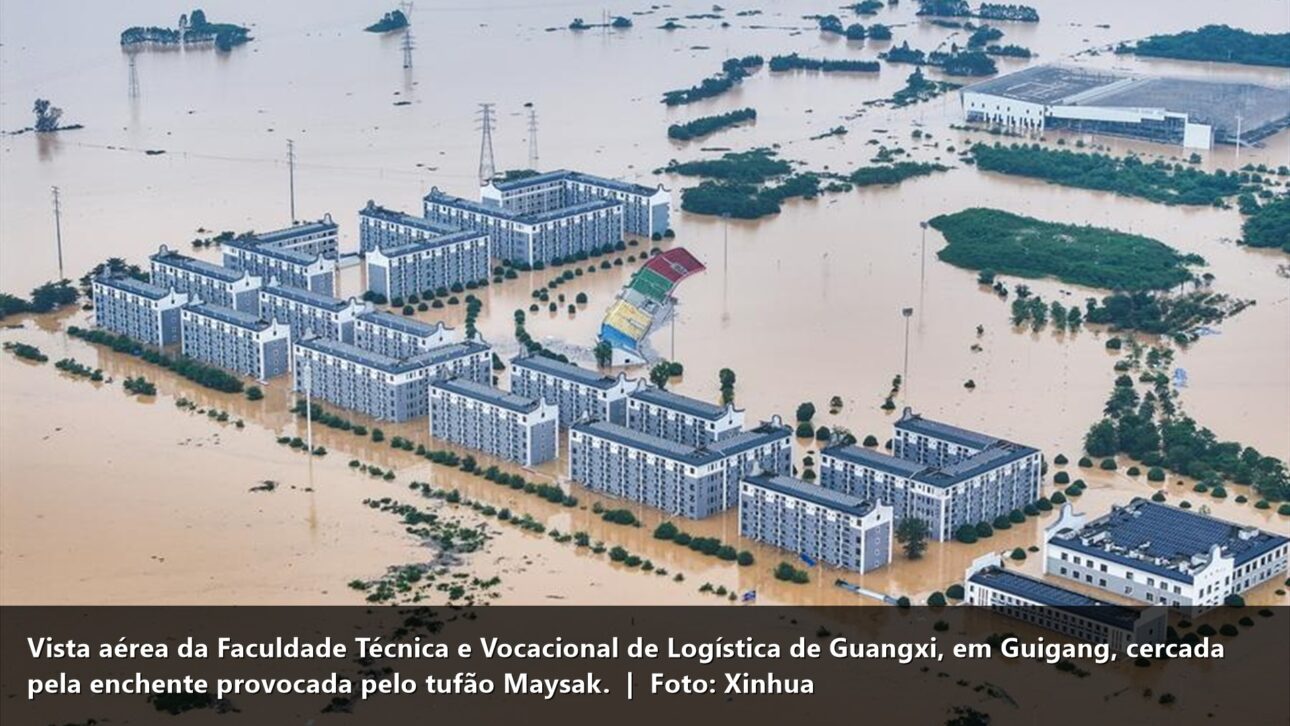
The origin of the chaos has a name: Maysak, the tenth typhoon of the year, which unleashed extreme rains over the Pearl River basin and caused severe floods in various parts of Guangxi. In Guigang, the water rose quickly and isolated the Guangxi Technical and Vocational Logistics College, trapping thousands of students on the upper floors.
-
Employee buys a ticket that a customer left behind, discovers a million-dollar prize, tries to claim the fortune, is fired after 20 years, and ends up in a legal dispute with the company.

-
China returned almost 20 Brazilian ships with soybeans and is now back to buying from the USA, but stocks above 9 million tons raise suspicions of a political move, not a commercial necessity.

-
Japan will have a bullet train that levitates at 500 km/h and will cross 90% of the route through tunnels; the project promises trips in just 67 minutes but faces billion-dollar challenges and unprecedented environmental obstacles.
-
Few people know, but the smallest city in Rio holds a tunnel that was once the largest in the world, covering only 95.35 km², housing a railway work of 2,233 meters, and is also known for the historic title of the 4th best climate in the world.



In the midst of the tragedy, the storms left dozens dead in different cities in the south of the country, with most of the victims concentrated in Hengzhou, where the partial collapse of a dam sent a wall of water over the urban area.
As the level kept rising, time became the most dangerous enemy. Every hour of waiting meant greater risk for those inside the school, and traditional methods, inflatable boats, and small boats could handle only a few people at a time. It was necessary to move crowds, and quickly. At this point, the response stopped relying solely on improvisation and began to depend on heavy equipment, designed exactly for this type of scenario.
A floating bridge that emerges in half an hour
The floating bridge is motorized and consists of modules that float and fit together, assembled directly on the water. The structure, about 60 meters long, can be erected in approximately 30 minutes, without relying on pillars driven into the bottom or onshore works. Instead of a fixed bridge, it is almost a floating conveyor belt that extends from a dry point to the edge of the flooded area, creating a path where there was only a current before.
The scale gain is what changes the game. With space for up to 500 people per trip and resistance above 60 tons, the structure transformed the bottleneck of a few rescued at a time into a continuous flow of people coming out of the water. It is not brute force or record speed: it is engineering designed to get the maximum number of people out in the shortest possible time, precisely when every minute counts.
Who was on the other side of the current: China Anneng
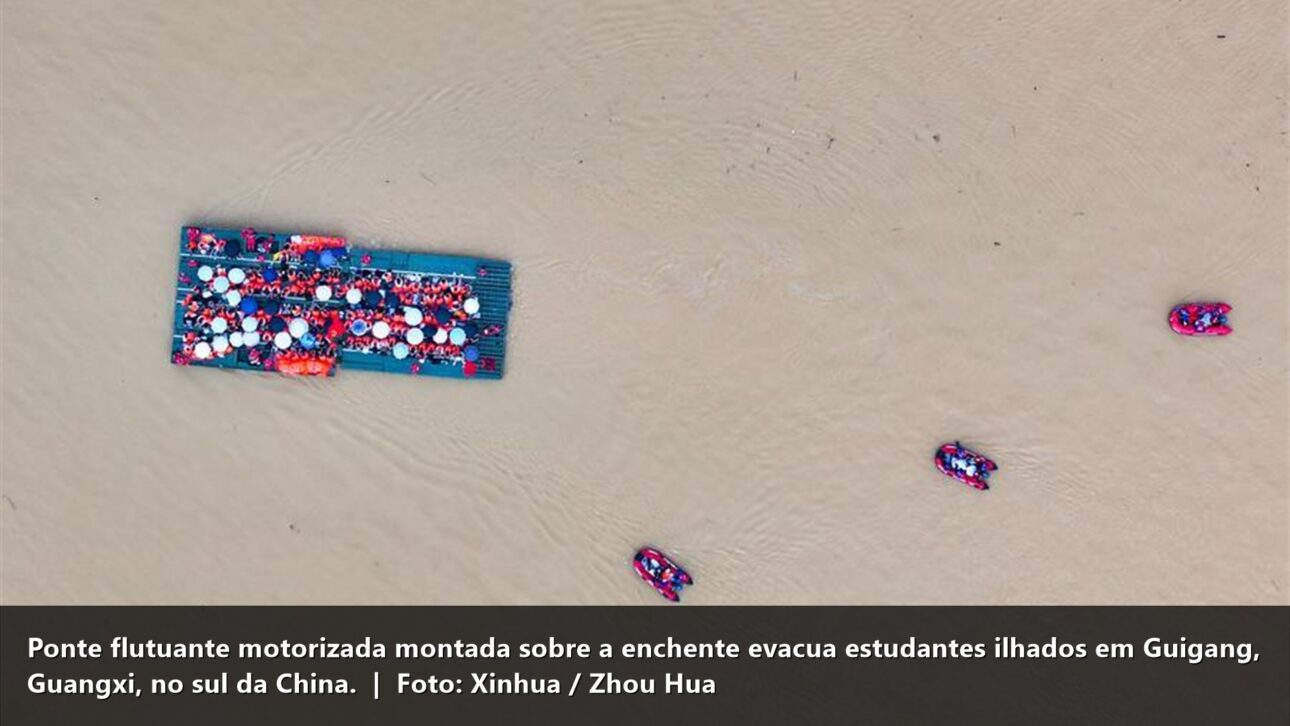
The operation was conducted by China Anneng (中国安能), a state-owned company specialized in emergency and disaster response. Its origin helps explain the speed: the company descends from a military construction engineering battalion, a heritage that translates into heavy equipment, trained protocols, and teams accustomed to working under pressure in hostile terrain.
It was not a rescue improvised by last-minute volunteers. It was the mobilization of a professional structure that already had the equipment ready, knew how to assemble it, and knew the step-by-step process. This difference — between reacting with what you have and reacting with what you prepared — often separates a tragic number from a happy ending.
Why the bridge already existed before the tragedy
Perhaps the most important detail of the story is not in the 30 minutes of assembly, but in what came before them. A structure capable of supporting 60 tons and 500 people is not manufactured in the middle of a flood: it is the result of years of planning, investment, maintenance, and training. When the water rose, the equipment was already available and the team already knew what to do.
This is where the less visible lesson of the episode lies. Emergency infrastructure is not born during the disaster; it is decided long before, in budgets and exercises that no one sees. A country that prepares responds faster, protects the population better, and saves more lives — and the rescue of the students in Guigang is, deep down, the portrait of a decision made years ago.
What the Guigang Rescue Says to Brazil
For Brazil, the Chinese scene is not exotic. The country is well aware of the damage caused by water; the historic floods in Rio Grande do Sul in 2024, the landslides on the coast, and the recurring floods in large cities have shown how entire communities can become isolated in a matter of hours. The question that remains is not whether it will rain heavily again, but whether there will be equipment and teams ready when it happens.
It’s not about copying a Chinese bridge, but about treating preparation as a permanent public policy, rather than a late response. Buying equipment, training teams, and rehearsing the worst-case scenario costs money and patience — but it is precisely this silent investment that appears, as a savior, on the day the water invades the school.
A floating bridge assembled in half an hour took more than 6,000 students out of the flood because someone, long before, decided to prepare for the worst. It is proof that planning saves lives. Do you think your city would have the equipment and teams ready for a rescue of this magnitude, or do we still rely on luck and improvisation when the water rises? Tell us here in the comments.


