






 Portuguese
  Spanish
  7 min of reading
  0 comments


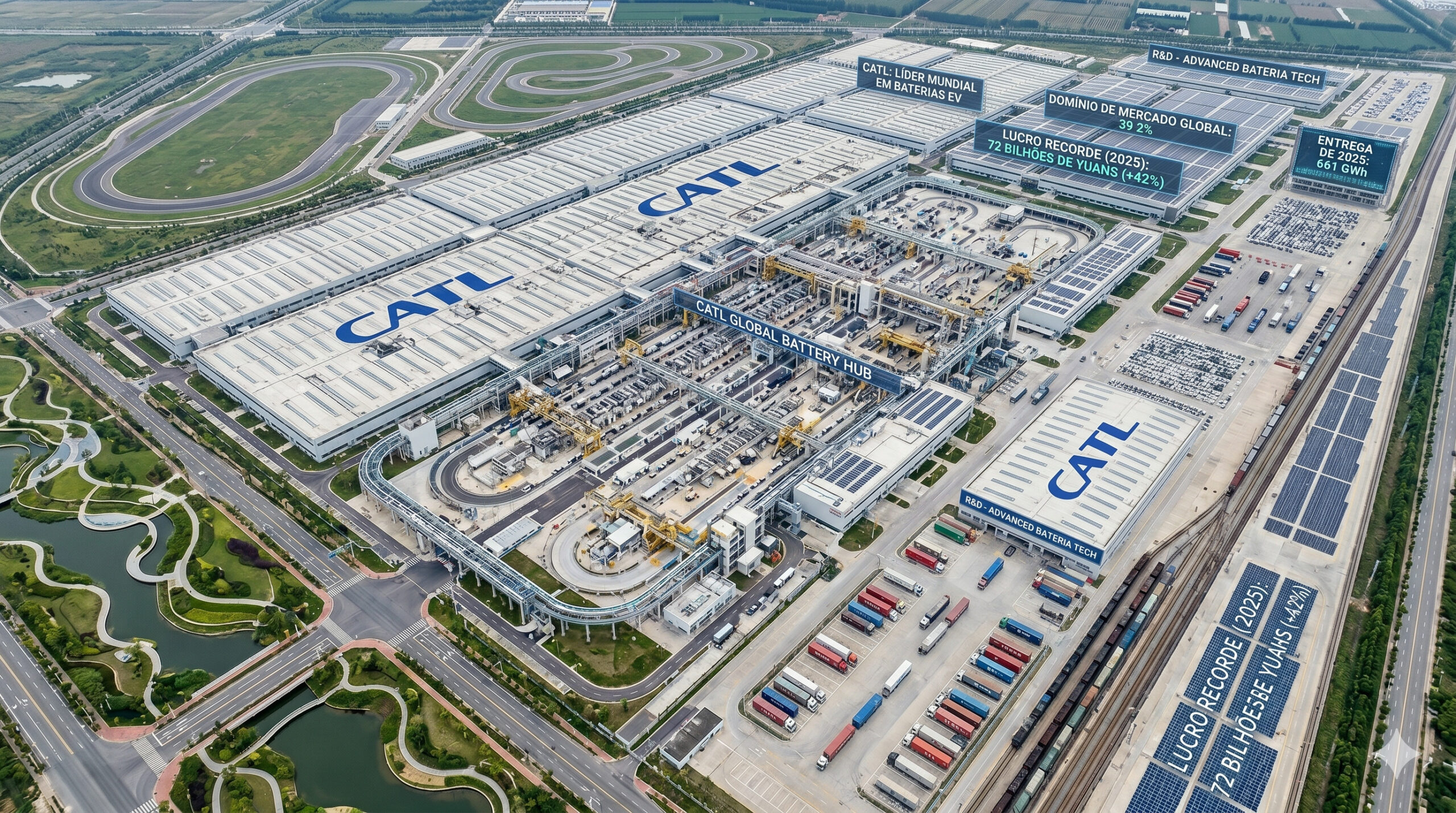
CATL delivered 661 GWh in batteries in 2025, led the global market for the eighth consecutive time, and extended its lead over BYD, LG, and Panasonic.
According to Battery-Tech Network, Contemporary Amperex Technology Co. Limited, CATL, published its 2025 annual report in March 2026 with unprecedented figures in the battery industry: revenue of 423.7 billion yuan, net profit of 72.2 billion yuan, a 42% growth compared to 2024, 772 GWh of production capacity, and 661 GWh of lithium-ion batteries delivered. CATL’s global market share reached 39.2% in passenger vehicle batteries and 30.4% in energy storage systems. It was the eighth consecutive time the company led the global electric vehicle battery market, consolidating a position that no competitor has achieved on a similar scale.
To put the number in perspective, the 661 GWh delivered by CATL represents more than double the production of the second-place company, BYD, with 194.8 GWh. LG Energy Solution, in third place and the main manufacturer outside of China, produced less than one-third of the volume delivered by CATL.
CATL leads the global electric car battery market with 661 GWh delivered
CATL is currently the only company with a market share above 20% in a sector where the second-place competitor has 16%. This difference shows that the Chinese manufacturer’s leadership is not just momentary, but structural.
-
Without a mansion, without high investment, and without a traditional classroom, a teacher living in a 22 m² house taught students to build a 9 m² studio apartment with the equivalent of R$10,000.

-
Without her own home and pressured by rent, a 25-year-old bought a small 15-meter boat, gradually renovated the interior by herself, transformed the interior with paint, new flooring, a larger bathroom, and started living on the canals, paying much less per month.
-
Long before sustainable construction became a trend, China built earthen fortresses with multiple floors, a central courtyard, and the capacity to house up to 800 people living in a community.
-
He got tired of renting, bought an old school bus, removed the seats, modified the roof, reinforced everything with steel, and created a two-story mobile home that looks small on the outside but houses two bedrooms inside.




More than half of the electric cars sold worldwide in 2025 use batteries that came from one of CATL’s factories. The list includes Tesla models manufactured in Shanghai, BMW vehicles produced in Europe, and Toyota cars manufactured in Japan.

This dominance places CATL at the center of the global energy transition. The company does not sell cars to end consumers, but it controls the most expensive, strategic, and decisive component of any electric vehicle: the battery.
Robin Zeng created CATL after manufacturing batteries for Apple’s iPod
CATL was founded in December 2011 by Robin Zeng Yuqun, in Ningde, a port city in Fujian province, southeast China. Before that, Zeng had co-founded ATL, Amperex Technology Limited, a battery supplier for Apple’s iPod in the early 2000s.


The connection with Apple was decisive. By manufacturing batteries for one of the most demanding electronics of its time, Zeng’s team developed quality control, energy density, safety, and lifespan processes that would later migrate to the automotive sector.
The industrial discipline required by Apple, with low tolerance for failures and batch-to-batch consistency, became the foundation for CATL’s entry into electric car batteries. In vehicles, a battery failure can mean fire, recall, and loss of trust from global automakers.
From Ningde to the Shenzhen stock exchange, CATL became a giant in the electric vehicle supply chain
In 2018, CATL went public on the Shenzhen stock exchange with a valuation of US$12.3 billion. In May 2025, it completed a secondary listing in Hong Kong, raising HK$41 billion, about US$5.2 billion, in the largest global IPO of that year.
In just 14 years, Robin Zeng transformed a company born in a little-known city outside China into the most important manufacturer in the electric car value chain. The battery came to define the cost, range, performance, charging time, and competitiveness of each electric model.
Tesla understood the importance of electric cars before most traditional automakers. CATL understood another point: whoever dominated batteries could supply almost all automakers simultaneously, including companies that compete with each other.
CATL’s 772 GWh capacity is equivalent to millions of electric cars per year
CATL’s 772 GWh production capacity requires context. One gigawatt-hour is equivalent to 1 billion watt-hours, while the battery of a compact electric car like the BYD Dolphin has about 44 kWh.
With 772 GWh of annual capacity, CATL could produce enough batteries for approximately 17.5 million compact electric cars. This volume exceeds the total number of electric cars sold worldwide in 2024.
The 96.9% utilization rate is also impressive. Industrial factories typically operate between 80% and 85% of capacity to maintain a margin for maintenance and operational flexibility. CATL operates almost at its maximum limit, with production lines practically always active.
CATL operates 15 battery factories and advances in Europe with Germany and Hungary
CATL operates 15 battery manufacturing plants around the world. In China, the main facilities are located in Ningde, Liyang, Changzhou, Shanghai, Zhaoqing, Xiamen, and Jining.

Abroad, the company has the Erfurt factory in Germany, which began mass production in 2024 and became profitable in the same year. It is also building a 100 GWh plant in Debrecen, Hungary, with an investment of €7.3 billion and full production expected by 2026.
The European expansion is strategic because it brings CATL closer to customers such as BMW, Volkswagen, and Mercedes-Benz. Producing batteries in Europe reduces logistical risks, meets local requirements, and strengthens the company’s presence outside China.
Yibin factory became the world’s first zero-carbon battery plant
The Yibin factory in Sichuan is one of CATL’s most important assets. According to the source text, it is considered the world’s first zero-carbon battery factory, operating 100% with renewable energy from hydropower and solar.

This reduces the carbon footprint of the lifecycle of batteries produced on site. In a sector that sells electrification as a climate solution, the origin of the energy used in manufacturing also becomes part of the environmental equation.
The Jining plant in Shandong is another relevant expansion. With 60 GWh in phase 1 and expected to exceed 100 GWh by 2026, it is set to become one of CATL’s largest units focused on energy storage.
Shenxing, Qilin, and sodium-ion batteries sustain CATL’s technological advantage
CATL’s leadership does not depend solely on scale. The company maintains a technological advantage on several fronts, including LFP, NCM, Qilin, Shenxing, and sodium-ion batteries.
The Shenxing battery is one of the main bets on fast charging, with the promise of going from 10% to 80% in 10 minutes in commercial production. The Qilin, also called CTP 3.0, uses cell-to-pack architecture, eliminating intermediate modules and increasing energy density.

In 2025, CATL began commercializing sodium-ion batteries, which use sodium instead of lithium as the charge carrier. They have lower energy density but lower raw material costs and better performance at sub-zero temperatures.
Sodium batteries can reduce dependence on lithium, cobalt, and nickel
Sodium-ion batteries are strategic because they reduce dependence on critical minerals such as lithium, cobalt, and nickel. These inputs concentrate geopolitical, environmental, and price risks.
Although they have lower density, sodium batteries can serve urban vehicles, stationary systems, and markets where cost, safety, and cold weather performance outweigh maximum range. This diversification protects CATL against sudden changes in the raw material market.

The company’s strategy is clear: not to depend on a single chemistry. By producing various technologies at scale, CATL reduces the risk of obsolescence and maintains a dominant position even if the market shifts to new formulations.
Tesla, BMW, Volkswagen, Toyota, and Ford depend on CATL batteries
One of the paradoxes of the global market is that many automakers trying to reduce their dependence on CATL continue to buy batteries from the company. Tesla uses CATL batteries in Model 3 and Model Y vehicles manufactured in Shanghai for Asian and European markets.
BMW uses CATL batteries in its European electric line, including models like the i4 and iX. Volkswagen uses CATL in ID family vehicles, while Toyota and Ford also maintain supply contracts.
All these companies invest in their own batteries or in contracts with LG, Panasonic, and other suppliers. Even so, they continue to buy from CATL because no competitor delivers the same volume, cost, speed, and industrial consistency.
Chinese industrial scale has become a difficult advantage for Western competitors to replicate
Robin Zeng summarized CATL’s advantage by stating that it is not in a specific product, but in the combination of technology, scale, development speed, and production cost. This combination is difficult to replicate outside of China.
The Chinese ecosystem concentrates material suppliers, equipment, specialized labor, logistical infrastructure, and enormous domestic demand for electric vehicles. This allows for cost reduction, accelerated development cycles, and rapid product scaling.
Competitors like LG Energy Solution, Panasonic, and Samsung SDI remain relevant, but operate in a fragmented environment with less supply chain integration. CATL’s advantage is less in a single battery and more in the complete industrial machine that produces millions of them.
From the iPod battery to the most strategic component of the energy transition
In 2011, when Robin Zeng founded CATL, the global market for electric vehicle batteries was less than 20 GWh annually. In 2025, CATL alone delivered 661 GWh, a volume 33 times greater than the entire global market in 2011.
This growth reflects a precise bet: electric vehicles would dominate personal transportation in decades, not centuries. Zeng did not bet on manufacturing cars, but on producing the component that all automakers would need to buy.
The lithium used by CATL comes mainly from countries like Australia, Chile, and Argentina. Cobalt has strong ties to the Democratic Republic of Congo, while manganese, phosphorus, and other inputs come from multiple global supply chains.
CATL controls the part that defines the cost, range, and performance of electric cars
The transformation of these raw materials into reliable batteries, delivered to dozens of countries, is the core of CATL’s strength. The process takes place in factories that operate at high utilization, with a larger scale than any direct competitor.
The battery defines almost everything in an electric car: price, range, charging speed, weight, safety, durability, and resale value. Therefore, the company that dominates this chain occupies a position equivalent to that of strategic engine suppliers in the old world of combustion cars.
CATL did not exist when the iPhone was launched. Less than two decades later, it became a central supplier to Tesla, BMW, Volkswagen, Toyota, Ford, and other giants. The Chinese company moved from portable electronics batteries to commanding the most strategic component of global electric mobility.


Be the first to react!