Portuguese
  Spanish


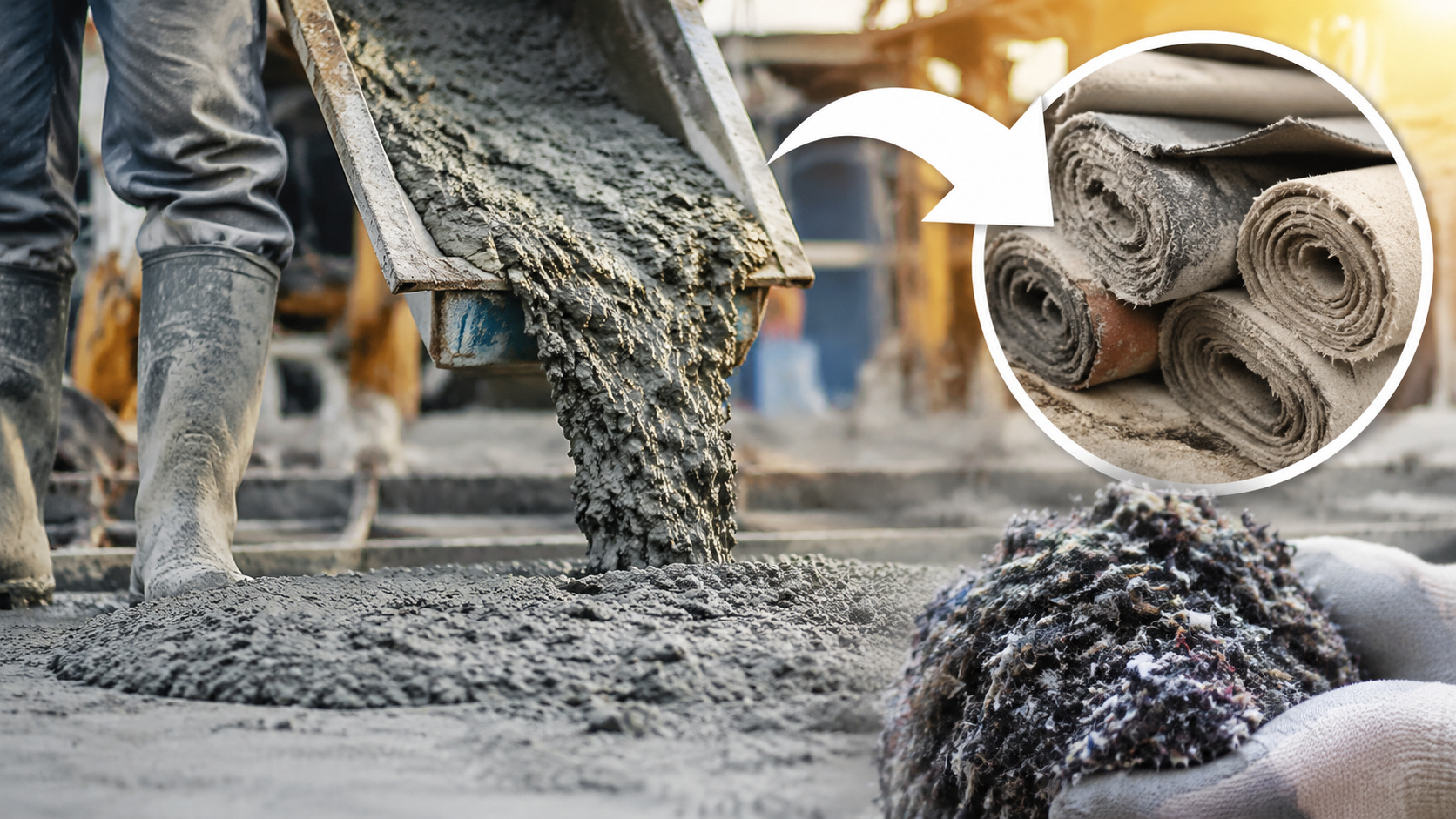

Slabs on the ground can use discarded carpet fibers to reduce costs and improve structural performance
The carpet that left the office can return as slab reinforcement, offering reduced maintenance costs and lower environmental impact. The use of discarded textile fibers in ground floor concrete slabs controls cracks and extends the lifespan of the construction, preventing tons of waste from ending up in landfills.
The information was released by ScienceDirect, a scientific article platform, which detailed the key points of the study on the performance of concrete reinforced with discarded carpet fibers.
Why carpets are difficult to recycle
Carpets combine textile fibers, plastic base, and adhesives, making separation and reuse complex. These mixed materials cannot be recycled in traditional processes and often end up in urban landfills. The difficulty of recycling increases the environmental impact and raises the cost of waste management.
-
U.S. City Builds Tiny Home Village on Water Company Land to House 136 Homeless People: Inside the Social Housing Units

-
Woman Turns Shipping Container into Home, Embraces Rural Life to Cut Monthly Expenses to Just Over $330
-
France Revamps 530 Social Housing Units with Large Balconies and Glass Facades Without Demolishing Existing Buildings

-
Facing high rent, couple transforms parents’ garage into a fully functional apartment, creating a complete home at a fraction of the market cost.




Furthermore, the collection and sorting of discarded carpets is still uncommon in many cities, making reuse alternatives, such as use in concrete, a practical and sustainable solution.
How fibers enter the concrete
The discarded carpet fibers are mixed into the concrete before application on the ground. They act as distributed reinforcement, helping to control cracks and improve the slab’s durability. Unlike steel bars, the fibers are small and spread throughout the concrete, preventing small cracks from spreading.
The study published by ScienceDirect, a scientific article platform, showed that concrete with carpet fibers presented lower maintenance costs and reduced environmental impact compared to conventional concrete and concrete with steel fibers.
Where ground floor slabs use this type of reinforcement
This type of reinforcement is ideal for slabs on the ground, such as warehouse floors, circulation areas in industries, and light pavements. In these locations, the concrete needs to resist cracks and surface wear, but not extremely high loads. The textile fibers help maintain performance and reduce costs over time.
The application does not replace traditional methods in heavier structures but offers significant gains in light floors and ground slabs, combining sustainability and economy.
Why it is not suitable for every structure
In constructions that require high mechanical strengths, such as columns and long beams, concrete reinforced only with carpet fibers may not meet performance requirements. In these cases, the use of steel reinforcements remains essential to ensure safety and stability.

Fiber reinforcement is recommended only for places where the main goal is crack control and maintenance cost reduction, without compromising structural safety.
The importance of reusing carpets in concrete
Reusing discarded carpets as reinforcement in slabs helps reduce the amount of textile waste in landfills and decrease operational costs of floors. This practice transforms a material considered difficult to recycle into a technical and sustainable input for civil construction.
The information was published by ScienceDirect, a platform of scientific articles, providing concrete data on cost reduction and lower environmental impact when carpet fibers are incorporated into concrete.
Share your opinion or leave a comment if you believe this alternative could be applied in constructions near your region.